


Venezuela doublet earthquake: At least 589 people have been confirmed dead and 2,980 injured following the most destructive earthquake sequence to strike Venezuela in more than a century — and seismologists, emergency planners, and the government’s own acting president all say that number is almost certainly going to climb. On June 24, 2026, a magnitude 7.2 foreshock and a magnitude 7.5 mainshock struck Venezuela’s north-central region 39 seconds apart, both at shallow depths of roughly 10 to 22 kilometers below the surface. Two quakes. Thirty-nine seconds. A nation shattered. NPRpaho
What Is a Doublet Earthquake — And Why Is It So Deadly?
Most people understand earthquakes as a single violent event followed by progressively smaller aftershocks. A doublet breaks that pattern entirely.
A seismic doublet occurs when two earthquakes of very similar magnitude take place very close together in time and very close together in space. The key distinction lies in that similarity of magnitudes: whereas a conventional aftershock is, under what is known as Båth’s Law, roughly 1.2 magnitude units smaller than the main event, in a doublet both quakes share comparable strength — generally within about 0.4 units on the moment magnitude scale. euronews
The USGS has described the Venezuela pair as a doublet sequence, a phenomenon in which two tremors of similar magnitude strike roughly the same area at around the same time. The doublet pattern took place on a tangled system of faults near San Felipe, Venezuela — a zone so complex that it will take more time for researchers to understand precisely which faults within it ruptured. NBC News
Doublets are deadlier than single quakes because structurally compromised buildings collapse in the second event. The sequence creates a window of maximum danger for first responders that a single earthquake simply does not produce. Buildings that crack and lean during the 7.2 — but don’t fall — are primed to collapse when the 7.5 arrives seconds later. There is no gap. There is no warning. There is no time. Outlook India
A previous doublet — of magnitudes 6.2 and 6.3 — struck an area west of Caracas in September 2025, killing at least one person and injuring more than 100 others. That was a warning. Wednesday’s sequence was of a categorically different scale. Phys.org
The Fault System Beneath Venezuela’s Feet
Venezuela’s seismic risk is not a secret — it is simply underappreciated outside the region.
The doublet occurred along the diffuse onshore boundary between the Caribbean and South American tectonic plates. In northern Venezuela, these plates slide past each other at a rate of about 20 millimeters per year as the Caribbean Plate moves east relative to the South American Plate. This produces large strike-slip faults, including the Boconó, San Sebastián, and El Pilar fault systems — an active plate boundary that generates frequent shallow earthquakes, some of which can be damaging. The Conversation
The mainshock is the largest earthquake in Venezuela since the 1900 San Narciso earthquake, a magnitude 7.7 event that struck northeast of Caracas. The 1967 Caracas quake — far smaller at magnitude 6.5 — killed approximately 272 people, primarily in building collapses, and triggered the introduction of formal seismic construction codes in Venezuela. Those codes were a start. But decades of economic contraction eroded their impact. WikipediaThe Global Statistics
Venezuela does not have an early earthquake warning system — the kind that relies on sensors to detect the first waves of a quake and alert populations seconds before strong shaking arrives. “It’s very distressing that there was basically no time to evacuate,” one seismologist noted. That observation doesn’t need much elaboration. PBS
The shaking is also followed by months or years of elevated landslide risk, because the rocks have been displaced. The next rainstorm in Venezuela will likely trigger landslides — meaning more damage and perhaps more deaths are still ahead. theconversation
How Venezuela’s Crisis Turned a Disaster Into a Catastrophe
The geology explains the shaking. The politics explain the death toll.
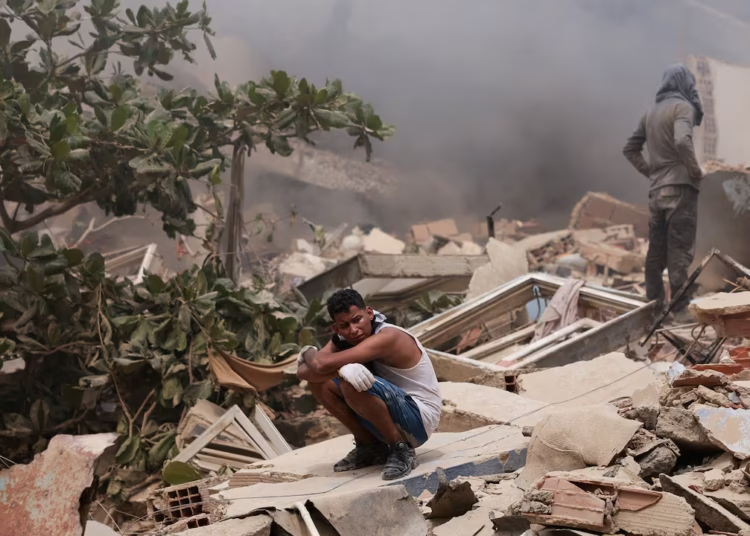
About half of Caracas’s five million residents are thought to live in informal housing — densely populated barrios comprising self-constructed structures built with unreinforced cinderblocks or bricks, often without formal foundations or steel reinforcement, mostly on mountainous hillsides surrounding the capital. These buildings were not designed to absorb seismic energy. They absorbed it anyway, and they collapsed. Al Jazeera
About 80 percent of Venezuela’s population lives in quake-prone areas, and many live in houses not built to withstand strong earthquakes. Some of Caracas’s hardest-hit neighborhoods are built on soft sediments that amplify seismic waves, making buildings more vulnerable to collapse than those constructed on solid bedrock. Al Jazeera
Rodríguez has only recently begun efforts to revive growth, with public services buckling under strain, hospitals short of equipment and medication, and frequent power outages — leaving emergency response stretched thin even before the quakes struck. NPR
Overwhelmed hospitals were forced to set up improvised wards in hallways and even on the street. Venezuela’s health system has been undergoing a long crisis due to years of deterioration and lack of investment. CNN
With emergency resources stretched thin, volunteers arrived at disaster sites carrying their own shovels, hammers and basic tools to assist rescue efforts. Volunteer Sebastian Arias moved between neighborhoods where buildings had collapsed and found some sites overcrowded with helpers while others appeared to lack help and equipment entirely. That is not an emergency response system. That is improvisation in the face of institutional collapse. NPR
According to the CEPR, the US-based Center for Economic and Policy Research called on the United States and other governments to lift economic sanctions on Venezuela to allow aid to reach those in need more quickly, arguing that the government must be free to receive and allocate earthquake relief without restriction.

USGS PAGER: What the Death Toll Models Are Saying
The official confirmed death toll is 589. The statistical models suggest this number may be a fraction of the final count.
The USGS PAGER system — Prompt Assessment of Global Earthquakes for Response — estimated a 39% probability of between 1,000 and 10,000 deaths and a 37% probability of 10,000 to 100,000 deaths for the magnitude 7.5 mainshock alone. There is also an 11% probability that the final death toll will exceed 100,000. Wikipedia
PAGER combines earthquake shaking, population exposure, and country-specific vulnerability to estimate likely human and economic impact. For the magnitude 7.5 event, the USGS issued a red alert — a designation it applies globally only once or twice per year. Its model estimated approximately 7.75 million people exposed to moderate or stronger shaking, including 2.37 million at MMI VII intensity and 400,000 at MMI VIII. Miyamotointernational
Economic losses were projected at a 39% probability of falling between $10 billion and $100 billion — with upper estimates approaching 20% of Venezuela’s entire GDP. Miyamotointernational
These are not predictions of what will happen. They are planning tools built from decades of global earthquake data applied to Venezuela’s specific conditions. Venezuela scores poorly on nearly every dimension relevant to seismic resilience: building vulnerability, population density in high-risk zones, ground conditions, and economic capacity to mount an effective response. The PAGER system’s models reflect that reality. The Global Statistics
The USGS PAGER alert for the June 24, 2026 Venezuela mainshock is publicly available and updated as field data comes in.

What International Aid Is — and Isn’t — Doing
The global response has been fast. Whether it will be sufficient is a different question.
The US pledged $150 million in emergency aid — a $100 million contribution to a UN humanitarian fund and $50 million to aid organizations already in Venezuela — while deploying two elite urban search and rescue teams from Fairfax County, Virginia (80 personnel, 6 dogs) and Los Angeles County (71 personnel, 6 dogs). CNN
Search and rescue efforts are described as “very difficult” — potentially taking 12 to 48 hours to safely rescue a single person, according to a battalion chief from Fairfax County’s special operations division. The variation of structures and situations is what complicates the effort. CNN
Secretary Rubio confirmed the teams draw on expertise in rescue operations, emergency medicine, engineering, and hazardous material management. Notably, the Fairfax team had participated in a strategic airlift exercise at Dover Air Force Base just days before the disaster, validating cache-loading procedures for sudden onset deployments. Council on Foreign Relations
Mexico, Chile, and El Salvador are sending emergency teams and medical supplies. The United States has also confirmed aerial imagery support to assess damage in remote coastal areas. NPR
There is a diplomatic undercurrent running beneath all of it. The international response is unfolding against a sensitive backdrop: former Venezuelan leader Nicolás Maduro was seized in January during a US operation, further straining already tense relations between Washington and Caracas. That tension has not stopped cooperation — acting President Rodríguez confirmed that US officials had been in constant contact with her administration since the earthquakes struck, stating: “Venezuela will never forget the hand extended to our people in these hard hours.” NPRHNGN
But there are structural limits to what speed of arrival can fix. Simón Bolívar International Airport is currently closed due to severe damage to its infrastructure — complicating the deployment of heavy equipment and personnel by air. The 2023 Türkiye-Syria doublet — which killed more than 56,000 people — exposed recurring failures in international disaster response: poor coordination among arriving teams, bottlenecks in transport corridors, and local organizations consistently sidelined in relief architecture. Venezuela’s civil society, which has long filled gaps left by the state, is already doing the same work here. Whether the formal international response will learn from that history, or repeat it, is one of the central questions of the coming weeks. NBC NewsCGTN
According to the Pan American Health Organization, 21 regional and international Emergency Medical Teams from 15 countries have been identified, including three teams ready to deploy. PAHO is supporting rapid assessments of health facility functionality and identifying priority needs for medicines, medical supplies, oxygen, and fuel. paho

A Century of Warnings: Venezuela’s Seismic History
Venezuela is not a country that has been blindsided by seismic risk. It is a country that could not afford to address it.
An estimated 30,000 people were killed in 1812 when a powerful earthquake devastated the cities of Mérida and Caracas — one of the most lethal natural disasters in the Western Hemisphere’s recorded history. The 1812 quake struck along the same Boconó fault system that runs the length of the Venezuelan Andes for roughly 300 miles. The Caribbean plate has not stopped moving since then. It will not stop after this. Al Jazeera
Buildings constructed to post-1967 code standards performed significantly better in the 2026 event than older stock. But decades of economic contraction under the Maduro government and the broader humanitarian crisis meant that a large proportion of Venezuelan housing — including informal settlements covering significant portions of Caracas’s hillsides and La Guaira’s waterfront — was built outside code compliance. The Global Statistics
The European Commission had identified 7.9 million Venezuelans in need of humanitarian assistance before this disaster, with 56% living in extreme poverty. The earthquake did not create that fragility. It exposed it. CGTN

FAQ: Venezuela Earthquake 2026
What caused the Venezuela earthquakes on June 24, 2026?
The earthquakes occurred along the boundary between the Caribbean and South American tectonic plates, where the plates slide past each other at about 20 millimeters per year. This produces large strike-slip faults — including the Boconó, San Sebastián, and El Pilar fault systems — which have generated significant earthquakes throughout Venezuela’s history. The Conversation
What is a doublet earthquake?
A seismic doublet occurs when two earthquakes of very similar magnitude strike very close together in time and location. Unlike a standard aftershock, which is typically 1.2 magnitude units smaller than the main event under Båth’s Law, the two quakes in a doublet share comparable strength — generally within 0.4 units on the moment magnitude scale. euronews
How many people died in the Venezuela earthquake?
As of June 26, 2026, acting President Delcy Rodríguez confirmed 589 people dead and 2,980 injured. The death toll is expected to rise significantly. The USGS PAGER system has assigned a 37% probability that the final death toll will fall between 10,000 and 100,000, and an 11% probability it will exceed 100,000. NPRWikipedia
Why did so many buildings collapse in Venezuela?
About half of Caracas’s population lives in informal housing built with unreinforced cinderblocks or bricks, often without formal foundations or steel reinforcement, mostly on hillsides surrounding the capital. Some of the hardest-hit neighborhoods are built on soft sediments that amplify seismic waves. Years of economic collapse also deferred maintenance on formal building stock that was already aging. Al JazeeraAl Jazeera
What international aid is being sent to Venezuela?
The United States pledged $150 million in emergency aid and deployed search and rescue teams from Fairfax County, Virginia (80 personnel) and Los Angeles County (71 personnel). Mexico, Chile, and El Salvador have also dispatched emergency teams and medical supplies. The United Nations is coordinating the deployment of additional urban search and rescue teams. CNNNPR
Is Venezuela at risk of more earthquakes after this?
The USGS assessed a 99% chance of at least one magnitude 4 aftershock hitting Venezuela within the following week, and a 24% chance of a magnitude 6 or larger event occurring. Beyond aftershocks, the region also faces elevated landslide risk for months or years, because the earthquake has displaced rocks across hillside terrain — meaning future rainstorms could trigger additional casualties. PBStheconversation
What Comes Next
The 72-hour window most likely to yield living survivors is closing. After that, the mission changes — from rescue to recovery, from recovery to reconstruction. For Venezuela, reconstruction means rebuilding not just buildings but the institutional capacity that determines whether the next earthquake kills hundreds or thousands.
The USGS warned immediately after the quake that “high casualties and extensive damage are probable, and the disaster is likely widespread.” That language was calibrated. It was also correct. The confirmed death toll will likely look like an undercount within days, as rescue teams reach isolated coastal communities and the full scope of La Guaira’s destruction is systematically mapped. Al Jazeera
Disaster mortality in least developed countries runs 2.5 times higher than the global average, according to the UN Office for Disaster Risk Reduction. The earthquake did not create Venezuela’s fragility — it exposed structural underinvestment that is neither unique nor inevitable. CGTN
What is unique is the scale. The June 24, 2026 mainshock is the largest earthquake in Venezuela since 1900. Everyone who was alive for the 1967 quake — the previous benchmark — has now lived through something measurably worse. The people digging through rubble with their own shovels in Caracas and La Guaira understand that better than any model can capture. Wikipedia
Follow Stucci Media‘s continuing coverage of the Venezuela earthquake relief effort](INTERNAL LINK: Venezuela earthquake coverage hub) as the situation develops.


