


Brazil Woman Dies: Maria Eduarda Rodrigues de Freitas woke up on June 13, 2026, ready for the adventure of her life. The 21-year-old physical education graduate from Jandira, São Paulo, had signed up for a rope jump off an abandoned railway bridge — the kind of adrenaline experience that fills your Instagram feed and gives you a story to tell forever.

At 7:31 a.m., she posted to her Instagram Stories: a photo of her event wristband, the company banner, the canyon view. She wrote a caption — playful, excited, full of life: “Who was the crazy person who let me jump off a bridge???”
Three hours later, she was dead.
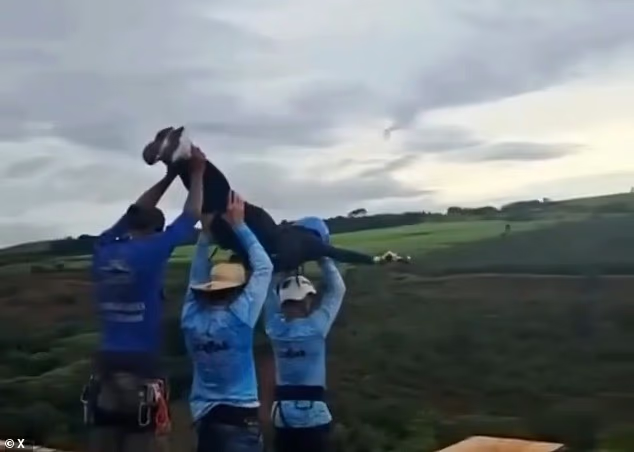
Three men — employees of a company called Entre Cordas — carried her to the edge of the platform, hoisted her overhead in what’s called a “Superman” pose, and threw her off. Bystanders below watched in horror as she fell 130 feet. Someone in the crowd screamed: “Guys, the rope!”
The safety rope was still coiled on the ground behind the instructors. Nobody had attached it.
The Ponte do Esqueleto — Skeleton Bridge — didn’t get that name by accident. The structure is the skeletal remains of a railway viaduct that was never properly put into service. It sits on the border of Limeira and Cordeirópolis in São Paulo state, on federal land, and has been abandoned for roughly three decades.
In that time, it became a social media magnet. Extreme sports operators started using it informally, marketing jumps on Instagram to thousands of followers. On the day Maria Eduarda died, approximately 100 people were gathered at the site, waiting their turn to jump.
Here’s the problem: the city of Limeira had zero authority over what happened there. The bridge is federal property. Local officials had reportedly sent formal warnings to federal authorities months earlier, demanding safety intervention, access restrictions, or at minimum some warning signage. Nothing came of it.

Limeira Mayor Murilo Félix announced in the wake of the tragedy that the city will now sue the federal government over its failure to act. Residents told local reporters that Maria Eduarda’s death was roughly the fourth fatality at that site in approximately three years — and that two women were gravely injured there as recently as last August.
Four deaths. Hundreds of jumps. Zero regulation. The federal government knew. And did nothing.
What Is Rope Jumping — And How Is It Different from Bungee?
Most Americans hear “bungee” and assume they know what happened here. They don’t. Rope jumping and bungee jumping are not the same thing, and the distinction matters.
Bungee jumping uses an elastic cord that stretches and recoils, giving you that iconic bounce at the bottom of the fall. Rope jumping — also called “human pendulum” — uses static climbing ropes. When you go over the edge, you don’t bounce. You swing in a wide arc, like a pendulum, absorbing significant gravitational force as the rope catches and redirects you.

Because the forces involved are severe and the margin for error is essentially zero, professional operations require multiple instructors to independently verify every single connection — every carabiner, every knot, every harness clip — before a jumper ever goes over the edge. The whole safety model is redundancy. One person checks. Another checks. Then it gets checked again.
On the morning of June 13, none of that happened.
According to CBS News, previous video footage of Entre Cordas operations at the same bridge showed participants wearing thick safety cords around their waists before jumping. The company knew the protocol. They simply didn’t follow it — and Maria Eduarda paid with her life.
The Arrests, the Charges, and a Legal Gray Area
Six people connected to the event were taken in for questioning by Limeira police. Three men — identified by Brazilian newspaper O Globo as Luis Felipe Feliciano Egoroff, 27; Vitor de Freitas Gonçalves, 32; and Maicon Fernandes Cintra, 42 — were arrested at the scene and charged with homicídio com dolo eventual, or homicide with eventual intent.

Under Brazilian law, this charge applies when the accused didn’t set out to kill someone, but knowingly engaged in conduct so reckless that they accepted the risk of death as a possible outcome. It’s roughly analogous to what American law might call depraved indifference. It’s a serious charge. These men are facing prison time.
The other three detained — five men and one woman in total — were questioned and released.
Civil police delegate Andrea Dantas Levy was unambiguous in her assessment. “It was a team that wasn’t regulated,” she told Brazilian outlet G1. “They didn’t even have authorization to be there.”
That last part is critical. Entre Cordas and its linked instructor brand Ih Voei — whose staff wore branded shirts at the event — had set up operations on federal land without any permit, any authorization, or any government inspection. One hundred people were lined up to jump that morning. Nobody had checked whether anyone was legally allowed to run this event.

A defense lawyer for the accused, Rafael Gomes dos Santos, told O Globo that rope jumping “isn’t formally regulated in Brazil but isn’t prohibited either” — and that similar events had run at the Skeleton Bridge before without government intervention. He called the incident a “triste fatalidade” — a sad fatality.
A sad fatality. Three people under arrest disagree with that framing.
The Company Vanished. So Did Its Social Media.
Entre Cordas — which translates, with some irony, to “Between Ropes” — had built a following of more than 80,000 Instagram followers. They marketed the jump as a ticket to the extraordinary. Tickets ran roughly 130 to 180 Brazilian reais per person, approximately $25–$32 at current exchange rates.
Within hours of Maria Eduarda’s death, the company deleted its Instagram account. A WhatsApp group used to communicate with customers was also removed. This happened while other customers were still waiting on the bridge to jump.
They didn’t send people home. They didn’t issue a statement. They deleted their digital footprint and ran.
According to Newsweek, two operators actually fled the scene and were only located later with the help of a police helicopter surveying woodland near the bridge.
Maria Eduarda’s fiancé was at the bridge that morning. He was filming when she went over the edge. He collapsed at the scene and had to be taken for medical treatment after watching her die.
This Isn’t the First Time. It Won’t Be the Last.
Brazil’s Skeleton Bridge has claimed lives before. But this isn’t just a Brazil problem — it’s an extreme sports regulation problem that runs worldwide.
In 2021, a 25-year-old Colombian woman named Yecenia Morales plunged 164 feet to her death at an Amagá bungee site after a communications error caused her to jump without a fastened cord. She was reportedly the 90th jumper of the day when the fatal miscommunication occurred. The Fox News report from that incident reads almost identically to the headlines this week — different country, same catastrophic failure mode.

The pattern is consistent: informal operators, unsanctioned locations, no standardized safety checklists, and no regulatory body with the authority and will to enforce standards. When things go wrong, the company deletes its social media, lawyers argue it was an accident, and nothing systemic changes.
Brazil’s adventure tourism sector operates in what legal analysts have described as a gray zone — activity that isn’t prohibited but carries no mandatory certification requirement, no independent safety inspection, and no licensing framework that would keep unqualified operators out. According to reporting from InformedClearly, reforms may accelerate in the wake of this incident. They said the same thing after 2021 in Colombia.
Her Last Post Was a Joke. Now It’s a Eulogy.
Maria Eduarda Rodrigues de Freitas was 21 years old. She had degrees in physical education and sports management. She worked at a gym. She loved outdoor activities, documented her adventures on social media, and trusted the professionals at an event to do their jobs.
Her last public post was taken minutes before she died — excited, playful, alive. The gym where she worked posted a message of mourning the same afternoon.
Her fiancé saw everything.
There is no version of this story where “they forgot the rope” is an acceptable explanation. Rope jumping safety is built entirely around verification. The redundancy exists specifically because human beings forget things. The checklists, the double-checks, the backup verifications — they exist because forgetting is human. Skipping them is a choice.
Three men chose not to check. A 21-year-old woman is dead.
Frequently Asked Questions
Q: What is the difference between bungee jumping and rope jumping? Bungee jumping uses an elastic cord that allows the jumper to bounce at the bottom of the fall. Rope jumping — sometimes called “human pendulum” — uses a non-elastic static climbing rope, causing the jumper to swing in a wide arc rather than bounce. The forces involved are intense, which makes proper harness and rope attachment verification even more critical before any jump.
Q: Were the workers at the Brazil bridge jump accident arrested? Yes. Three men — ages 27, 32, and 42 — were arrested at the scene and charged under Brazilian law with homicide with eventual intent (dolo eventual), meaning they knowingly engaged in reckless conduct that carried a risk of death even if they didn’t intend to kill the victim. Six people total were questioned; three remained in custody as of the latest reports.
Q: Is rope jumping regulated in Brazil? No. As of June 2026, rope jumping and similar extreme sports in Brazil exist in a legal gray area — not explicitly prohibited, but also not subject to mandatory certification, licensing, or safety inspection requirements. The company operating at the Skeleton Bridge in Limeira reportedly lacked authorization to even be at the site. Calls for regulation have increased significantly following Maria Eduarda’s death.
Sources: CBS News, Newsweek, KTLA, G1 (Brazilian news outlet), São Paulo Secretariat of Public Security
Follow Stucci Media and keep with with real facts!


