


A bone-deep look at fire, 1.8 million years before the first matchstick
Oldest Fire Evidence: For most of human history, fire was the line between us and everything else — the thing that let our ancestors cook, stay warm through brutal nights, and keep predators at bay. Scientists have spent decades trying to pin down exactly when that line was crossed. A new study out of South Africa’s Wonderwerk Cave just pushed that date back by hundreds of thousands of years, and the evidence is sitting in the burned bones of small animals that owls dropped on a cave floor nearly two million years ago.
Published in PLOS One, the research points to fire use inside the cave dating between roughly 1.07 million and 1.79 million years ago — making it one of the oldest credible records of hominins controlling fire anywhere on Earth.
What Researchers Actually Found
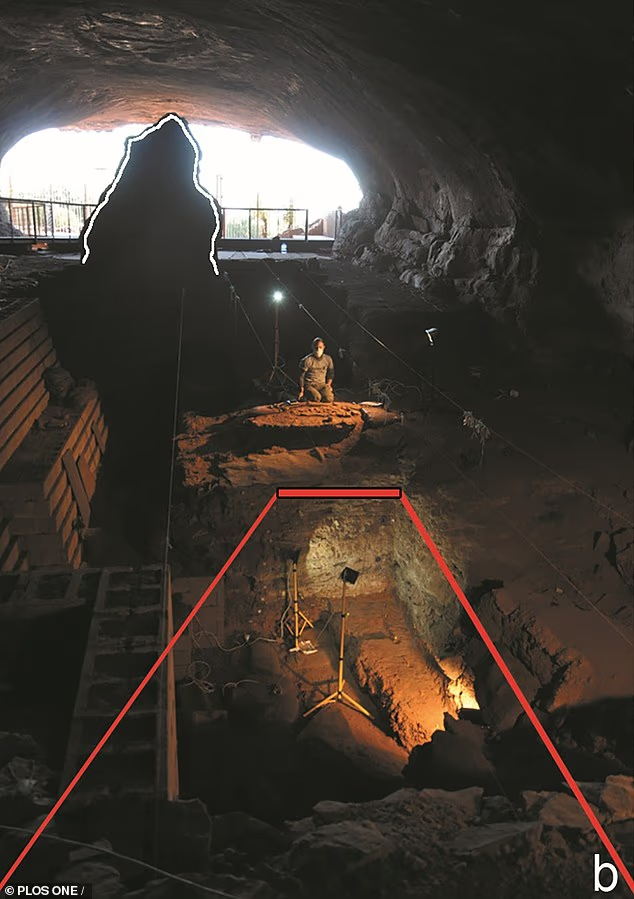
Wonderwerk Cave, tucked near the edge of the Kalahari Desert in South Africa’s Northern Cape, has been a goldmine for archaeologists for decades. A previous excavation already established that early humans were using fire inside the cave around one million years ago, based on burnt bone, ash, and heat-altered stone tools in a layer called Stratum 10.
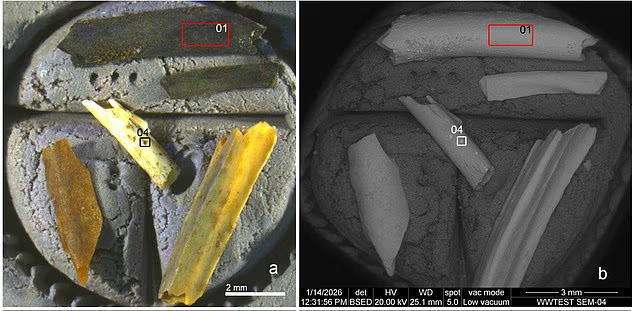
This time, an international team led by researchers including Maria Dolores Marin-Monfort dug deeper — literally — into an older layer called Stratum 11. There, they examined 161 fossilized bones from small mammals, many of which likely ended up in the cave the way owls have been depositing prey remains for eons: as leftovers in pellets dropped from roosts on the cave ceiling.
To figure out which of those ancient bones had been burned, the team used two independent techniques. The first, Fourier Transform Infrared Spectroscopy (FTIR), detects structural changes in bone caused by heat. The second is a bone luminescence method: shine high-energy blue light on a fossil, and a burned bone glows red through a special filter, while an unburned one stays bright and pale. Researchers calibrated the method using modern bones burned under controlled lab conditions, then cross-checked it against known burned material from a Bronze Age site in Spain to confirm it actually works on archaeological samples.
The result: every white and gray fossil bone tested from Stratum 11 showed signs of heating, with both methods agreeing.
Why “Deep Inside a Cave” Matters More Than You’d Think
The location of these burned bones is the detail that makes this study hold up under scrutiny. The deposits sat at least 30 meters from the cave entrance — far enough that a wildfire sweeping across the Kalahari grassland simply couldn’t reach them. Surface fires don’t crawl 30 meters into solid rock.
That distance is the researchers’ strongest argument against the obvious alternative explanation: that this is just evidence of a natural brushfire, not deliberate fire use. Add to that the fact that burned bones weren’t scattered evenly across the excavation but appeared in distinct clusters, suggesting repeated burning in specific spots over a long stretch of time — which looks a lot more like a hearth than an accident.
The burned bones also turned up alongside Acheulean stone tools, the hand-axe technology associated with Homo erectus. That pairing is what lets researchers connect the fire evidence directly to a specific group of hominins rather than leaving it as an unexplained anomaly in the sediment.
The Bigger Question: Did They Make Fire, or Just Keep It?
Here’s where the study stays admirably cautious, and where a lot of headline writers tend to overreach. The researchers aren’t claiming Homo erectus invented fire-starting technology — flint and steel, friction drills, anything like that. The more likely scenario, based on the evidence, is that these early humans captured fire from a natural source, such as a lightning-sparked grass fire, and then kept it alive and carried it back into the cave.
That might sound like a smaller achievement than “inventing fire,” but it isn’t. Keeping an ember burning, transporting it without losing it, and maintaining a fire deep inside a cave environment all require planning, cooperation, and a working understanding of how fire behaves. That’s a meaningful cognitive and social leap on its own — arguably the more interesting story here.

Why This Keeps Getting Pushed Back
Fire’s role in human evolution has been debated for over a century, and the timeline keeps shifting because the evidence is so hard to nail down. Wildfires happen constantly in nature, leaving behind ash and charred material that can easily be mistaken for — or genuinely confused with — deliberate human fire use. Distinguishing “a hominin built a fire here” from “a wildfire happened to reach here” requires exactly the kind of layered, multi-method analysis this study used.
That’s also why the bone luminescence technique matters beyond this one cave. It’s described as fast and non-destructive, meaning researchers can screen large numbers of fossils from other sites without damaging them, potentially opening the door to finding similar fire evidence elsewhere in Africa — and revising the timeline yet again.
For context on how slow and contested this kind of revision usually is: a 2012 study on Wonderwerk’s more recent Stratum 10 layer, published in the Proceedings of the National Academy of Sciences, pushed the fire-use date back by about 300,000 years and was treated as a landmark finding at the time. This new study goes roughly 700,000 to 800,000 years further still. Learn more about the 2012 Wonderwerk findings.

What Comes Next
The Wonderwerk team isn’t done. The same researchers note that future work at other sites could apply this bone luminescence approach to test whether similarly ancient fire evidence is hiding in collections that have already been excavated but never screened this way. If that happens, the “oldest fire” record could keep moving — and Wonderwerk Cave, which has already rewritten this story twice, might do it again.
Frequently Asked Questions
Q: Is this officially the oldest evidence of fire use by humans?
A: It’s among the oldest currently published, with evidence dating to between roughly 1.07 and 1.79 million years ago. Researchers describe it as one of the oldest known records of hominin fire use, though the field continues to debate other early candidate sites, and the title of “oldest” has shifted before and could shift again.
Q: Does this mean Homo erectus could start fires from scratch?
A: Not necessarily. The study suggests they more likely captured and maintained fire from natural sources rather than igniting it themselves — but doing that reliably still required real planning and cooperation.
Q: How do scientists tell a deliberate fire from a wildfire in old bones?
A: By combining multiple lines of evidence — in this case, infrared spectroscopy and bone luminescence to confirm burning, plus the location (30 meters inside the cave, where wildfires couldn’t reach) and the clustering pattern of the burned remains.


