

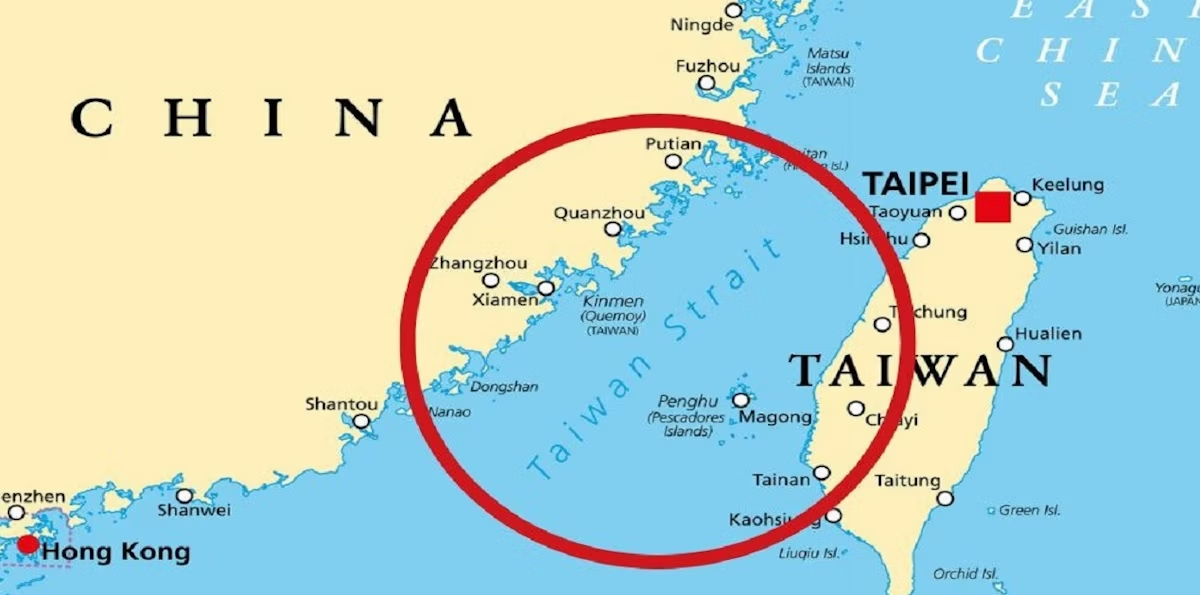
In a stark warning that has reverberated through diplomatic channels worldwide, U.S. Secretary of Defense Pete Hegseth recently cautioned that a Chinese invasion of Taiwan “could be imminent.” This assessment comes amid increasingly aggressive military posturing by Beijing and represents a significant escalation in official U.S. rhetoric regarding the Taiwan Strait.
For the 23 million residents of Taiwan, this warning confirms what many have long suspected: the threat from mainland China is real, growing, and requires unprecedented preparation. But how exactly is Taiwan transforming its defense capabilities to counter what many analysts describe as the most dangerous flashpoint in global politics?


Taiwan’s Military Preparations: A Nation Mobilizing
The Taiwanese government has implemented sweeping changes to its military readiness posture, most notably extending mandatory military service from four months to one year. This policy shift, which took effect in January 2024, marks a significant reversal of the island’s previous trend toward a fully professional military.
“The decision wasn’t made lightly,” explains Dr. Lin Wei-chou, a defense analyst based in Taipei. “But examining Ukraine’s resistance against Russia made it clear that Taiwan needs both professional soldiers and a large reserve of trained civilians ready to mobilize quickly.”
Beyond the extension of service requirements, Taiwan has fundamentally reimagined its reservist training programs. Where once reservists might train sporadically with limited intensity, the new system implements more frequent, realistic, and rigorous training scenarios specifically designed to counter amphibious invasion attempts.
Wang Tzu-chiang, a 26-year-old software engineer completing his reservist training near Taoyuan, reflects the changing attitude among many Taiwanese: “Before Ukraine, many of us saw military service as something to endure. Now, there’s a sense that what we’re learning might actually determine our future. The training feels more purposeful, more urgent.”
This sentiment is increasingly common among Taiwan’s youth, who have watched events in Ukraine unfold with particular interest. Taiwan’s Ministry of Defense has capitalized on this shift, launching civilian defense initiatives that teach basic medical care, emergency response, and even elements of territorial defense to ordinary citizens.
U.S. Military Support: HIMARS and Beyond
At the center of Taiwan’s military transformation is an unprecedented level of support from the United States. Recent years have seen billions in arms sales approved, including sophisticated weapons systems that would significantly complicate any Chinese invasion attempt.
Perhaps most notable among these acquisitions are the High Mobility Artillery Rocket Systems (HIMARS), the same platform that has proven devastatingly effective in Ukraine against Russian forces. These truck-mounted rocket launchers combine mobility with precision strike capability, allowing Taiwan to target invasion forces from significant distances while constantly relocating to avoid counter-battery fire.
“HIMARS represents exactly the kind of asymmetric capability Taiwan needs,” explains former U.S. defense official Dr. Michael Carpenter. “They’re relatively affordable, highly mobile, and can deliver precision strikes against ships, staging areas, and other high-value targets that would be critical in an invasion scenario.”
Taiwan has ordered 29 HIMARS systems as part of an $860 million deal, with deliveries expected to be completed by 2027. These systems complement other recent acquisitions, including Harpoon anti-ship missiles, advanced F-16V fighter jets, and sophisticated air defense systems.
Beyond hardware, the United States has expanded intelligence sharing and training programs with Taiwan. U.S. special operations forces have conducted increasingly sophisticated training exercises with their Taiwanese counterparts, focusing on asymmetric warfare tactics that would maximize Taiwan’s defensive advantages against a numerically superior force.


China’s Military Posturing: Escalating Provocations
China’s response to Taiwan’s military transformation has been predictable: more frequent and increasingly complex military drills surrounding the island. In the past year alone, the People’s Liberation Army (PLA) has conducted over 20 major exercises that simulate blockades, amphibious landings, and precision strikes against Taiwanese military installations.
These exercises have grown increasingly bold, with Chinese aircraft and naval vessels regularly crossing the median line of the Taiwan Strait—the unofficial boundary that had previously been largely respected by both sides for decades.
“What we’re seeing is not just military preparation, but psychological warfare,” notes Dr. Huang Kwei-bo, former deputy foreign minister of Taiwan. “Beijing wants to normalize its military presence around Taiwan, creating a sense of inevitability about reunification while testing our response capabilities and international resolve.”
China’s military modernization has proceeded at a breathtaking pace. The PLA Navy now possesses the world’s largest fleet by number of vessels, though the U.S. Navy remains superior in terms of tonnage and capabilities. China’s amphibious assault capabilities—critical for any Taiwan invasion scenario—have expanded dramatically, with the commissioning of multiple Type 075 amphibious assault ships similar in capability to America’s Wasp-class vessels.
The timeline of provocations shows a clear pattern of escalation:
- 2021: 969 Chinese military aircraft entered Taiwan’s Air Defense Identification Zone (ADIZ)
- 2022: 1,727 aircraft incursions, representing a 78% increase
- 2023: Over 2,300 incursions, with larger formations and more advanced aircraft
- 2024 (first quarter): Pace suggests the annual total may exceed 3,000 incursions

The Ukraine Connection: Lessons in Modern Resistance
Perhaps no factor has influenced Taiwan’s defense transformation more profoundly than the ongoing conflict in Ukraine. Taiwan’s military planners have studied Ukraine’s resistance against Russia with intense interest, drawing numerous lessons that are reshaping doctrine, procurement, and training.
“Ukraine demonstrated that a smaller nation can effectively resist a larger aggressor if it prepares correctly,” explains Major General Chen Ying-zhen (Ret.) of Taiwan’s defense ministry. “We’ve been particularly interested in their use of distributed defense networks, civilian involvement, and exploitation of terrain advantages—all directly applicable to Taiwan’s situation.”
Taiwan has sent teams to study Ukraine’s defense efforts firsthand, and even welcomed Ukrainian military advisors who have shared experiences from the frontlines. This knowledge exchange has influenced Taiwan’s accelerated acquisition of portable anti-tank and anti-aircraft weapons, communication systems resistant to jamming, and unmanned aerial vehicles for reconnaissance and strike missions.
Taiwan’s military exercises increasingly incorporate lessons from Ukraine, including:
- Emphasis on territorial defense rather than centralized resistance
- Dispersion of command and control to enhance survivability
- Stockpiling of supplies in hardened, distributed locations
- Preparation for electronic and cyber warfare
- Development of redundant communication networks
- Training civilians in basic military skills and resistance techniques
Yu Hsin-wei, a Taiwanese volunteer who fought in Ukraine’s International Legion before returning home, now helps train civil defense groups in Taipei. “The most important lesson I brought back was that modern warfare isn’t just about soldiers and weapons—it’s about an entire society’s will to resist,” Yu explains. “In Ukraine, I saw grandmothers making Molotov cocktails and IT professionals coordinating artillery strikes. Taiwan needs that same whole-of-society approach.”
Public Sentiment and Preparedness: A Nation Awakening
Public opinion surveys show a significant shift in Taiwanese attitudes toward defense preparedness. A recent poll by the Taiwanese Public Opinion Foundation found that 68% of respondents now believe a Chinese invasion attempt is likely within the next decade—up from 35% in 2018. More importantly, 74% indicated they would actively resist such an invasion, compared to 58% four years ago.
This awakening has manifested in growing participation in civilian defense programs. Courses teaching basic first aid, emergency response, and even rudimentary combat skills regularly reach capacity within hours of being announced. Community organizations have formed to discuss neighborhood defense plans, evacuation routes, and supply stockpiling.
“The change is remarkable,” notes social psychologist Dr. Lai Mei-hui. “Five years ago, discussing invasion preparations was considered alarmist. Today, it’s seen as responsible citizenship. Young people especially are taking this seriously—they’ve watched their peers in Hong Kong lose autonomy and in Ukraine fight for survival.”
Taiwan’s government has capitalized on this shift, launching nationwide resilience initiatives that blend practical preparation with psychological readiness. These programs emphasize that Taiwan’s best defense is making the cost of invasion unacceptably high for China—a strategy that requires widespread civilian participation.
Not all experts believe Taiwan’s preparations are sufficient, however. “There remains a troubling gap between perception and reality,” warns defense analyst Su Tzu-yun. “Many Taiwanese now acknowledge the threat, but still haven’t taken concrete steps to prepare. The government must do more to convert awareness into action.”

Geopolitical Implications: Beyond the Taiwan Strait
The stakes of Taiwan’s defense transformation extend far beyond the island itself. Taiwan produces approximately 60% of the world’s semiconductors and over 90% of the most advanced chips—components essential to everything from smartphones to military systems.
“The global economy simply cannot absorb the shock that would come from Taiwan’s semiconductor industry being damaged or disrupted,” explains economist Dr. Jennifer Huang of the Global Economic Institute.
“We’re talking about potential impacts that would dwarf the supply chain disruptions seen during the COVID-19 pandemic.”
This economic reality has influenced the U.S. position on Taiwan’s defense. While maintaining strategic ambiguity about exactly how it would respond to an invasion, American officials have made increasingly clear statements about Taiwan’s importance. President Biden has stated multiple times that the U.S. would defend Taiwan, though White House officials have subsequently clarified these remarks.
Regional allies have also strengthened their positions. Japan has doubled its defense budget and explicitly identified Taiwan’s security as essential to its own. Australia has deepened military cooperation with both the United States and Taiwan, while Philippines has granted expanded access to its bases for U.S. forces—positions that would be critical in any Taiwan contingency.
Diplomatic solutions remain possible, though increasingly challenging as positions harden on all sides. China maintains that Taiwan is an internal matter and has rejected international mediation efforts. Taiwan’s government has expressed willingness to engage in dialogue but insists on recognition of its democratic sovereignty. The United States has attempted to maintain open communication channels with Beijing while strengthening Taiwan’s defensive capabilities.
“We’re in a dangerous period where all sides are preparing for conflict while still hoping to avoid it,” observes international relations professor Dr. Richard Chen. “The risk of miscalculation or unintended escalation remains high.”
Assessment and Outlook: Prepared but Vulnerable
Taiwan’s military transformation represents its most significant defense realignment in generations. The combination of enhanced domestic capabilities, international support, and lessons from Ukraine has unquestionably strengthened the island’s position.
Yet vulnerabilities remain. China’s military advantage in terms of raw numbers is overwhelming, and its ability to isolate Taiwan through blockade before attempting an invasion presents a scenario difficult to counter. Taiwan’s mountainous geography provides defensive advantages, but its high population density and concentration of critical infrastructure along the western coast create vulnerabilities.
Defense expert Ian Easton, author of “The Chinese Invasion Threat,” assesses Taiwan’s current preparedness: “Taiwan is significantly better positioned today than five years ago, but still has not fully implemented the asymmetric capabilities needed to maximize its defensive advantages. The next three years will be critical in determining whether Taiwan can create a defense posture truly capable of deterring Chinese aggression.”
For ordinary Taiwanese citizens like Lin Yu-ting, a 34-year-old elementary school teacher in Kaohsiung, the situation demands a balance between preparation and normal life. “We can’t live every day in fear,” she says. “But neither can we ignore reality. So we prepare—we discuss emergency plans with family, we learn basic skills, we stay informed. And we hope that preparation itself helps prevent the worst from happening.”
As Taiwan continues its military transformation, the world watches closely—recognizing that what happens in the Taiwan Strait will reverberate far beyond its shores, potentially reshaping the international order for decades to come.
Global tensions like the Taiwan-China situation evolve rapidly. Subscribe to Stucci Media’s International Affairs newsletter for expertly curated updates, in-depth analysis, and exclusive expert interviews that help you understand complex geopolitical issues without the sensationalism. Join our community of informed readers today.


