



Unsung Heroes of the Wild West: The Enduring Legacy of Black Cowboys in US History: When we envision the American West, our collective imagination often conjures images of dusty trails, cattle drives, and solitary figures silhouetted against vast horizons. For generations, this iconic imagery has been predominantly portrayed through a narrow lens that failed to capture the true diversity of those who shaped the frontier. Among the most significant omissions from this historical narrative has been the profound contribution of Black cowboys—individuals whose skills, resilience, and determination helped forge the very essence of the American West.
The erasure of Black cowboys from popular culture and historical accounts represents more than a simple oversight; it constitutes a fundamental misrepresentation of American history. These cowboys weren’t peripheral figures but essential participants in the development of the cattle industry, western expansion, and the creation of cowboy culture itself. Their stories deserve recognition not merely as a footnote to history but as a central chapter in understanding how the American West was won.

Origins: From Slavery to the Open Range
The roots of Black cowboy culture trace back to the antebellum South, particularly in cattle-rich states like Texas. Enslaved African Americans developed exceptional skills in livestock management, horsemanship, and animal husbandry—often becoming more knowledgeable than their enslavers about cattle handling techniques and horse training. These abilities, honed under the brutal conditions of slavery, would later become valuable currencies in the post-Civil War economy.
When the Civil War ended in 1865 and emancipation became reality, many formerly enslaved individuals faced limited options in the still-hostile South. The expanding cattle industry of the West offered something precious: opportunity. As cattle drives became essential to the nation’s economy, the demand for skilled cowhands created employment possibilities for Black Americans seeking both livelihood and distance from the oppressive racial climate of the South.

By the Numbers: A Substantial Presence
Historical research has revealed the significant numerical presence of Black cowboys in the American West. According to multiple scholarly accounts, Black cowboys comprised approximately 25% of all cowboys who participated in the great cattle drives from the 1860s to 1880s. This substantial representation—one in four cowboys being Black—challenges the predominantly white portrayal perpetuated by Hollywood and popular literature.
In the 1870s, when the cattle industry was at its peak, an estimated 35,000 cowboys worked the ranges of the American West, with Black cowboys numbering around 8,000-9,000. These figures represent not a marginal presence but a fundamental component of the workforce that drove the economic development of the West.
Skilled Professionals on the Frontier
Black cowboys weren’t merely present; they were often among the most skilled professionals on the frontier. They excelled across diverse roles essential to the cattle industry. As expert ropers, they demonstrated precision and technique that earned respect even in the prejudiced society of the time. Many served as trail cooks, a position of tremendous responsibility that required not only culinary skills but also the ability to manage supplies and maintain morale over long, arduous journeys.
As wranglers and bronco busters, Black cowboys displayed exceptional horsemanship, often being assigned to break and train the most challenging horses—a dangerous but prestigious role that showcased their abilities. During cattle drives, Black drovers guided vast herds across hostile terrain, navigating natural barriers and potential dangers with remarkable skill and judgment.
Beyond these core responsibilities, many Black cowboys served as hunters, providing fresh game to supplement trail rations. Some became entertainers, developing riding and roping demonstrations that would later influence rodeo competitions. Others acted as security for white cattlemen, protecting valuable herds from rustlers and bandits in lawless territories.

The Exoduster Movement and Western Migration
The migration of “Exodusters”—Black migrants who left the South for Kansas between 1879 and 1884—further amplified the presence of Black cowboys in the West. Drawn by opportunities presented by initiatives like the Homestead Act, which allowed citizens to claim land in the western territories, these migrants sought both economic independence and escape from the violent racism of the post-Reconstruction South.
Many Exodusters who possessed equestrian and livestock management skills found natural employment in the cattle industry. Their migration represented a broader movement of Black Americans seeking to redefine their lives in the aftermath of slavery, with the open range offering a degree of freedom and opportunity unavailable in other regions.

Iconic Figures of the Black Cowboy Legacy
From this rich historical tapestry emerged several iconic figures whose stories exemplify the broader legacy of Black cowboys in American history:

Nat Love: “Deadwood Dick”
Born into slavery in Tennessee in 1854, Nat Love emerged as one of the most celebrated Black cowboys of his era. After emancipation, Love headed west to Kansas and began his cowboy career. His exceptional skills as a horseman, marksman, and roper earned him widespread recognition.
Love earned his famous nickname “Deadwood Dick” in 1876 after winning a prominent rodeo competition in Deadwood, South Dakota, where he demonstrated his mastery of roping, shooting, and bronco riding. The $200 prize and subsequent fame established him as a legendary figure on the frontier.
What distinguishes Love in the historical record is his 1907 autobiography, “The Life and Adventures of Nat Love, Better Known in the Cattle Country as ‘Deadwood Dick’,” one of the few first-person accounts by a Black cowboy. This invaluable document details his experiences fighting cattle rustlers, enduring harsh weather, engaging with Native American tribes, and mastering the cowboy’s diverse skills, providing rare insight into the Black cowboy experience.

Bill Pickett: Pioneer of “Bulldogging”
William “Bill” Pickett, born in Texas in 1870, revolutionized rodeo competition by inventing “bulldogging” or steer wrestling, a technique that remains a standard rodeo event today. Pickett’s method involved wrestling a steer to the ground by grabbing its horns and twisting its neck, demonstrating both his innovation and physical prowess.
As one of the first Black cowboy stars, Pickett toured the country with the 101 Ranch Wild West Show, showcasing his extraordinary talents to national audiences. His performances not only entertained but also challenged racial stereotypes by demonstrating the exceptional skill of Black cowboys. Pickett’s cultural impact was formally recognized in 1971 when he became the first Black cowboy inducted into the National Cowboy and Western Heritage Museum’s Hall of Fame.
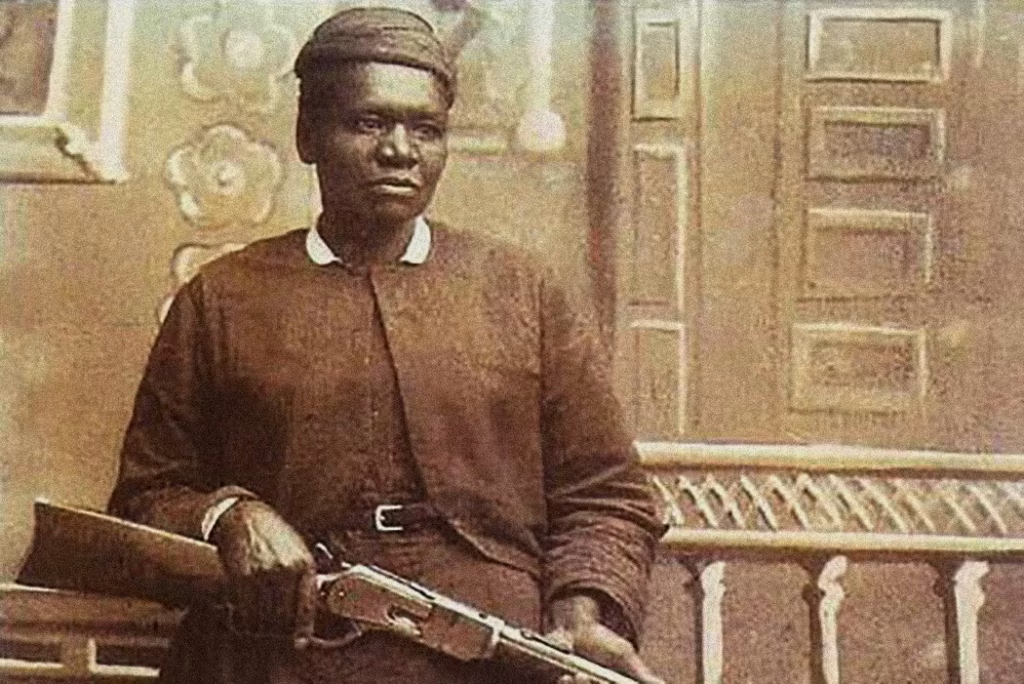
Mary Fields: “Stagecoach Mary”
Mary Fields, commonly known as “Stagecoach Mary,” stands as a powerful symbol of both racial and gender barriers overcome on the frontier. Born into slavery around 1832, Fields later moved to Montana, where she became the first African American woman and only the second woman to be employed as a Star Route mail carrier for the United States Postal Service.
Taking on her mail route at approximately 60 years of age in 1892, Fields delivered mail in the Montana wilderness for eight years, navigating treacherous terrain and harsh weather with remarkable reliability. Her toughness was legendary—she reportedly defended her mail deliveries with a rifle and revolver, never missing a day of work despite dangers from weather, wildlife, and bandits.
Fields’ determination and courage earned her immense respect in the Montana community of Cascade, where she later operated a laundry business and became known for her generosity toward children. Her pioneering role as a Black woman in a traditionally white male profession challenged multiple layers of prejudice and expanded the narrative of who could succeed on the American frontier.

Bass Reeves: Legendary Lawman
Though not strictly a cowboy, Bass Reeves represents an adjacent frontier archetype whose story intersects with and complements the Black cowboy narrative. Born into slavery in 1838, Reeves became one of the first Black deputy U.S. marshals west of the Mississippi River.
Serving primarily in the dangerous Indian Territory (present-day Oklahoma), Reeves built an extraordinary record of law enforcement over his 32-year career. He reportedly arrested over 3,000 felons and was forced to kill 14 outlaws in self-defense during arrests. His largest single accomplishment was the capture of 19 horse thieves near Fort Sill in a single operation.
Reeves’ methods were innovative and effective—he often worked undercover, spoke multiple languages, and demonstrated exceptional tracking abilities. Even more remarkably, he maintained his integrity in an era of widespread corruption, famously even arresting his own son when duty required it. Reeves continued serving as a peace officer until Jim Crow laws forced African Americans out of the marshal service in Oklahoma.

Challenges and Discrimination
Despite their vital contributions and extraordinary skills, Black cowboys faced persistent discrimination and structural barriers. On the trail, racial dynamics could be complex—skill and reliability sometimes transcended racial prejudice in the isolated environment of cattle drives, where survival depended on teamwork and competence. However, this relatively egalitarian atmosphere rarely extended to towns and settlements, where segregation and discrimination were rigidly enforced.
Black cowboys typically received lower wages than their white counterparts for identical work. They were often assigned the most dangerous and difficult tasks, including breaking the most temperamental horses and working the most perilous positions during cattle drives. In towns along the trail, they faced segregated accommodations, limited access to services, and sometimes outright hostility.
The historical record itself represents another form of discrimination. The contributions of Black cowboys were systematically omitted from early histories, popular literature, and later Hollywood westerns, creating a distorted image of the American West that persisted for generations. The widespread illiteracy among cowboys of all races, but particularly Black cowboys who had been denied education during slavery, meant that few personal accounts were recorded, further obscuring their stories.
Collective Response and Community Building
In response to these challenges, Black cowboys created their own institutions and networks. Many participated in “soul circuits”—rodeo events specifically organized for Black participants who were excluded from mainstream competitions. The formation of the Southwestern Colored Cowboys’ Association represented an important step in collective organization, providing both economic opportunities and community support.
Black cowboys also established their own ranches and settlements in various western states, creating spaces where they could exercise greater autonomy and build community. Places like Dearfield, Colorado, and Nicodemus, Kansas, represented attempts to create Black-controlled agricultural and ranching communities beyond the reach of southern racism.
The Enduring Cultural Legacy
The legacy of Black cowboys extends far beyond their direct historical impact, influencing American culture in profound and ongoing ways. Their stories challenge simplistic narratives about both the American West and African American history, revealing the complex interplay of opportunity and oppression that characterized frontier life.
In recent decades, there has been increasing recognition of Black cowboys’ contributions, with museums, documentaries, and scholarly works exploring their significance. Organizations like the Black Cowboys Museum in Rosenberg, Texas, and the Black American West Museum in Denver, Colorado, preserve and share these vital stories.
Contemporary Black rodeo associations continue the traditions established in the 19th century, with events like the Bill Pickett Invitational Rodeo showcasing the talents of Black cowboys and cowgirls while honoring their historical predecessors. Urban Black riding clubs in cities like Philadelphia, New York, and Los Angeles maintain equestrian traditions within African American communities, connecting younger generations to this aspect of their heritage.
Conclusion
The story of Black cowboys represents a crucial chapter in American history—one that expands our understanding of both the development of the West and the diverse ways African Americans sought freedom and opportunity in the post-Civil War era. These men and women demonstrated extraordinary courage, skill, and determination in the face of systemic racism and challenging frontier conditions.
Their legacy reminds us that American history is always more complex and diverse than simplified narratives suggest. The cowboys who helped forge the American West came from many backgrounds, bringing different experiences and perspectives to the frontier. The substantial presence and significant contributions of Black cowboys deserve recognition not as a footnote but as an essential component of how the West was won.
By acknowledging and celebrating these unsung heroes, we gain a more accurate understanding of our shared past and honor the full spectrum of individuals who shaped the American experience. Their stories of resilience, innovation, and excellence continue to inspire and inform our national identity, reminding us that the opportunity to define oneself—despite obstacles—remains a fundamental American ideal.


