
Sunday, February 22, 2026
Home Blog Page 8

Unsung Heroes of the Wild West: The Enduring Legacy of Black Cowboys in US History

0
1_I_wkv86aWDNXFtBNcR_QoQ

Unsung Heroes of the Wild West: The Enduring Legacy of Black Cowboys in US History: When we envision the American West, our collective imagination often conjures images of dusty trails, cattle drives, and solitary figures silhouetted against vast horizons. For generations, this iconic imagery has been predominantly portrayed through a narrow lens that failed to capture the true diversity of those who shaped the frontier. Among the most significant omissions from this historical narrative has been the profound contribution of Black cowboys—individuals whose skills, resilience, and determination helped forge the very essence of the American West.

The erasure of Black cowboys from popular culture and historical accounts represents more than a simple oversight; it constitutes a fundamental misrepresentation of American history. These cowboys weren’t peripheral figures but essential participants in the development of the cattle industry, western expansion, and the creation of cowboy culture itself. Their stories deserve recognition not merely as a footnote to history but as a central chapter in understanding how the American West was won.

Unsung Heroes of the Wild West: The Enduring Legacy of Black Cowboys in US History

Origins: From Slavery to the Open Range

The roots of Black cowboy culture trace back to the antebellum South, particularly in cattle-rich states like Texas. Enslaved African Americans developed exceptional skills in livestock management, horsemanship, and animal husbandry—often becoming more knowledgeable than their enslavers about cattle handling techniques and horse training. These abilities, honed under the brutal conditions of slavery, would later become valuable currencies in the post-Civil War economy.

When the Civil War ended in 1865 and emancipation became reality, many formerly enslaved individuals faced limited options in the still-hostile South. The expanding cattle industry of the West offered something precious: opportunity. As cattle drives became essential to the nation’s economy, the demand for skilled cowhands created employment possibilities for Black Americans seeking both livelihood and distance from the oppressive racial climate of the South.

By the Numbers: A Substantial Presence

Historical research has revealed the significant numerical presence of Black cowboys in the American West. According to multiple scholarly accounts, Black cowboys comprised approximately 25% of all cowboys who participated in the great cattle drives from the 1860s to 1880s. This substantial representation—one in four cowboys being Black—challenges the predominantly white portrayal perpetuated by Hollywood and popular literature.

In the 1870s, when the cattle industry was at its peak, an estimated 35,000 cowboys worked the ranges of the American West, with Black cowboys numbering around 8,000-9,000. These figures represent not a marginal presence but a fundamental component of the workforce that drove the economic development of the West.

Skilled Professionals on the Frontier

Black cowboys weren’t merely present; they were often among the most skilled professionals on the frontier. They excelled across diverse roles essential to the cattle industry. As expert ropers, they demonstrated precision and technique that earned respect even in the prejudiced society of the time. Many served as trail cooks, a position of tremendous responsibility that required not only culinary skills but also the ability to manage supplies and maintain morale over long, arduous journeys.

As wranglers and bronco busters, Black cowboys displayed exceptional horsemanship, often being assigned to break and train the most challenging horses—a dangerous but prestigious role that showcased their abilities. During cattle drives, Black drovers guided vast herds across hostile terrain, navigating natural barriers and potential dangers with remarkable skill and judgment.

Beyond these core responsibilities, many Black cowboys served as hunters, providing fresh game to supplement trail rations. Some became entertainers, developing riding and roping demonstrations that would later influence rodeo competitions. Others acted as security for white cattlemen, protecting valuable herds from rustlers and bandits in lawless territories.

Unsung Heroes of the Wild West: The Enduring Legacy of Black Cowboys in US History

The Exoduster Movement and Western Migration

The migration of “Exodusters”—Black migrants who left the South for Kansas between 1879 and 1884—further amplified the presence of Black cowboys in the West. Drawn by opportunities presented by initiatives like the Homestead Act, which allowed citizens to claim land in the western territories, these migrants sought both economic independence and escape from the violent racism of the post-Reconstruction South.

Many Exodusters who possessed equestrian and livestock management skills found natural employment in the cattle industry. Their migration represented a broader movement of Black Americans seeking to redefine their lives in the aftermath of slavery, with the open range offering a degree of freedom and opportunity unavailable in other regions.

Unsung Heroes of the Wild West: The Enduring Legacy of Black Cowboys in US History

Iconic Figures of the Black Cowboy Legacy

From this rich historical tapestry emerged several iconic figures whose stories exemplify the broader legacy of Black cowboys in American history:

Nat Love: "Deadwood Dick"

Nat Love: “Deadwood Dick”

Born into slavery in Tennessee in 1854, Nat Love emerged as one of the most celebrated Black cowboys of his era. After emancipation, Love headed west to Kansas and began his cowboy career. His exceptional skills as a horseman, marksman, and roper earned him widespread recognition.

Love earned his famous nickname “Deadwood Dick” in 1876 after winning a prominent rodeo competition in Deadwood, South Dakota, where he demonstrated his mastery of roping, shooting, and bronco riding. The $200 prize and subsequent fame established him as a legendary figure on the frontier.

What distinguishes Love in the historical record is his 1907 autobiography, “The Life and Adventures of Nat Love, Better Known in the Cattle Country as ‘Deadwood Dick’,” one of the few first-person accounts by a Black cowboy. This invaluable document details his experiences fighting cattle rustlers, enduring harsh weather, engaging with Native American tribes, and mastering the cowboy’s diverse skills, providing rare insight into the Black cowboy experience.

Bill Pickett: Pioneer of "Bulldogging"

Bill Pickett: Pioneer of “Bulldogging”

William “Bill” Pickett, born in Texas in 1870, revolutionized rodeo competition by inventing “bulldogging” or steer wrestling, a technique that remains a standard rodeo event today. Pickett’s method involved wrestling a steer to the ground by grabbing its horns and twisting its neck, demonstrating both his innovation and physical prowess.

As one of the first Black cowboy stars, Pickett toured the country with the 101 Ranch Wild West Show, showcasing his extraordinary talents to national audiences. His performances not only entertained but also challenged racial stereotypes by demonstrating the exceptional skill of Black cowboys. Pickett’s cultural impact was formally recognized in 1971 when he became the first Black cowboy inducted into the National Cowboy and Western Heritage Museum’s Hall of Fame.
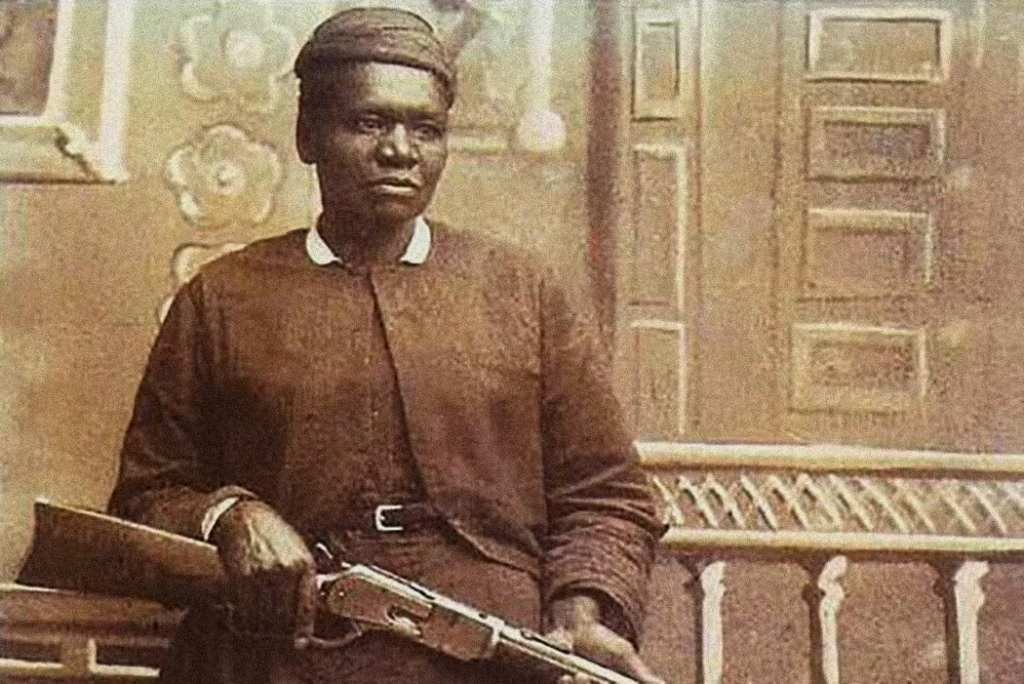
Mary Fields: "Stagecoach Mary"

Mary Fields: “Stagecoach Mary”

Mary Fields, commonly known as “Stagecoach Mary,” stands as a powerful symbol of both racial and gender barriers overcome on the frontier. Born into slavery around 1832, Fields later moved to Montana, where she became the first African American woman and only the second woman to be employed as a Star Route mail carrier for the United States Postal Service.

Taking on her mail route at approximately 60 years of age in 1892, Fields delivered mail in the Montana wilderness for eight years, navigating treacherous terrain and harsh weather with remarkable reliability. Her toughness was legendary—she reportedly defended her mail deliveries with a rifle and revolver, never missing a day of work despite dangers from weather, wildlife, and bandits.

Fields’ determination and courage earned her immense respect in the Montana community of Cascade, where she later operated a laundry business and became known for her generosity toward children. Her pioneering role as a Black woman in a traditionally white male profession challenged multiple layers of prejudice and expanded the narrative of who could succeed on the American frontier.

Bass Reeves: Legendary Lawman

Bass Reeves: Legendary Lawman

Though not strictly a cowboy, Bass Reeves represents an adjacent frontier archetype whose story intersects with and complements the Black cowboy narrative. Born into slavery in 1838, Reeves became one of the first Black deputy U.S. marshals west of the Mississippi River.

Serving primarily in the dangerous Indian Territory (present-day Oklahoma), Reeves built an extraordinary record of law enforcement over his 32-year career. He reportedly arrested over 3,000 felons and was forced to kill 14 outlaws in self-defense during arrests. His largest single accomplishment was the capture of 19 horse thieves near Fort Sill in a single operation.

Reeves’ methods were innovative and effective—he often worked undercover, spoke multiple languages, and demonstrated exceptional tracking abilities. Even more remarkably, he maintained his integrity in an era of widespread corruption, famously even arresting his own son when duty required it. Reeves continued serving as a peace officer until Jim Crow laws forced African Americans out of the marshal service in Oklahoma.

Unsung Heroes of the Wild West: The Enduring Legacy of Black Cowboys in US History

Challenges and Discrimination

Despite their vital contributions and extraordinary skills, Black cowboys faced persistent discrimination and structural barriers. On the trail, racial dynamics could be complex—skill and reliability sometimes transcended racial prejudice in the isolated environment of cattle drives, where survival depended on teamwork and competence. However, this relatively egalitarian atmosphere rarely extended to towns and settlements, where segregation and discrimination were rigidly enforced.

Black cowboys typically received lower wages than their white counterparts for identical work. They were often assigned the most dangerous and difficult tasks, including breaking the most temperamental horses and working the most perilous positions during cattle drives. In towns along the trail, they faced segregated accommodations, limited access to services, and sometimes outright hostility.

The historical record itself represents another form of discrimination. The contributions of Black cowboys were systematically omitted from early histories, popular literature, and later Hollywood westerns, creating a distorted image of the American West that persisted for generations. The widespread illiteracy among cowboys of all races, but particularly Black cowboys who had been denied education during slavery, meant that few personal accounts were recorded, further obscuring their stories.

Collective Response and Community Building

In response to these challenges, Black cowboys created their own institutions and networks. Many participated in “soul circuits”—rodeo events specifically organized for Black participants who were excluded from mainstream competitions. The formation of the Southwestern Colored Cowboys’ Association represented an important step in collective organization, providing both economic opportunities and community support.

Black cowboys also established their own ranches and settlements in various western states, creating spaces where they could exercise greater autonomy and build community. Places like Dearfield, Colorado, and Nicodemus, Kansas, represented attempts to create Black-controlled agricultural and ranching communities beyond the reach of southern racism.

The Enduring Cultural Legacy

The legacy of Black cowboys extends far beyond their direct historical impact, influencing American culture in profound and ongoing ways. Their stories challenge simplistic narratives about both the American West and African American history, revealing the complex interplay of opportunity and oppression that characterized frontier life.

In recent decades, there has been increasing recognition of Black cowboys’ contributions, with museums, documentaries, and scholarly works exploring their significance. Organizations like the Black Cowboys Museum in Rosenberg, Texas, and the Black American West Museum in Denver, Colorado, preserve and share these vital stories.

Contemporary Black rodeo associations continue the traditions established in the 19th century, with events like the Bill Pickett Invitational Rodeo showcasing the talents of Black cowboys and cowgirls while honoring their historical predecessors. Urban Black riding clubs in cities like Philadelphia, New York, and Los Angeles maintain equestrian traditions within African American communities, connecting younger generations to this aspect of their heritage.

Conclusion

The story of Black cowboys represents a crucial chapter in American history—one that expands our understanding of both the development of the West and the diverse ways African Americans sought freedom and opportunity in the post-Civil War era. These men and women demonstrated extraordinary courage, skill, and determination in the face of systemic racism and challenging frontier conditions.

Their legacy reminds us that American history is always more complex and diverse than simplified narratives suggest. The cowboys who helped forge the American West came from many backgrounds, bringing different experiences and perspectives to the frontier. The substantial presence and significant contributions of Black cowboys deserve recognition not as a footnote but as an essential component of how the West was won.

By acknowledging and celebrating these unsung heroes, we gain a more accurate understanding of our shared past and honor the full spectrum of individuals who shaped the American experience. Their stories of resilience, innovation, and excellence continue to inspire and inform our national identity, reminding us that the opportunity to define oneself—despite obstacles—remains a fundamental American ideal.

The Nuclear Paradox: Fusion Closer To Reality, But Is Enough Being Done to Keep Fission-Driven Industry Safe?

0
The Nuclear Paradox: Fusion Closer To Reality, But Is Enough Being Done to Keep Fission-Driven Industry Safe?

Nearly a half-century since the worst US accident, and with disasters in Ukraine and Japan in the
years since, the world is increasing its reliance on nuclear energy to meet its growing needs. While
numerous strides being made in research and development are promising, there appears to be little
evidence to suggest such accidents could be avoided in the future.

The Nuclear Paradox: Fusion Closer To Reality, But Is Enough Being Done to Keep Fission-Driven Industry Safe?
When in the past countries have worked fiercely to build and maintain nuclear weapons, they’ve
invested over seven billion dollars (as of 2024) to make nuclear fusion a viable energy source. Every star
in the universe produces energy combining small atoms into larger nuclei. Fusion generates substantially
more energy than current nuclear reactors, leaving mostly helium as a byproduct. Producing the
conditions necessary for sustaining that reaction and generating more energy than was necessary to
produce said reaction has been the greatest hurdle. Only two years ago, Lawrence Livermore National
Laboratory’s National Ignition Facility (NIF) in California successfully used  inertial fusion energy, or
IFE, to fuse deuterium and tritium atoms together, creating 3.15 megajoules of energy, more than the 2.05
megajoules the NIF’s 192 lasers used to generate the reaction.

Arianna Gleason, Staff scientist and deputy director of the High Energy Density Science division
at SLAC National Accelerator Laboratory (also in California), touted the NIF’s December 2022 success
as “an incredible watershed moment in fusion research,” in a recent SLAC article:

“Right now, the NIF produces one or two (laser) shots each day. We’re trying to go from one shot
each day to multiple shots each second. If we can orchestrate these implosions multiple times a second,
we can generate a continuous flow of power – and do so in a way that is safe, carbon-free and at a scale
that meets the long-term energy demands of our world.”

The Nuclear Paradox: Fusion Closer To Reality, But Is Enough Being Done to Keep Fission-Driven Industry Safe?
Commercial Fusion energy, it is hoped, could be realized by the mid-2030s. Meeting both
increasing energy demands and climate-based policies have US cities re-evaluating their opinions toward
the viability of conventual fission reactors. Such re-evaluation also has energy companies eyeing once-
dormant reactors for possible re-starts, a possibility that has one Pennsylvania community very concerned
and for very good reason.

Middletown, PA is still living in the shadow of the cooling towers. March 1979 is still very fresh
in the memories of its residents, when the small community witnessed the worst commercial nuclear
accident in US history. Forty-six years later, those same residents have once again been left scared-and
outraged.

TMI-2 Solutions, the subsidiary of Utah-based nuclear waste processor EnergySolutions, received
a “non-cited violation” by the Nuclear Regulatory Commission for issues which led to a fire in the
infamous Unit 2 reactor building. The company failed to make crucial inspections which would have
identified an unprotected “contamination control curtain,” which may have been ignited by an acetylene
torch being used in the vicinity. Jeff Richardson, president of decommissioning and decontamination at
EnergySolutions, explained the work was work was part of an “equipment hatch expansion,” facilitating
large equipment and materials moved in and out of containment as the plant is dismantled.

TMI-2 Solutions had a fire response team on-site, which quickly handled the situation, and made
calls to the NRC and DEP the same day. It had several opportunities to report the incident, including
meetings of its own Community Advisory Panel. The general public, however, had no idea the fire even
occurred until May 2 nd , when the NRC posted an inspection report dated April 24 th .
TMI-2 Solutions is only responsible for the dismantling of the contaminated Unit 2 reactor, which
it hopes to have completed by 2052. Public backlash over the incident has not instilled confidence in a
possible restart of Unit 1, which is owned by Maryland-based Constellation Energy. While reports have
expressed Constellation’s confidence in retuning Unit 1 to service by 2028 and its plans to rename the
facility the Crane Clean Energy Center, they made no reference to the February 11 th event whatsoever.

What Happens When Leaders Hide Illness? Inside the Most Shocking Government Health Cover-Up Scandals

0

Imagine the world’s most powerful leaders making life-and-death decisions while concealing serious health issues from the public. Sound like a political thriller? It’s history.

From U.S. presidents to global heads of state, governments have often gone to great lengths to keep their leaders’ illnesses secret. Sometimes, it’s for national stability—but often, it’s about maintaining power and public confidence. This secret-keeping isn’t just political theater; it can shake the very foundation of democracy.

In this deep-dive, we’ll take you behind the headlines to explore infamous government health cover-up scandals, their impact on society, and what they reveal about the importance of transparency in leadership.


Historical Government Health Cover-Ups: When the Truth Stayed Hidden

Franklin D. Roosevelt—A Nation Shielded from Paralysis

Franklin D. Roosevelt—A Nation Shielded from Paralysis

One of the most striking examples is President Franklin D. Roosevelt (FDR), who led the U.S. through the Great Depression and World War II. While much of America knew he had polio, his advisors and the media helped hide the full extent of his paralysis and declining health. When Roosevelt died in office, many Americans were shocked—raising questions about who was really steering the nation in his final days.

John F. Kennedy—Under-the-Radar Prescriptions

John F. Kennedy—Under-the-Radar Prescriptions

JFK was widely seen as the picture of youth and vigor, but behind the scenes, he continued to battle significant health issues—including Addison’s disease and chronic back problems. His administration went to great lengths to downplay these issues, even denying medications in official records.

Boris Yeltsin—Ailing at the Helm

Boris Yeltsin—Ailing at the Helm

In Russia, Boris Yeltsin’s heart attacks and alcoholism while in office were a closely guarded state secret. These episodes, revealed only after his presidency, prompt ongoing debate about how much turmoil was hidden from both the Russian people and the world in the 1990s.

Other Notable Cases

  • Mao Zedong: His cognitive and physical decline in later years were downplayed to maintain party stability in China.
  • Winston Churchill: Suffered a major stroke in 1953—but British officials kept the public (and even Parliament) in the dark as he continued nominally as Prime Minister.

Why Do Governments Hide Leaders’ Illnesses?

1. To Maintain National Stability

Leaders are the face of nations. Public knowledge of serious illness could cause panic or embolden adversaries.

2. To Control Perception

A healthy, vigorous leader suggests strong governance—even when it’s far from the truth. Controlling illness narratives helps manipulate political perception in turbulent times.

3. To Protect Political Power

Admission of weakness can spell disaster in politics. Many administrations have decided it’s better to risk a cover-up than to lose power.


The Dangers of Cover-Ups: Democracy at Risk

Secret health struggles don’t just affect the ill leader. They have far-reaching consequences for the nation—even the world:

  • Poor Decision-Making: An ailing leader may be less effective, leading to disastrous policy choices.
  • Lack of Accountability: When cover-ups succeed, governments set a precedent for hiding other truths.
  • Public Trust Erodes: Secrecy breeds cynicism; a democracy relies on informed voters.

Today’s Context: Echoes from History

Recent political cycles have reignited debates about transparency and the health of world leaders. In the digital era, rumors move fast, and fact-checking can be manipulated. But the lesson remains: hidden truths threaten the integrity of governance.


How Can Citizens Demand Accountability?

  • Insist on Transparency Laws that require regular reporting on leaders’ fitness
  • Support Investigative Journalism to uncover truths otherwise buried
  • Challenge Secrecy and encourage open discussion about public officeholder health

Quick-Read FAQs

  • Why do governments hide illness?
    To maintain power, control public perception, and avoid instability.
  • Is it legal to conceal a leader’s health issues?
    In most nations, it’s not illegal—but it’s an ethical gray area that can harm democracy.
  • Does the public have a right to know?
    In a democracy, yes: public trust and informed voting depend on it.

Key Takeaways

  • Secrecy about leadership health can distort public trust and weaken democracy.
  • Historical cover-ups changed the course of major events—sometimes with disastrous impacts.
  • Demanding transparency is vital for every citizen wanting honest, accountable government.

Subscribe for Exclusive Truths

Don’t miss exclusive insights like these—subscribe to Stucci Media now and get the stories mainstream news won’t tell you!

Usher’s Revealing Testimony: What Really Happened With Diddy When He Was 14

0
Usher’s Revealing Testimony: What Really Happened With Diddy When He Was 14

When Usher Raymond entered the music industry, no one imagined his success would one day intersect with one of hip-hop’s most powerful moguls—in such a dramatic and public way. Secrets that were kept behind closed doors for decades have now come to light, as Usher bravely stepped forward to testify about his experiences as a young teenage artist mentored by Sean “Diddy” Combs.

This exclusive feature breaks down Usher’s courtroom revelations, explores the legal and cultural impact, and asks: Where does the music industry go from here?

Usher’s Revealing Testimony: What Really Happened With Diddy When He Was 14


The Shocking Testimony That Shook the Industry

In a packed courtroom—and before the eyes of millions via news streams—Usher recounted experiences that stunned fans and industry insiders alike. At just 14, he was thrust into a world of power, excess, and at times, alleged exploitation.

Key moments from Usher’s testimony:

  • Descriptions of “wild parties” and industry events he attended as a minor.
  • Signed contracts with strict confidentiality, preventing him and others from speaking out for years.
  • Allegations of manipulation and coercion affecting not just his own career, but those of other young stars.

“I was surrounded by things no teenager should see or experience—and I felt unable to say no,” Usher stated.


Diddy & Usher: The Mentor-Mentee Relationship

Diddy (then Puff Daddy) was a kingmaker in the 1990s music scene. For Usher, mentorship under Diddy meant instant credibility—and high expectations.

  • Mentoring or Control? Court documents and Usher’s statements raised questions about boundaries and intent.
  • Implications of Silence: Usher revealed a complex dynamic defined by gratitude, loyalty, and fear—echoing a familiar pattern within the music business.

Legal & Cultural Fallout

Usher’s public testimony is already sparking industry-wide discussions, with supporters praising his courage and critics examining systemic failures.

Key implications:

  • Ongoing criminal and civil cases involving Diddy
  • Public pressure for reform in talent development and artist protection
  • Musicians of all ages speaking out about similar experiences

https://people.com/dawn-richard-usher-neyo-jimmy-iovine-diddy-punch-restaurant-11737497


Timeline: Usher, Diddy, and the Case Unfolds

1993: Usher arrives in New York; begins working with Diddy
1994–1995: Attends high-profile events as a minor
2000s: Non-disclosure agreements block public discussion
2024: Usher breaks silence in court, sparking widespread media coverage


What This Means for Today’s Artists

The testimony challenges major labels and managers to reevaluate policies around young talent. Will Usher’s case force positive change, or is the old system too entrenched?

  • Stronger legal protections for minors
  • More transparent mentor programs
  • Increased mental health support in the industry

FAQs

Q: Is Diddy facing more lawsuits after Usher’s testimony?
A: Multiple cases are under investigation; some filings cite Usher’s testimony directly.

Q: Why did Usher stay quiet for so long?
A: Binding confidentiality contracts, career pressures, and emotional trauma.

“My silence wasn’t by choice—it was by contract.”
— Usher, court testimony


CONCLUSION

As Usher’s voice breaks through decades of silence, the music world is forced to reckon with its past—and rethink its future. Whether you’re a fan, an aspiring musician, or simply a curious reader, the real story behind the headlines makes it clear: truth, transparency, and protection for artists are needed now more than ever.


Want more exclusive stories like this? Subscribe to Stucci Media for insider access to the biggest celebrity news and legal dramas—delivered straight to your inbox.

Trump’s Historic Middle East Visit: Unprecedented Economic Deals, Syria Sanctions Relief, and New Warnings to Iran

0
Trump’s Historic Middle East Visit: Unprecedented Economic Deals, Syria Sanctions Relief, and New Warnings to Iran

By Stucci Media International Desk


A Trip Poised to Reshape U.S.–Middle East Ties

President Donald Trump’s latest Middle East tour has upended conventional expectations and delivered diplomatic and economic outcomes with far-reaching consequences. Over a single week—with high-profile stops in Saudi Arabia, Qatar, and the United Arab Emirates—Trump finalized trade agreements eclipsing historical records, pivoted decades-long U.S. policy on Syria via sanctions relief, and added renewed urgency to American warnings directed at Iran.

What does this all mean for the U.S., its allies, and global business? Here, we break down the agreements, controversies, and strategic calculations that are redefining a critical region at the crossroads of economics and security.


Table of Contents

  1. The High Stakes: Setting the Stage
  2. Deal of the Century: Record-Breaking Economic Partnerships
  3. Syria Sanctions Relief: Geopolitical Gamble?
  4. Warnings to Iran: Red Lines and Diplomacy
  5. Ukraine-Russia Talks: A Decided Afterthought
  6. Public and Regional Reaction
  7. What Comes Next: Analysis and Outlook
  8. Key Takeaways
  9. FAQ
  10. Stay Informed: Subscribe to Stucci Media!

Trump’s Historic Middle East Visit: Unprecedented Economic Deals, Syria Sanctions Relief, and New Warnings to Iran


1. The High Stakes: Setting the Stage

Few presidential trips have begun under such a glare—or with such explicit aims. Before embarking, President Trump made clear he intended to secure at least $1 trillion in trade and investment with the Gulf states. Yet, perhaps fewer expected his administration to walk away with economic frameworks that, on paper, far exceed even those elevated targets.

Add to this the element of geopolitical surprise: the dramatic rescinding of much of the U.S.’s long-standing sanctions regime on Syria, steadfast U.S. retorts to Iranian actions, and a marked cooling regarding Ukrainian-Russian peace negotiations.


2. Deal of the Century: Record-Breaking Economic Partnerships

Saudi Arabia: $600 Billion Strategic Economic Partnership

The president’s first stop in Riyadh set the tone, symbolizing not just a diplomatic reset but a trade revolution.

Headline Figures:

  • $600 Billion “strategic economic partnership”
  • $142 Billion defense and security deal (“the largest in history”)
  • Massive Saudi investments into U.S. AI, energy infrastructure, and bi-national tech collaborations
  • Promise of up to 2 million new U.S. jobs (White House estimate)

What Does It Cover?

  • U.S. AI Data Centers: Saudi fund investment promises major capacity expansions on American soil.
  • Dual-Nation Energy Grids: A new push towards cross-border, next-generation energy technology.
  • Defense Technology: Beyond mere hardware, deals pledge joint R&D on drones, missile defense, and cybersecurity.

Implication: Such an infusion of capital and tech partnership changes the character of U.S.–Saudi relations—aligning major economic and strategic interests for the next decade.


Qatar: $1.2 Trillion Economic Exchange

While the Saudi deal rattled headlines, the president’s next stop in Doha produced an even larger number.

Key Facets:

  • $1.2 Trillion in direct and indirect economic agreements
  • 210 Boeing jets purchased by Qatar Airways—valued at $96 billion
  • Cooperative infrastructure investments (shipping, ports, energy pipelines)
  • “Quantum technology” and workforce development initiatives

Controversy: The optics of Qatar’s offer to “gift” Trump a new Air Force One—made during high-level ceremonies—drew immediate international scrutiny and domestic criticism for perceptions of undue influence.

Scope: This agreement, if realized in its entirety, would create one of the world’s largest state-sponsored technology alliances and secure U.S. civil aviation manufacturing jobs for a generation.

Trump’s Historic Middle East Visit: Unprecedented Economic Deals, Syria Sanctions Relief, and New Warnings to Iran


UAE: Final Stop, More Deals

The president’s whirlwind concluded in Abu Dhabi with a series of investment protocols focused on logistics, green energy, and tech startups. While less publicized, these deals further cement the region’s status as America’s most important emerging global tech corridor.


3. Syria Sanctions Relief: Geopolitical Gamble?

Unexpectedly, Trump announced the rollback of decades-old U.S. sanctions against Syria—a policy maintained under both Republican and Democratic administrations.

What Changed?

  • Easing of trade and financial sanctions
  • Immediate restart for humanitarian and reconstruction efforts
  • U.S.–Syria dialogue channels “to be expanded”

Why Now?
Administration officials cite the need to draw Syria back from Iranian influence while leveraging ongoing regional rapprochement. Critics, however, warn of emboldening Assad’s regime without meaningful democratic concessions.

What Experts Say:
“Relief of sanctions is a double-edged sword. It can rebalance regional influence, but risks legitimizing and empowering a controversial regime if not tied to reforms.” — Middle East Policy Analyst, Brookings


4. Warnings to Iran: Red Lines and Diplomacy

If economic agreements dominated headlines, the president’s rhetorical targeting of Iran left no doubt about U.S. priorities.

Key Moments:

  • Reiterated American “red lines” on regional security, nuclear ambitions
  • Coordinated messaging with Gulf allies on responses to “malign activity”
  • New intelligence-sharing accords formalized

Impact: While some observers see bold deterrence, others caution increased risk of escalation in an already-tense region.


5. Ukraine-Russia Talks: A Decided Afterthought

Confirming days of speculation, Russian President Vladimir Putin did not attend the planned late-stage Ukrainian-Russian peace talks, instead delegating minor officials. Trump noticeably played down the importance of this outcome, signaling a shift in U.S. focus—at least for this summit—toward Middle East realpolitik and economic realignment.


6. Public and Regional Reaction

United States:
Business groups, especially in defense and tech, have cheered job creation and export guarantees. Critics decry the secrecy around agreement terms and the ethical implications of Gulf generosity.

Middle East:
Gulf leaders have hailed the agreements as “historic and transformational.” There are signals of renewed trust—even as voices in the region fret about shifting allegiances and strategic risk, especially vis-à-vis Iran and Syria.

Global:
European and Asian governments are carefully monitoring implications for energy markets, tech transfers, and global security alliances.


7. What Comes Next: Analysis and Outlook

For the U.S.:
The surge in economic partnerships strengthens American industry while anchoring U.S. geopolitical influence in a strategically vital region.

For the Middle East:
The agreements may catalyze innovation and growth—if realized. But longstanding political frictions and unpredictable security environments temper unqualified optimism.

Watch:

  • Congressional scrutiny/approval of defense and aviation deals
  • Implementation timeline for sanctions relief to Syria
  • Iran’s response—diplomatic or otherwise
  • Evolution of U.S. policy priorities toward Eastern Europe

8. Key Takeaways

  • Historic trade deals: Trump secured more than $1.8 trillion in agreements across Saudi Arabia, Qatar, and the UAE.
  • Syria sanctions: Decades-old U.S. restrictions lifted—potentially changing regional power dynamics.
  • Tehran tensions: U.S. signals strong deterrence, but with risks of escalation.
  • Jobs and tech: U.S. industries (especially defense, aviation, energy) primed for multiyear growth.
  • Controversy and optics: Questions linger over Qatar’s “gift” and the full terms and transparency of these deals.

9. FAQ

Q: What’s in the Saudi deal for American workers?
A: Up to 2 million jobs, mainly in construction, tech, and defense manufacturing.

Q: Will sanctions relief in Syria lead to peace?
A: It may foster dialogue and reboot reconstruction but could also empower Assad further.

Q: How does Iran view these developments?
A: Iranian officials have condemned the deepening U.S.–Gulf ties, suggesting destabilizing effects.

Q: Are these deals final?
A: Most agreements announce frameworks, with legal and legislative hurdles ahead.

Q: Why is the Air Force One “gift” controversial?
A: Ethics concerns over foreign attempts to curry favor with the U.S. president, as well as transparency of such offers.


10. Stay Informed: Subscribe for Critical Analysis!

Want to stay ahead of the headlines with unbiased, in-depth global analysis? Subscribe to Stucci Media today and never miss a critical update or expert insight. Join our community of informed readers—your source for truth in a complex world.


Don’t miss out: Sign up with Stucci Media for world-class news, delivered whenever and wherever you need it!

How America’s Founders Warned Us About Today’s Tyranny and What Congress Accountability Means For Your Liberty

0

Have you wondered why today’s Congress seems so out of touch with the concerns of ordinary Americans? Why do bureaucratic overreach and a lack of transparency dominate headlines, and what would America’s Founders say about it all?

As frustration with government grows, a simple truth stands out: The Founders predicted these threats and their solutions still matter today.


The Founders’ Warnings: Lessons We Haven’t Learned

The architects of American liberty—Jefferson, Madison, Washington—foresaw the dangers of unchecked power. They designed a system based on individual rights, separation of powers, and “government by the people.”

But their warnings are being ignored:

  • Lack of Accountability: Congress often passes sweeping laws but leaves details to unelected agencies.
  • Bureaucratic Overreach: Federal regulations now impact everyday life in ways never approved by voters.
  • Erosion of Rights: Freedoms once assumed are now subject to interpretation—or neglect—by those in power.

“When the people fear the government, there is tyranny; when the government fears the people, there is liberty.” – Thomas Jefferson


Is This Tyranny in Action?

Today, many Americans feel “represented” only in name. Decisions happen behind closed doors. Agencies issue mandates that bypass open debate. Signs of creeping tyranny include:

  • Laws too complex for most to understand
  • Growing surveillance and data collection
  • Punitive agencies operating with little oversight
  • Political speech being regulated in subtle ways

Why Does Congressional Accountability Matter?

At its core, Congress accountability is about responsibility—representatives must answer directly to the people. When they don’t:

  • Bureaucrats fill the void
  • Corruption goes unchecked
  • Your rights are at risk

Real accountability means regular town halls, transparent votes, accessible records, and a willingness to listen to constituents’ concerns.


What Can Citizens Do?

  1. Understand Your Rights: Read the Constitution, Bill of Rights, and reliable commentaries.
  2. Check Your Representatives’ Records: Look up how they vote and speak out when disappointed.
  3. Demand Transparency: Ask for open meetings and clear explanations of new laws.
  4. Engage Locally: Attend school board and city council meetings—real change often starts small.
  5. Support Independent Media: Seek out sources that hold power to account.

Key Takeaways

  • America’s Founders predicted the dangers of unaccountable power.
  • Modern politics often disregards those safeguards—putting liberty at risk.
  • Congress accountability is the first line of defense for your rights.
  • Every citizen’s voice matters—lawmakers must earn your trust.
  • Ongoing vigilance and education are essential.

Frequently Asked Questions

Q: How do I find out what my Congress member is doing?
A: Check their official website, review their voting record on sites like GovTrack.us, and subscribe to nonpartisan government watchdog newsletters.

Q: Can citizens really make a difference?
A: Absolutely—direct calls, emails, and in-person visits can sway a representative (especially when many voices unite).


“5 Ways Congress Erodes Liberty”

  1. Unchecked agencies
  2. Complex laws
  3. Closed-door decisions
  4. Weak oversight
  5. Shrinking civil liberties

Join the Movement

Don’t wait for others to speak out. Subscribe to Stucci Media for straightforward insights and the tools you need to stay informed. Be part of a growing community that values liberty, accountability, and practical action.

Humans Emit a Faint Light That Extinguishes at Death: The Science and Spiritual Meaning of Ultraweak Photon Emission

0
Humans Emit a Faint Light That Extinguishes at Death: The Science and Spiritual Meaning of Ultraweak Photon Emission

What if every human being glows with a light invisible to the naked eye—a light that vanishes at the instant of death? Recent research into ultraweak photon emission (UPE) reveals this is not just poetic metaphor but measurable reality. This breakthrough discovery is sparking new conversations at the intersection of science, medicine, and spirituality, challenging our understanding of life, death, and what it means to be made in the image of God [ref:1,2,7].

Humans Emit a Faint Light That Extinguishes at Death: The Science and Spiritual Meaning of Ultraweak Photon Emission

The Science Behind the Human Glow

What Is Ultraweak Photon Emission?

Ultraweak photon emission is the spontaneous release of extremely low-intensity light from living cells. Unlike visible bioluminescence in fireflies, this glow is far too faint for the unaided human eye to detect—about 1,000 times dimmer than what we can perceive [ref:2,3,7].

How and Why Do We Emit Light?

This faint emission is a byproduct of cellular metabolism. Specifically, mitochondria—the energy factories within our cells—produce reactive oxygen species (ROS) as they generate energy. When ROS interact with biomolecules like proteins and lipids, they emit tiny packets of light called biophotons. This process is ongoing in all living beings [ref:2,7,10].

The Experiment: Light That Dies With Us

In a recent University of Calgary study, scientists measured UPE in mice before and after death. The results were striking: as soon as life ceased, the glow faded almost instantly. This suggests UPE is a definitive marker of life itself, extinguishing at the point of death [ref:2,10].


Spiritual Implications: Light, Life, and the Soul

Biblical and Spiritual Parallels

The idea of humans as “beings of light” resonates deeply within spiritual traditions. Scripture describes God as pure, unapproachable light and speaks of humanity created in His image. Passages like Genesis 1:27 and 2 Corinthians 3:18 highlight a divine connection, echoed in the physical reality of our biophoton glow.

The Light as a Metaphor for the Soul

For many, the vanishing of this light at death is more than a biological event—it’s a powerful symbol of the soul’s departure, a poetic affirmation of ancient beliefs about the spark of life and our connection to the divine.


Medical Promise: A New Frontier in Diagnostics

Biophoton Emission as a Health Indicator

Because UPE reflects metabolic activity, it could become a revolutionary, non-invasive way to monitor health. Elevated or diminished UPE levels may signal oxidative stress, metabolic disorders, or the early stages of diseases like cancer and neurodegeneration [ref:1,6,7].

Passive, Real-Time Health Monitoring

Unlike blood tests or imaging, UPE measurement is passive and painless. Future devices could continuously track cellular health, offering early warnings and personalized insights without invasive procedures [ref:1,6].


The Mystery of Life and Death

The fading human glow at death is both a scientific fact and a spiritual mystery. For scientists, it marks the end of metabolism. For believers, it may represent the soul’s departure. Either way, it invites us to reflect on the miracle of life and the profound transition of death.


Frequently Asked Questions

Q: Can we see this light with our eyes?
No, it’s far too faint for human vision. Sensitive scientific equipment is required [ref:3].

Q: Does everyone emit this light?
Yes, all living beings emit UPE, though intensity can vary with health and metabolic activity [ref:2,7].

Q: Could UPE be used to detect illness?
Potentially, yes. Research is ongoing into using UPE as a non-invasive diagnostic tool [ref:1,6].

Q: Is this proof of the soul?
While science measures the photons, the spiritual meaning is open to interpretation—many see it as a powerful metaphor for the soul [ref:2,7].


Conclusion: Bridging Science and Spirituality

The discovery that humans emit a faint light—one that vanishes at death—offers a bridge between science and spirituality. Whether you see it as a marker of metabolic activity or the signature of the soul, this glow is a reminder of life’s wonder and mystery.

As research advances, we may unlock new medical breakthroughs and deepen our appreciation for the spiritual truths that have inspired humanity for millennia.


Call-to-Action:
Love discoveries like this? Subscribe to Stucci Media for more mind-expanding science and spirituality stories!

Predatory Narcissists in Power: How Society Enables Abuse and the Fight for Justice

0

The Epstein case. Diddy’s lawsuits. Hidden trafficking networks. Behind these headlines lies a disturbing pattern: predatory narcissists in positions of power exploiting systemic flaws to evade justice. This article uncovers how psychology, societal indifference, and legal loopholes allow abuse to thrive—and how we can dismantle them.


The Psychology of a Predatory Narcissist

Predatory narcissists operate with three core traits:

  1. Grandiosity: Belief in their invincibility (e.g., Epstein’s “Lolita Express” flights).
  2. Lack of Empathy: Viewing victims as disposable tools.
  3. Manipulation: Using charm, money, or blackmail to silence critics.

Case Study: Jeffrey Epstein’s network relied on enablers—lawyers, politicians, and even academics—who turned a blind eye for personal gain.


How Society Protects Predators

  • Silence as Complicity: Fear of retaliation keeps victims and witnesses quiet.
  • Wealth as a Shield: Legal teams exploit loopholes (e.g., NDAs in Epstein settlements).
  • Cultural Denial: Dismissing victims as “opportunists” or “gold-diggers.”

Quote from a Survivor: “He told me no one would believe me. For years, he was right.”


The Path to Justice: Accountability Over Apathy

  1. Legal Reforms: Strengthen trafficking laws and penalize enablers.
  2. Public Awareness: Expose grooming tactics (e.g., love-bombing, isolation).
  3. Support Survivors: Fund trauma-informed counseling and legal aid.

Success Story: The Ghislaine Maxwell trial demonstrated how victim testimony can pierce layers of protection.


What You Can Do

  • Educate Yourself: Recognize red flags (excessive secrecy, sudden wealth displays).
  • Demand Transparency: Push for laws banning NDAs in abuse cases.
  • Amplify Survivor Voices: Share resources like the National Human Trafficking Hotline.

Subscribe to Stucci Media for in-depth investigations into abuse networks, survivor advocacy tools, and updates on justice efforts. Together, we can turn awareness into action.

GOP’s Mega Bill: Medicaid Cuts, Child Credit Hikes, and Tax Break Surprises Shake Up Washington

0

In a move that has reignited fierce debate across the political spectrum, Republican lawmakers have introduced what they are calling “The One, Big, Beautiful Bill”—a sweeping and controversial tax and spending proposal that promises to reshape the economic landscape for years to come. Unveiled by the House Ways and Means Committee, the bill is being touted as a fulfillment of several Trump-era campaign promises, offering a dramatic mix of deep Medicaid cuts, generous tax breaks for high earners and parents, and a bold new approach to tipped and overtime pay. Yet beneath the surface, experts warn the proposal could balloon the federal deficit by nearly $5 trillion over the next decade and leave millions of Americans without health coverage.

GOP’s Mega Bill: Medicaid Cuts, Child Credit Hikes, and Tax Break Surprises Shake Up Washington

A Closer Look: What’s Inside the GOP’s Giant Tax Proposal?

1. Massive Medicaid Cuts

At the heart of the proposal lies a sweeping $880 billion reduction in Medicaid spending over the next ten years. Medicaid, the federal-state program that provides health coverage for over 80 million low-income Americans, has long been a political lightning rod. The proposed cuts would dramatically scale back federal funding, shifting more responsibility to states and potentially leading to significant reductions in coverage and benefits.

The Congressional Budget Office (CBO), in a recent analysis, cautioned that millions could lose coverage if these cuts are enacted. Some moderate Republicans, including Missouri Sen. Josh Hawley, have expressed concerns about the potential fallout. Health policy experts warn that the Medicaid reductions would disproportionately affect children, seniors in nursing homes, and people with disabilities—groups that make up the bulk of Medicaid enrollees.

2. Tax Breaks for High Earners—and Some for Workers

The bill’s tax provisions are sweeping but uneven. According to a preliminary report by the Urban Institute’s Tax Policy Center, nearly 70% of the proposed tax cuts in 2026 would flow to households earning more than $217,000 annually. The top income tax rate would fall, estate tax thresholds would rise, and capital gains would face a lighter touch. These changes are designed to appeal to high earners and investors, echoing the supply-side economic philosophy that has dominated Republican tax policy for decades.

But the bill also includes a headline-grabbing provision for working-class Americans: starting in 2025, federal income tax would be eliminated on tips and overtime pay. This measure, aimed at workers in hospitality and service industries, would only apply to those in traditionally tipped jobs and with incomes below $160,000. While the provision is likely to be popular among servers, bartenders, and similar workers, critics argue its scope is limited and may not offset the broader losses from Medicaid cuts.

3. Child Credit Boosts and “Mysterious” Tax Breaks

In a nod to working families, the bill increases the Child Tax Credit, making it more generous for parents with young children. However, the details remain murky, with some analysts questioning whether the changes would be permanent or subject to phase-out over time. The proposal also includes a suite of “mysterious” tax breaks—targeted incentives for electric vehicle purchases, business investments, and certain forms of gig work. Some of these provisions appear to be designed to win over specific constituencies, but their long-term impact on the deficit and economic growth is unclear.

4. Overtime, Electric Vehicles, and More

Beyond income tax cuts, the bill proposes to reshape overtime regulations, making it easier for employers to offer flexible schedules and for employees to earn extra pay without triggering higher tax rates. Electric vehicle incentives, a perennial point of contention between the parties, are reworked to favor American-made cars and domestic manufacturing. These provisions reflect an attempt to balance traditional conservative priorities with the shifting economic realities of the 2020s.

Winners and Losers: Who Benefits from the Bill?

The distributional impact of the GOP’s proposal is stark. High-income households stand to gain the most, with significant reductions in their tax liabilities and expanded opportunities for wealth accumulation. Middle-class and lower-income Americans would see far smaller gains, and many could lose access to affordable health coverage if Medicaid cuts go through.

The elimination of taxes on tips and overtime is a notable exception, offering targeted relief to millions of service workers. Yet, as critics point out, these benefits may be dwarfed by the loss of health insurance and other safety-net protections. The increased Child Tax Credit could help some families, but the overall package appears to tilt heavily toward the wealthy.

The Political and Fiscal Fallout

Perhaps the most controversial aspect of the bill is its impact on the federal deficit. The CBO estimates that, if enacted in full, the proposal would increase the deficit by nearly $5 trillion over the next decade. Supporters argue that economic growth and increased investment will offset some of these costs, but independent analysts remain skeptical.

The political response has been swift and polarized. Democrats have condemned the bill as a giveaway to the rich at the expense of the vulnerable, while some Republicans are uneasy about the scale of the Medicaid cuts and the deficit impact. With a presidential election looming, the bill is likely to become a central issue in the national debate over economic policy and the future of the American safety net.

Conclusion: A Bill with Big Promises—and Big Risks

“The One, Big, Beautiful Bill” represents a bold and risky gamble by Republican lawmakers. By combining deep cuts to Medicaid with sweeping tax breaks for high earners, parents, and select workers, the proposal seeks to deliver on long-standing conservative goals. Yet the potential costs—in terms of lost health coverage, rising deficits, and increased inequality—are substantial.

As Congress prepares to debate the bill, the stakes could hardly be higher. The outcome will shape not only the nation’s tax code but also its social contract, determining who benefits from prosperity and who bears the burden of change. For millions of Americans, the question is simple: will this bill make their lives better, or leave them further behind? The answer, for now, remains uncertain.

David Hogg Slams ‘Fast-Track’ Effort to Oust Him as DNC Vice Chair: What It Means for the Future of Party Leadership

0
David Hogg Slams 'Fast-Track' Effort to Oust Him as DNC Vice Chair: What It Means for the Future of Party Leadership

The landscape of American politics is often tumultuous, rife with power struggles, policy disputes, and heated rhetoric. Yet, few episodes capture the attention of party loyalists and reform advocates alike as sharply as an internal showdown over leadership and direction. Such was the case on Monday, when Democratic National Committee (DNC) Vice Chair David Hogg openly criticized the DNC Credentials Committee for what he called a “fast-track” effort to remove him from his leadership role—a move he contends is not merely procedural but deeply intertwined with the party’s resistance to change.David Hogg Slams 'Fast-Track' Effort to Oust Him as DNC Vice Chair: What It Means for the Future of Party Leadership

The Allegations: Procedural or Political?

At the heart of the controversy is a procedural challenge surrounding the way the DNC conducted its officers’ elections. On its face, the Credentials Committee’s decision to elevate a vote on this issue could be interpreted as an exercise in organizational housekeeping—an attempt to clarify or rectify administrative processes regarding leadership roles. However, Hogg, a prominent voice for reform within the party, paints a more complex picture.

“While this vote was based on how the DNC conducted its officers’ elections, which I had nothing to do with, it is also impossible to ignore the broader context of my work to reform the party which loomed large over this vote,” Hogg said in a statement following the committee’s decision.

His remarks underscore a deep-seated tension between establishment figures—often accused of maintaining the status quo—and a new wave of activists and leaders pushing for modernization and transparency in party governance. Hogg’s own trajectory, as a well-known gun control advocate and youth organizer, has been emblematic of this generational shift.

Reform Versus the Status Quo

Hogg’s frustration appears rooted not just in the prospect of being ousted, but in what he characterizes as the DNC’s reluctance to evolve in the face of growing political and social challenges. “I ran to be DNC Vice Chair to help make the Democratic Party better, not to defend an indefensible status quo that has caused voters in almost every demographic group to move away from us,” Hogg declared.

His assertion is supported, at least in part, by recent polling indicating that long-standing Democratic coalitions—particularly among young voters, working class Americans, and some communities of color—have shown signs of fraying. The reasons are manifold: disillusionment with incrementalism, dissatisfaction with legislative gridlock, and demands for more comprehensive action on issues ranging from climate change and economic disparity to voting rights and police reform.

In this context, Hogg’s leadership style and reform agenda likely represent a threat to some within the party apparatus who prefer stability and continuity—even if it means alienating segments of the base. Thus, the procedural argument masking as an election dispute may, in Hogg’s eyes, merely be a cover for a broader resistance to transformative change.

David Hogg Slams 'Fast-Track' Effort to Oust Him as DNC Vice Chair: What It Means for the Future of Party Leadership

Differing Perspectives Within Party Leadership

Not everyone within the DNC echoes Hogg’s interpretation. A fellow vice chair, speaking after the Credentials Committee meeting, maintained that the vote in question is “not about Hogg, even though he clearly wants it to be.” Such comments reflect a familiar dynamic in party politics: the tension between personal narratives and institutional process.

From this vantage point, the committee’s actions are simply about adherence to internal rules and principles of accountability—not a targeted pushback against any individual, no matter how conspicuous. Yet, given the highly charged atmosphere within the party and the looming general election, even seemingly minor procedural moves are invested with considerable symbolic significance.

The Broader Implications for the DNC

Beyond the immediate drama, the controversy raises important questions about how the Democratic Party balances internal discipline with openness to new leadership and ideas. As Hogg himself notes, the stakes are high: “America is a country in crisis, and the Democratic Party is asleep at the wheel.” His criticism is blunt, but it is also a clarion call for bolder, more responsive leadership at a time when democratic norms are under attack and partisan polarization shows no sign of abating.

Should the DNC proceed with efforts perceived as hostile to reform-minded leaders, it risks further alienating an already restive base. On the other hand, failure to enforce clear rules and processes could undermine the committee’s legitimacy and ability to govern effectively through turbulent times.

Moving Forward: Leadership, Legitimacy, and the 2024 Stakes

For the Democratic Party, the path forward will require more than navigating the latest controversy. It must reconcile a desire for unity with the necessity of adaptation. The outcome of the vote, and whether Hogg retains his vice chairmanship, is certainly important for those involved. But the more consequential battle is over the soul and direction of the party itself.

As the nation hurtles toward a pivotal election year, the DNC’s handling of internal disputes, its receptiveness to calls for reform, and its ability to project coherent, inclusive leadership will all be tested. For Hogg, and those who see his predicament as emblematic of deeper structural challenges, the choice is clear: “We need a DNC that listens, innovates, and earns the trust of voters.”

Whether that vision prevails—or is sidelined by procedural maneuvering—will say much about the future not just of Democratic leadership, but of democratic politics in America.


Author’s Note:
The situation involving David Hogg and the DNC Vice Chair position is fluid and may evolve rapidly. The analysis provided here aims to contextualize the significance of these events within broader trends in party politics and American democracy. For readers interested in continued updates, follow official DNC statements and major news outlets tracking the story.

Catastrophic Global Floods: Unraveling Earth’s Ancient Climate Mysteries

0

When most of us picture climate change, we think of modern melting glaciers or dramatic weather headlines. But Earth’s past is written in even more dramatic strokes—ancient floods so catastrophic they re-shaped continents and altered the course of history. Geologist and thinker Randall Carlson has spent years digging through these mysteries, helping us question what we know about our planet’s most turbulent times.

Below, we explore the most significant ancient floods in Earth’s history, the science behind melting ice sheets, how critical thinking helps unravel these mysteries, and why these lessons still matter today.


The Greatest Catastrophes: Floods That Changed the World

What Are Catastrophic Global Floods?

Catastrophic global floods are immense surges of water—often set in motion by the sudden melting of vast ice sheets at the end of ice ages. Unlike regular floods, they can reshape entire regions and leave traces in the deep layers of Earth’s geology.

Quick Facts:

  • The Missoula Floods (U.S. Pacific Northwest) released 2,500 cubic kilometers of water at once.
  • Evidence suggests multiple ancient floods occurred globally at the end of the last Ice Age (~12,000 years ago).
  • These floods likely formed many modern landscapes—canyons, valleys, and lake beds.

Randall Carlson’s Perspective: The Missing Puzzle Pieces

Carlson argues that critical thinking and open inquiry are essential in understanding Earth’s true history. He cautions against blindly accepting “single-narrative” explanations, and instead, urges us to examine ancient evidence, consider alternative theories, and recognize the role of propaganda in shaping historical narratives.

Key Takeaways:

  • Official stories often downplay catastrophic events; independent researchers find new patterns.
  • Massive outflows from melting ice sheets left immense scars on Earth’s crust—visible today from satellite imagery.
  • Modern science is just scratching the surface of what really happened as Earth warmed.

“Every inch of this planet has a story, written in stone, waiting to be read.” —Randall Carlson


How Ancient Ice Sheets Melted—and Why It Mattered

The Science in a Nutshell

  1. Ice Age Ends: Climate warms rapidly ~12,000 years ago.
  2. Glacial Dams Break: Huge lakes and seas of meltwater, held back by giant walls of ice, suddenly escape.
  3. Super Floods: Floodwaters roar across continents, carrying massive rocks and reshaping landscapes almost overnight.
  4. Long-Term Effects: Oceans rose, coastlines shifted, and new patterns of human and animal migration emerged.

Timeline

  • 20,000 years ago: Peak Ice Age
  • 14,000 years ago: Initial melting, glacial lakes form
  • 12,800–11,500 years ago: Most major catastrophic floods
  • Today: Geological “footprints” remain across the globe

Lessons for Today: More Than Just Ancient History

Understanding these cataclysmic events isn’t just about the past. They show how quickly Earth’s climate can change—and how those changes can impact human civilization.

Did You Know?

  • Many ancient flood stories (Gilgamesh, Noah, and others) may be memories of real prehistoric events.
  • Modern climate change research relies on unlocking these ancient patterns.

Critical Thinking: Separating Science from Propaganda

Carlson’s approach encourages skepticism and rigorous analysis when studying both ancient and modern climate data:

  • Question mainstream explanations: Are alternative scenarios possible?
  • Look for physical evidence: Rock layers, flood deposits, and ancient shorelines are the real clues.
  • Stay curious: Science advances when we admit what we don’t yet know.

FAQs

Q1: Where did the most famous catastrophic flood happen?
A: The Missoula Floods in North America are among the best studied, but similar events occurred worldwide.

Q2: Could such floods happen again today?
A: Unlikely at the same scale, unless rapid, catastrophic ice melt or dam failures occur.

Q3: What did ancient humans experience during these floods?
A: Massive habitat disruption, changing coastlines, and perhaps the origin of many flood legends.


Visual Guide: Spotting Flood Clues in Your Backyard

  • Look for giant boulders (“erratics”) stranded far from mountains.
  • Visit local canyons or coulees—often carved by ancient megafloods.
  • Study “wave marks” or ripples in large valley floors.

Earth’s story is filled with drama and mystery, much of it still hidden beneath our feet. By thinking critically, questioning received wisdom, and searching for the physical evidence, we can better understand our planet’s amazing—and sometimes turbulent—past.

Want more science mysteries and ancient secrets delivered straight to you? Subscribe to Stucci Media and join a curious community exploring the wonders of our world!

How Trump’s Executive Order Could Lower Prescription Drug Prices: What It Means for You

0

Your Guide to Understanding the Latest Move to Tackle Soaring Medication Costs

Discover how the latest executive order signed by President Trump is set to reshape prescription drug pricing—what the policy changes mean for your medication costs, the pharmaceutical industry’s response, and how these changes could impact your health and wallet.


Introduction

For millions of Americans, paying for prescription medications has become an overwhelming financial burden. With drug prices among the highest in the developed world, any changes to U.S. policy grab public attention. In a major move, President Trump signed a transformative executive order targeting high medication costs—offering potential relief, but also sparking fierce debate within the healthcare industry.

How Five Fishermen Survived 55 Days Adrift: Rainwater, Seawater, and Resilience


What’s in Trump’s Executive Order on Prescription Drug Prices?

Key Points:

  • The executive order directs pharmaceutical companies to lower the prices of certain prescription drugs within 30 days.
  • If negotiated prices don’t fall, the federal government will reduce current subsidies for those companies.
  • The policy also proposes aligning U.S. drug payments with the lowest prices paid by developed countries globally—an effort often called “most-favored-nation pricing.”

What Does This Mean for Patients?

  • Potentially lower out-of-pocket costs on many vital medications.
  • Increased government negotiation power.
  • Possible access to drugs at prices similar to those in Europe or Canada.

Why Did Trump Push This Through?

Escalating healthcare costs are a major voter concern. The U.S. frequently pays two or three times more than other countries for name-brand medications. Trump’s administration argues that by pressuring drug makers and reforming price benchmarks, Americans can finally pay fairer prices.


How Are Pharmaceutical Companies Responding?

The order faced instant backlash from industry leaders:

  • Argument: Reducing prices could threaten research and development budgets.
  • Pharma’s Position: Innovations, especially in life-saving and rare disease drugs, rely on current U.S. price models for investment.

Yet, advocacy groups argue that the global pharmaceutical industry remains one of the most profitable and that the current system unfairly burdens U.S. consumers.


What Could Change for You?

If fully enforced, the executive order could:

  • Slash costs for seniors on Medicare and others using common brand-name drugs.
  • Prompt insurers and pharmacy benefits managers to adjust copayment formulas.
  • Create competitive pressures internationally as drug companies renegotiate with foreign buyers.

But: Changes will take time, and potential for legal challenge by pharmaceutical giants remains high.


FAQ: Casual Readers’ Top Concerns

Will my medications get cheaper right away?
Change won’t be instant. Drugmakers and government agencies have up to 30 days to negotiate. Watch for gradual price adjustments in 3–12 months.

Could some drugs become harder to get?
Possibly with new price controls, if companies limit supply or discourage sales in the U.S., but strong oversight is expected.

How does this compare to previous drug pricing efforts?
Most prior efforts targeted rebates or transparency. This order directly ties U.S. prices to the best international rates—making it more aggressive.


Expert Opinions: Will It Succeed?

Critics warn about possible job losses or stripped-back research. Supporters insist it’s a long-overdue, consumer-first reset. Whatever the outcome, the executive order thrusts the U.S. prescription model into the global pricing spotlight.

Trump’s Redirecting Illegal Alien Funds to House 6,000 Homeless Veterans by 2028


Summary: What Happens Next?

  1. Government and industry negotiate pricing.
  2. Watchdog groups monitor affordability and supply.
  3. American consumers await tangible savings at pharmacy counters.

Stay Informed with Stucci Media

Healthcare policy changes affect what you pay—and what care you get.
Subscribe to Stucci Media now for clear, ongoing coverage of America’s evolving healthcare landscape, practical savings tips, and direct updates on when prescription drug prices truly start to fall!

Hollywood’s War on Tradition: Chad Prather Exposes the Scripted Fall of Family, Faith, and Freedom

0

In a recent thought-provoking episode, commentator Chad Prather delves deep into the ongoing cultural battle shaped by Hollywood’s powerful influence. Titled “Hollywood’s War on Tradition: How They Scripted the Fall of Family, Faith, and Freedom,” Prather examines how today’s entertainment industry is systematically eroding the core pillars of society—family, faith, and freedom.

Prather argues that Hollywood has intentionally shifted from promoting uplifting, moral narratives towards glorifying dysfunction, rebellion, and the breakdown of traditional values. Where audiences once found stories that celebrated strong family bonds and faith-based virtues, modern films and shows often focus on fractured families, disrespect for spiritual beliefs, and the normalization of chaos.

One of Prather’s main concerns centers on how these changes impact children. He contends that when young people constantly consume content portraying rebellion and dysfunction as normal, it shapes their attitudes and beliefs—often in ways that undermine respect, unity, and personal responsibility.

The episode calls for a renewed sense of discernment from viewers. Prather urges families to be intentional with their media choices and consider supporting alternative platforms that champion positive values and truthful storytelling.

With Hollywood’s influence touching nearly every aspect of culture, Prather’s message is clear: the defense of family, faith, and freedom begins with what we choose to watch and support. By championing content that builds up, rather than tears down, audiences can play a pivotal role in scripting a better future.

Inside Pope Leo XIV’s New Vatican Life: Priceless Regalia, Papal Palaces, and the $660,000 Fisherman’s Ring

0
Inside Pope Leo XIV’s New Vatican Life: Priceless Regalia, Papal Palaces, and the $660,000 Fisherman’s Ring

The election of a new pope always stirs global attention, but the ascent of Pope Leo XIV—a historic first for an American bishop—sees a unique blend of lavish tradition and humble innovation. From a $660,000 gold Fisherman’s Ring to cliff-top Vatican estates and the legendary Popemobile, we go inside the world of papal privilege and ponder what Pope Leo XIV’s choices might tell us about the future of the Catholic Church.


A Life Transformed: From Illinois to Vatican Heights

Growing up in suburban Illinois and serving as a missionary in rural Peru, Robert Francis Prevost’s journey to the papal throne has been marked by deep humility and service—a sharp contrast to the grandeur that now surrounds him as Pope Leo XIV.

As the new pope, he inherits not just immense spiritual responsibility, but also centuries-old regalia and treasures. Some symbols—like the Fisherman’s Ring and papal cross—are both personal and priceless; others, like the clifftop Castel Gandolfo estate or the bulletproof Popemobile, are eternal reminders of the Vatican’s unique blend of legacy and innovation.


Papal Regalia: Symbols of Spiritual Authority and Vatican Wealth

The Fisherman’s Ring: Tradition Set in Gold

  • Estimated Value: $660,000 (insured value; actual worth to the Church is incalculable)
  • Features: Inscribed with the pope’s papal name, depiction of St. Peter
  • Role: Official seal of the Pope; a symbol dating back to the 13th century

Inside Pope Leo XIV’s New Vatican Life: Priceless Regalia, Papal Palaces, and the $660,000 Fisherman’s Ring

“The ceremony of bestowing the Fisherman’s Ring epitomizes the transfer of spiritual leadership, connecting each pope to the apostle Peter, leader of the early Church.”

The Pectoral Cross: A Saintly Relic

  • Leo XIV’s pectoral cross contains bone fragments of three Augustinian saints: St. Augustine, St. Monica, and St. Thomas of Villanova
  • Personal and spiritual, these crosses vary for each pontiff

Fact: The cross acts as a sacred reminder of the pope’s roots and mission.

Vestments and Stoles

  • Pope Leo XIV has chosen a more elaborate inauguration stole than his predecessor—lavishly embroidered with the Gospel authors, a visible nod to the return of some traditional papal aesthetics.Inside Pope Leo XIV’s New Vatican Life: Priceless Regalia, Papal Palaces, and the $660,000 Fisherman’s Ring

Papal Residences: From Palatial Apartments to Humble Guesthouses

The Apostolic Palace

  • Traditionally the official residence for popes
  • Includes lavish private apartments, historic libraries, and audience rooms
  • Pope Francis famously shunned these, preferring simpler quarters

Casa Santa Maria Guesthouse

  • Where Pope Francis chose to live, emphasizing humility
  • Leo XIV has yet to announce whether he’ll return to the grand apartments or continue Francis’s minimalist tradition

Castel Gandolfo: The Summer Retreat

  • 135-acre hilltop estate with panoramic lake views, located 25km outside Rome
  • Past popes enjoyed its private pool and organic farm; Francis converted it into a museum
  • Leo XIV could choose to reclaim it for papal use

Did you know? Castel Gandolfo housed women in labor during WWII, a gesture of papal sheltering.

Inside Pope Leo XIV’s New Vatican Life: Priceless Regalia, Papal Palaces, and the $660,000 Fisherman’s Ring


The Popemobile: Tradition Meets Green Innovation

  • Pope Francis raised standards by opting for an all-electric, bulletproof Mercedes, at a cost of $500,000
  • His personal rides included modest vehicles like a Ford Focus and vintage Renault
  • All eyes are on Leo XIV’s forthcoming choice—will he maintain environmental focus or introduce new twists?

Comparing the Popes: Wealth, Image, and Influence

Table
PopeChosen ResidenceIconic ItemPersonal Touch
John Paul IICastel GandolfoOutdoor swimming poolPapal swims and organic farm
Benedict XVIApostolic PalaceOrganic farm at retreatEmphasis on tradition
FrancisSanta Marta GuesthouseElectric Popemobile, simplicityHumble attire, charity focus
Leo XIVTBD (likely continuity)Symbolic regalia, Fisherman’s RingAdvocate for poor, embracing ritual

Why the Luxuries? Papal Wealth in Perspective

Centuries-old traditions, diplomatic functions, and global symbolism require the Pope to embody both humility and the power of the Church. Regalia and residences are as much about signaling continuity as about displaying wealth.

Yet current trends favor popes who humanize the role with accessible choices—modest cars, personal anecdotes, and new social media strategies.


Frequently Asked Questions

Q: Is the Pope required to live in luxury?
A: Not by doctrine—each pope chooses his residence and symbols according to personal vision and Church priorities.

Q: What happens to papal jewelry after a Pope dies?
A: Regalia like the Fisherman’s Ring is destroyed upon a pope’s death to symbolize the end of his authority.

Q: Will Leo XIV change where the pope lives?
A: He has signaled continuity with Francis’s humility but might revisit some traditions for specific occasions.


Quick Facts

  • The Vatican’s finest jewelry is crafted by the historic Gammarelli family, Papal tailors since the 1700s.
  • Each Pope chooses a motto and personal insignia, recreated on rings, crosses, and papal banners.

Summary

As Pope Leo XIV embraces his new life—surrounded by priceless symbols and venerable traditions—the world watches, curious to see which old rituals remain and which are reimagined for a modern Church. His unique blend of humility and respect for tradition has already set a tone of continuity, yet subtle change.


Love behind-the-scenes Vatican stories and unique cultural insight?
Subscribe to Stucci Media now for exclusive features, updates on Pope Leo XIV, and more must-read coverage!

Police Recruitment Crisis: How Lowered Standards and DEI Initiatives Are Failing Communities

0

Why Lowering Police Standards Harms Public Trust — And What Experts Say We Must Do Now

In 2023, Minneapolis slashed police academy physical fitness requirements by 40%. By 2024, violent crime in the city rose 18%. This pattern isn’t unique — departments nationwide are sacrificing competency for diversity quotas, and communities are paying the price.

The DEI Dilemma in Policing
Dominic Izzo, a 25-year law enforcement veteran, argues that “lowering standards to meet diversity goals isn’t progressive — it’s dangerous.” Case in point:

  • New recruits in Los Angeles now bypass traditional psychological evaluations if they belong to “underrepresented groups.”
  • 72% of officers surveyed in a Law Enforcement Today study claim DEI initiatives have eroded merit-based promotions.

Cultural Shifts vs. Public Safety
Modern academies prioritize “cultural sensitivity training” over firearm proficiency and crisis negotiation. While community relations matter, Izzo warns: “You can’t de-escalate a gang shootout with a hashtag.”

Solutions from the Frontlines

  1. Restore Fitness and Psychological Testing (abandoned by 31% of major departments since 2020).
  2. Merit-Based Promotions: Tie pay raises to crime resolution rates, not diversity metrics.
  3. Veteran Mentorship Programs: Pair rookies with retired officers to bridge experience gaps.

[Infographic: “How Police Training Has Changed — And Why It Matters”]

The Road Ahead
Cities like Nashville and Tulsa saw crime drop 12% after reinstating rigorous standards. As Izzo puts it: “Accountability isn’t partisan — it’s survival.”


Stay Informed. Stay Safe.
Subscribe to Stucci Media for cutting-edge analysis on rebuilding effective, trustworthy policing.

The Hidden Taxpayer Risk in Letitia James’ Legal Battles

0
The Hidden Taxpayer Risk in Letitia James’ Legal Battles

New York Attorney General Letitia James’ aggressive litigation strategy—from suing the NRA to pursuing Donald Trump—has drawn national attention. But a lesser-known state law could shift the cost of her legal fights onto taxpayers, sparking bipartisan concern over accountability and fiscal responsibility.

How NY’s Finance Law Could Force Taxpayers to Pay

Under New York State Finance Law § 19, state officials are entitled to reimbursement for legal fees incurred during “official duties.” While this law aims to protect public servants from personal financial ruin, critics argue James’ politically charged lawsuits stretch the definition of “official duties.” For example:

  • Her $370 million civil fraud case against Trump, though settled, required extensive private legal support.
  • Ongoing lawsuits against ExxonMobil and the NRA involve complex, high-stakes battles that could drag on for years.

Legal experts estimate taxpayers could shoulder $5–10 million annually if these cases escalate—a figure that doesn’t include appeals or new lawsuits.

Bipartisan Pushback and Legal Gray Areas

Republican lawmakers have introduced bills to cap reimbursement for officials engaged in “partisan litigation,” while progressive groups worry about precedents that could deter future attorneys general from pursuing corporate malfeasance. Former NY State Assemblyman Dov Hikind stated:
“This isn’t about left vs. right—it’s about whether taxpayers should fund lawsuits that feel more political than public-minded.”

What’s Next for Taxpayers?

  • Transparency Demands: Watchdogs are pushing for itemized public reports of legal costs tied to James’ office.
  • Legal Challenges: Advocacy groups may sue to block reimbursements if they deem cases “outside the AG’s mandate.”
  • Election Impact: James’ potential 2026 gubernatorial run could intensify scrutiny of her spending.

Why This Affects You

Even non-New Yorkers should care: similar laws exist in 12 other states. If James’ strategy succeeds, it could embolden AGs nationwide to pursue riskier, costlier lawsuits—with public funds at stake.


Subscribe to Stucci Media
Want unbiased coverage of how government decisions impact your finances? Join our free newsletter for breaking updates, deep dives, and actionable insights.

Texas Values Under Fire: Chad Prather Sounds the Alarm

0

In his recent episode, Chad Prather addressed concerns about the shifting cultural landscape in Texas. Prather’s discussion, available on YouTube, centers on a perceived decline in traditional Texan values and the potential implications for the state’s identity.

Prather highlights specific examples, including the Texas House of Representatives’ recognition of Pakistan Day and other religious observances. He also raises questions about a proposed Muslim community project in Plano, Texas, called “Epic Cities,” specifically regarding its alignment with Texas’s historical roots and values. The conversation then extends into the broader topic of Islamic values in Texas, with Prather and his guest, Bryce Eddy, expressing concerns about a potential clash with traditional American values. Eddy emphasizes historical tensions between Islam and other cultures, reinforcing the importance of preserving American identity. The Immigration and Nationality Act of 1965 is also discussed in the context of its impact on American identity.

The episode culminates with a call to action. Prather urges individuals to stand up for traditional values in Texas and the nation. He critiques what he describes as a weakened American church and a climate of fear surrounding labels like “phobic” or “racist.” The video’s conclusion is a strong appeal to protect American values and preserve the spirit of Texas.

Key moments:

  • Prather expresses concern about changing values in Texas.
  • Mention of the Texas House of Representatives recognizing Pakistan Day.
  • Discussion of the “Epic Cities” project in Plano, Texas.
  • Prather and his guest discuss the influx of Islamic values and potential clash with American values.
  • Bryce Eddy highlights historical tension between Islam and other cultures.
  • The conversation touches on the Immigration and Nationality Act of 1965.
  • Prather and his guest discuss the need for strong men to defend traditional values.
  • Criticism of the American church and fear of being labeled.
  • The video concludes with a call to action to stand up for American values.

Cosmic Connections: Exploring Ancient Gods, Hermetic Wisdom, and Extraterrestrial Theories – Robert Bower

0

The conversation delves into the significance of ancient deities and their connection to human existence, exploring the teachings of Hermeticism and Gnosticism as profound sources of truth. It discusses the role of celestial beings in maintaining balance in the universe and the cyclical nature of creation and destruction. The speakers reflect on humanity’s divine potential and the importance of rediscovering lost knowledge for the future.

Takeaways

Hermeticism and Gnosticism provide deep insights into existence.

Ancient deities symbolize higher states of consciousness.

Humanity is a microcosm of the universe’s macrocosm.

Celestial beings maintain balance in the universe.

Cycles of creation and destruction are fundamental to existence.

We are divine beings experiencing a physical reality.

Mankind often forgets its spiritual essence.

The universe operates on principles of duality and balance.

Rediscovering lost knowledge is crucial for humanity’s future.

Understanding our divine nature can lead to greater awareness.

Robert Bower – https://RobertBower.com Robert Bower YouTube –    / @robertbower-media   Matt LaCroix –    / @matthewlacroix   Julian Dorey –    / @juliandorey  

Wrongfully Accused: A Mother’s Battle Against School Injustice – Alison Reedy’s Story on The Rocci Stucci Show

0

In a recent compelling episode of The Rocci Stucci Show LIVE, Rocci Stucci and Glenn Baker sat down with Alison Reedy—an ordinary mother thrust into an extraordinary battle for her son’s innocence. The segment gripped viewers as Alison recounted a chilling chain of events after her teenage son was accused of threatening violence at school, only to be publicly humiliated and nearly destroyed by a system more focused on politics and optics than truth or justice.

A Mother’s Ordeal in Modern America

Alison and her family had sought a fresh start in rural Michigan, hoping for a wholesome environment away from the political tension in their former city. Just weeks into the new school, a harmless classroom comment by her 14-year-old son, Dylan, was misconstrued as a threat. Despite context and witness statements supporting Dylan’s innocence, the school administration moved quickly and harshly—interrogating Dylan without parental presence and calling in law enforcement.

From there, Alison described a Kafkaesque ordeal involving public arrest, false media coverage, expulsion without due process, and a community quick to target both Dylan and his family. Even after Dylan was found not guilty in court, the stigma lingered. The school and the court system, Allison argued, seemed more interested in appeasing a politicized mob and maintaining authority than seeking truth.

Weaponization of Policy and Political Retaliation

Host Rocci Stucci highlighted a broader pattern: school authorities using zero-tolerance policies and political differences as weapons. Allison had previously questioned progressive materials in the school and requested accommodations for her son. “I was already a thorn in their side,” she reflects, implying that her conservative beliefs put her on a collision course with administration.

Glenn Baker and Rocci pointed out the hypocrisy: “You can remove faith, promote certain ideologies, but the moment you question it, you’re retaliated against.” The conversation emphasized the chilling effect on parents, especially Christian conservatives, who fear retribution simply for voicing concerns.

The Toll: Family, Finances, and Faith

The case devastated Dylan’s high school experience. Isolated, anxious, and stripped of peer support, he plunged into depression. The ordeal cost Alison over $26,000 in legal fees and nearly shattered the family’s livelihood and reputation, especially as Allison’s name was publicly linked to the controversy.

Yet, through every setback, faith and determination sustained the Reedy family. Community support from their church and groups like Moms for Liberty provided some relief, though national attention and fair media coverage remained elusive.

Why This Matters

Rocci Stucci and his guests argued that Dylan’s case is far from unique. Across America, children are caught in political crossfire, their words weaponized by bureaucratic systems more concerned with appearances than lives. The episode also touched on the dangers of “red flag” laws and the loss of due process.

Alison’s current fight continues in the appellate court, with her case serving as a rallying point for parents and patriots who see the urgent need for reform and accountability.

Standing Up, Moving Forward

As Alison’s battle continues, she invites people to join her awareness efforts through her Facebook group, My Son on the Altar, and to support her son’s college fund via GoFundMe. The Rocci Stucci Show pledged to continue covering developments and seeking justice for families like the Reedys.

As Rocci signed off: “If it’s a war they wanted, it’s a war they’re going to have. Much love, much respect—and don’t take shit from nobody.”

Chad Prather’s Church: Calling the Nation Back to Prayer – The History and Importance of the National Day of Prayer

0

A Heritage Rooted in Faith and History

Prather starts by highlighting that May 1, 2025, marks the National Day of Prayer—a tradition tracing back to the earliest days of the Republic. George Washington’s original call to national thanksgiving and prayer, Abraham Lincoln’s moving proclamations during the Civil War, and Harry Truman’s official establishment of the day in 1952 all serve to remind us that faith and unity have always been cornerstones of the American experience.

Chad carefully walks viewers through these milestones, sharing stories of leaders like Washington on his knees at Valley Forge and Lincoln’s humbling call for “humiliation, fasting, and prayer” during the nation’s darkest hours. While not every Founding Father saw federal prayer proclamations the same way (notably, Thomas Jefferson declined to continue them), the heartbeat of collective prayer has persisted throughout American history.

Presidential Leadership and Spiritual Guidance

Significant presidential leadership continually shaped the National Day of Prayer. Chad recounts Truman and Eisenhower’s postwar proclamations, Reagan’s revival of the observance in the 1980s, and even modern presidents like Bush, Obama, and Trump marking the day regardless of party lines. Notably influenced by figures like evangelist Billy Graham, the National Day of Prayer became a fixed observance—the first Thursday of each May—thanks to bipartisan support in the late 1980s.

Prather points out the beauty of this practice: whether American leaders are Democrats or Republicans, they have preserved this unifying moment for the nation to pause, reflect, and pray.

Challenges and Endurance

Despite its long history, the National Day of Prayer is not without challenges. Legal contests, like those brought by the Freedom from Religion Foundation, tried to strip the day from public life, citing the First Amendment. Yet, as the courts affirmed, the day remains—a voluntary invitation, not a mandate—for Americans of every background.

Prather argues passionately that defending the National Day of Prayer is not just for the religious, but for anyone who values America’s unique heritage of humility and unity in the face of struggle. He encourages all to engage, emphasizing that prayer in the public square is a moral compass, not an enemy of democracy.

The Power of Unity and Hope

In today’s divided social and political landscape, Chad believes the National Day of Prayer is a healing force—a moment where Americans of all faiths can find common ground. Whether praying in church, gathering at city halls, or quietly at home, people can join in the grand tradition that spans the nation’s story.

Chad closes with a call to action: participate, learn the history, share the legacy, and keep the flame of prayer bright for future generations.

The Legacy Media’s Greatest Betrayal: What Saigon’s Fall Still Teaches Us 50 Years Later

0

This week, on the 50th anniversary of the Fall of Saigon, Chad Prather delivered a searing critique of the American legacy media and its decades-long selective storytelling—a pattern with grave consequences for public trust and democracy itself.

The Day America Looked Away

April 30, 1975, marked not just the end of the Vietnam War, but also a media event that shaped the public consciousness in ways we’re only now beginning to understand. Prather argues that mainstream outlets, after relishing their pivotal role in exposing political scandals and chronicling anti-war movements, turned away just when truth-telling mattered most.

As desperate helicopters lifted the last Americans and Vietnamese allies from the embassy rooftop, millions watched. Then, according to Prather, the cameras blinked off. The stories of chaos—the betrayed allies, the refugees thrown into communist “re-education” camps, the silent horror of families clinging to hope in shark-infested waters—were largely ignored. History, he says, was sanitized for the sake of narrative closure.

Media Bias Isn’t New—It’s Just More Obvious

Prather draws a direct line from Saigon to recent moments when legacy media outlets have chosen agenda over accuracy. From the Nick Sandmann-Covington episode to the suppression of the Hunter Biden laptop story and the ongoing COVID-19 origins debate, he contends that selective amplification, distortion, and outright omission aren’t bugs but features of an agenda-driven press.

These “one-sided corrections,” often buried or begrudging, rarely heal the damage. Instead, the repeated pattern fuels public cynicism and division. “The press,” Prather insists, “lost the room” by shaping stories to fit preferred narratives and failing to hold themselves accountable.

The Consequences: A Crisis of Trust

Can a democratic society function if half its citizens assume the national press is lying? Prather’s answer is grim. Polls now show trust in the media at historic lows, particularly among conservatives, with many echoing language once unthinkable: that the media itself has become “the enemy of the people.” As facts become fragmented, debate devolves into dueling realities—each side dismissing the other’s sources out-of-hand.

Worse, this erosion doesn’t stop at journalism. It spreads, corroding trust in institutions and further polarizing civic life. In the vacuum, alternative media ecosystems rise—symptom and cause of the same broken trust.

What’s the Path Forward?

Prather doesn’t claim to have all the answers, but he insists the solution starts with accountability: prompt, public corrections, ideological diversity in newsrooms, and clear boundaries between reporting and narrative-spinning. With social media now the new battleground, he also calls for reforms to curb tech censorship and protect open debate.

The warning, above all, is that when the media blinks, human tragedies play out in the shadows. From Saigon’s abandoned allies to censored stories today, the lesson is as urgent as ever: democracy can’t survive without a press devoted to truth over narrative, and trust will not rebuild itself.

Natural Causes of Climate Change: How Supervolcanoes, Asteroids, and More Shape Earth’s Climate—Beyond Human Impact

0

Uncovering Earth’s Climate Mysteries Beyond Human Activity

When you hear “climate change,” most headlines zero in on carbon emissions and human activity. But is this the full picture? Recent scientific debates, growing media skepticism, and record-breaking natural events—like the huge eruption of the Hunga Tonga supervolcano or near-miss asteroids—remind us there’s much more influencing our planet’s climate than car exhaust and factories.

This article dives into the immense, often underreported natural forces that shape Earth’s climate: supervolcanoes, asteroid impacts, and the planet’s restless cycles. We’ll walk through their history, the science behind their cooling or warming effects, and why so many experts argue for a broader, more open conversation about what’s really driving change.


Table of Contents

  1. What the Mainstream Misses: Natural Fluctuations
  2. How Earth’s Climate Has Always Changed (With or Without Us)
  3. Volcanoes: Earth’s Ancient Climate Engineers
    • Hunga Tonga’s 2022 Eruption: A Case Study
    • CO?, Water Vapor, and Cooling After Eruptions
  4. Asteroids and Comets: When the Cosmos Hits Home
    • Recent Near-Misses and the Real Risk
    • The Tunguska and Shoemaker-Levy Events
  5. Limitations of the “Anthropogenic Only” Narrative
  6. Media, Metrics, and the Climate Conversation: Challenges and Bias
  7. FAQs and Quick Facts
  8. The Big Picture: Why Understanding Natural Drivers Matters
  9. Engage and Learn More

1. What the Mainstream Misses: Natural Fluctuations

The common story—humans burn fuel, the planet heats up, disaster looms—is supported by mountains of data. Yet, it often sidelines the evidence that climate has always swung dramatically long before humans were adding CO? to the air.

What’s left out?

  • Massive ice ages and warm spells, changing species and coastlines
  • Sea levels rising and falling hundreds of feet, sometimes within a few thousand years
  • Catastrophic global cooling or warming following volcanic mega-eruptions and asteroid impacts

Understanding these forces isn’t about denying human impact—it’s about putting our era into context.


2. Earth’s Ever-Shifting Climate: Naturally on the Move

Did you know that just 15,000 years ago, much of North America was covered under ice sheets a mile thick? Or that sea levels were up to 400 feet lower, exposing vast continental shelves? These changes happened without factories, SUVs, or even agriculture.

Key Points:

  • Paleoclimatologists confirm enormous, frequent historical shifts.
  • Even “today’s climate” is just a recent snapshot in Earth’s epic history.
  • Expecting a “steady state” climate is unrealistic—change is the norm.

3. Volcanoes: Earth’s Ancient Climate Engineers

Hunga Tonga’s 2022 Eruption: A Case Study

On January 15th, 2022, the Hunga Tonga-Hunga Ha’apai volcano erupted in the Pacific. It was the largest underwater explosion ever recorded by modern instruments—injecting incredible amounts of water vapor and ash high into the atmosphere.

  • Immediate effects: Satellite data showed the eruption sent more than 50 million tons of water vapor into the stratosphere, temporarily thickening the planet’s “cloud blanket,” trapping heat and–some experts argue–contributing to record-breaking heat the following year.
  • Historical context: Past volcanic events, like Mount Pinatubo in 1991 or Tambora in 1815, led to global cooling and even “years without a summer.” The mechanism? Ash and gases high in the atmosphere reflecting sunlight or, as with Hunga Tonga, trapping heat.

Fact: The mainstream news devoted limited coverage to Hunga Tonga’s potential long-term climate effects, instead focusing on incremental yearly temperature differences attributed to fossil fuels.

CO?, Water Vapor, and Cooling

Volcanoes produce both cooling (via ash blocking solar radiation) and warming (clouds, CO? emissions). However, water vapor—Earth’s most powerful greenhouse gas—often amplifies any temporary effects.


4. Asteroids and Comets: When the Cosmos Hits Home

Recent Near-Misses and the Real Risk

In July 2024, a house-sized asteroid passed between Earth and the Moon—just 180,000 miles away. Hardly anyone heard about it, yet had it struck, the explosion could have matched the largest hydrogen bombs ever tested, unleashing global consequences:

  • Local fireballs, shockwaves, and mass devastation
  • Dust and debris blocking sunlight—potential for “impact winter”
  • Disruption of agriculture worldwide for years

Remembering Tunguska and Shoemaker-Levy

  • Tunguska Event, 1908: A 15 megaton explosion over Siberia, flattening 800 square miles of forest.
  • Shoemaker-Levy 9 and Jupiter, 1994: 21 fragments of a comet bombarded Jupiter, giving astronomers a front-row seat to planetary-scale impacts.

5. Limitations of the “Anthropogenic Only” Narrative

Why do some voices argue that media and policymakers underplay natural events?

  • Policies and funding often focus exclusively on human-driven scenarios.
  • High-impact, short-lived natural events can dwarf annual human emissions or temperature changes but receive little attention.
  • Some critics warn this bias narrows public understanding—limiting our capacity to prepare for or adapt to major, sudden natural changes.

6. Media, Metrics, and the Climate Conversation: Challenges and Bias

  • Data distortion: Many official climate records come from urban measuring stations—places that have grown hotter due to development (“urban heat islands”), sometimes skewing long-term trend lines.
  • Selective reporting: Natural disasters inconsistent with ongoing narratives (like volcanic-induced warming episodes) are sometimes downplayed or left unexamined, fostering skepticism.

7. FAQs and Quick Facts

Q: How often do “supervolcanoes” erupt?
A: Major eruptions capable of changing global climate happen on the order of hundreds to thousands of years—rare but inevitable on geological timescales.

Q: How does water vapor from a volcano warm the planet?
A: Water vapor is a strong greenhouse gas; when injected into the stratosphere, it can trap heat that escapes from the surface, raising short-term global temperatures.

Q: How frequent are major asteroid impacts?
A: City-destroying impacts (like Tunguska) may happen once per century or so; extinction-level impacts are much less common, but always a possibility in cosmic time.


8. The Big Picture: Why Understanding Natural Drivers Matters

Recognizing the enormous impact of natural events isn’t about dismissing human responsibility—it’s about honestly facing the full spectrum of climate risks and mechanisms. Honest, robust science demands we account for nature’s role in shaping tomorrow, not just human footprints.


9. Engage and Learn More

Interested in learning more about what really moves the climate needle?
Subscribe to Stucci Media for unbiased deep-dives, timely news, and fascinating science… so you get the complete climate story, not just today’s headlines.

Get the full story, every time.
Subscribe to Stucci Media for deep science explainers, alternative viewpoints, trending headlines, and true climate literacy—delivered free, straight to your inbox.

Virginia Giuffre’s Final Message: A Heartfelt Plea for Sexual Abuse Survivors Before Tragic Death

0
Virginia Giuffre's Final Message: A Heartfelt Plea for Sexual Abuse Survivors Before Tragic Death

Virginia Giuffre, a prominent survivor and advocate against sexual abuse, tragically ended her life last Friday at her farmhouse near Perth, Western Australia. Known globally for her courageous battle against Jeffrey Epstein and Ghislaine Maxwell, Giuffre’s legacy continues through her powerful final message, discovered by her grieving family.

Virginia Giuffre's Final Message: A Heartfelt Plea for Sexual Abuse Survivors Before Tragic Death

“We Are Not Going to Go Away”: Giuffre’s Last Words Inspire Survivors

The handwritten note found by Giuffre’s brother Sky Roberts at her Neergabby farmhouse was a poignant message of solidarity intended for a protest rally outside the White House in Washington. Giuffre passionately wrote:

“We are not going to go away. Mothers, fathers, sisters, and brothers need to show the battlelines are drawn and we stand together to fight for the future of victims. Is protesting the answer—I don’t know, but we’ve got to start somewhere.”

Her words resonate deeply, highlighting her lifelong commitment to supporting fellow survivors and advocating for systemic change.

Virginia Giuffre's Final Message: A Heartfelt Plea for Sexual Abuse Survivors Before Tragic Death

A Life Marked by Advocacy and Pain

Virginia Giuffre became a prominent figure after bravely accusing Jeffrey Epstein, his associate Ghislaine Maxwell, and Britain’s Prince Andrew of sexual abuse and trafficking when she was just 17. Although Prince Andrew denied the allegations, he reportedly settled the lawsuit with Giuffre for millions.

Despite her public courage, Giuffre faced immense personal struggles. Recently separated from her husband of 22 years, Robert Giuffre, she battled severe physical pain after a serious neck injury. Her family revealed that she had been in constant discomfort, requiring full-time care.

The Heartbreaking Circumstances Surrounding Her Death

Giuffre’s death shocked her family, friends, and legal representatives. Just weeks earlier, she expressed fears for her life following a minor car collision. Her lawyer, Karrie Louden, revealed that Giuffre showed no signs of suicidal intent during their last conversations, making her death even more tragic and unexpected.

“Physically, she’s been very unwell for a long time,” Louden said, “But she’s a very strong person. She’s obviously been through hell.”

Virginia Giuffre's Final Message: A Heartfelt Plea for Sexual Abuse Survivors Before Tragic Death

Advocacy Legacy: The SOAR Foundation

Giuffre founded SOAR (Speak Out, Act and Reclaim), dedicated to providing safe spaces and empowering survivors of sex trafficking. Her brother Sky Roberts emphasized the importance of continuing her mission, sharing her note publicly to inspire others.

“Her voice will not be silenced,” Roberts stated, echoing Giuffre’s determination to fight for survivors’ rights.

Virginia Giuffre's Final Message: A Heartfelt Plea for Sexual Abuse Survivors Before Tragic Death

Denim Day and the Washington Rally: Continuing the Fight

Giuffre’s note was intended for the organizers of a rally in Washington D.C., coinciding with Denim Day, an event that raises awareness about sexual assault and victim-blaming. Led by survivor Summer Willis, the rally symbolizes a collective stand against sexual violence and a demand for legislative reform.

The Community’s Response and Continuing Impact

The emotional impact of Giuffre’s death reverberates through the survivor community. Online tributes emphasize her bravery, resilience, and unwavering advocacy. Her story continues to inspire survivors worldwide, reinforcing the importance of solidarity and activism.

Supporting Survivors: A Call to Action

Giuffre’s life and tragic passing highlight the critical need for ongoing support and advocacy for sexual abuse survivors. Her final message serves as a powerful reminder that the fight against sexual violence requires collective action and unwavering commitment.


Stay informed and support meaningful advocacy—subscribe to Stucci Media for ongoing updates and powerful stories that matter.

Florida Immigration Law Blocked: What the Court Injunction Means for Immigrants and Police

0

On April 30th, 2025, a federal judge in Florida shook the state’s legal and political landscape by reinforcing a preliminary injunction against a controversial new immigration law, blocking police across Florida from enforcing it — despite conflicting public messages from the state attorney general. Here’s what happened, why it matters, and what it means for communities across Florida.


Quick Facts: Florida’s Blocked Immigration Law

  • The law made it a misdemeanor for undocumented migrants to enter Florida by evading immigration officials.
  • U.S. District Judge Kathleen Williams issued a preliminary injunction stopping enforcement of the law statewide.
  • Florida’s Attorney General, James Uthmeier, advised police in a memo to ignore the judge’s order — leading to a tense courtroom exchange.
  • Judge Williams reaffirmed the order during a Miami hearing and stated her decision applies to every local police agency in the state.

What Is the Controversial Law?

Florida’s recently passed statute targeted undocumented migrants who enter the state after evading federal immigration officials, aiming to increase arrests and criminal charges against undocumented individuals. The law quickly faced legal challenges from civil rights groups and immigrant advocates, who called it discriminatory and unconstitutional.


Why Did Judge Williams Block the Law?

Judge Kathleen Williams found there was a strong possibility the law would be found unconstitutional and could cause significant harm to immigrants who live or travel through Florida. She called the state attorney general’s advice to local police to ignore her order “surprising and shocking,” making it clear her ruling must be observed statewide.

“This court’s order is not a suggestion — it is the law,” Judge Williams stated during the Miami hearing.


What Happens Next for Police and Immigrants in Florida?

For Law Enforcement

  • All local Florida police are legally barred from enforcing the blocked law for now.
  • Police agencies caught violating the judge’s order could face federal sanctions or lawsuits.

For Immigrants

  • Undocumented migrants currently cannot be arrested or charged under this specific statute.
  • Advocacy groups urge individuals to carry proof of residence or legal status, and to contact legal assistance if approached by police.

Why Did the Attorney General Say Police Didn’t Have to Listen?

Attorney General James Uthmeier sent a letter to police departments suggesting the federal ruling didn’t apply everywhere, which confused many law enforcement officers and enraged civil rights groups. Legal experts call this an unusual — and potentially unlawful — move from the state’s top legal officer.


National and Local Reactions

  • Immigrant advocacy groups: Praised the injunction as a relief for at-risk families.
  • State officials: Some continue to support the law, while others urge compliance with the judge’s ruling.
  • Legal analysts: Warn of state–federal standoffs as immigration laws become battlegrounds in U.S. courts.

What Does This Mean for You?

  • If you’re in Florida: Police must not enforce the blocked statute. Your rights remain protected by the court order.
  • For family members or friends: Remind them of their legal rights. Contact local legal advocacy groups for guidance.
  • For law enforcement: Agencies should follow the federal court’s ruling, regardless of conflicting advice from state officials.

Frequently Asked Questions (FAQs)

Is the entire law blocked?
Yes, the injunction covers all provisions that made it a crime for undocumented migrants to enter or stay in Florida by eluding immigration officials.

Can local police ignore the judge’s order?
No. Federal court rulings take precedence. Non-compliance can result in serious legal consequences for law enforcement agencies.

Does this apply to federal immigration authorities?
No. The injunction applies to local Florida law enforcement — not to federal ICE agents or U.S. Border Patrol.

What should immigrants do if approached by police?
Stay calm, ask if you are free to leave, and request to speak with an attorney. You do not have to answer questions about your immigration status.


Timeline: Key Events in Florida Immigration Law Block

Table
DateEvent
Early 2025Florida passes controversial anti-immigrant statute
April 30, 2025Judge Williams reaffirms statewide injunction
Last weekAG Uthmeier issues memo contradicting the order
This weekJudge Williams tells court injunction is binding

Legal Context: Why This Matters Nationally

Florida’s immigration law fight is part of a broader national trend — as GOP-led states test new local enforcement rules against federal immigration authority. The court’s response in Florida could set a legal precedent affecting immigration policy in other states considering similar laws.


Key Takeaways for Readers

  • Judge Williams’s order protects immigrant communities and reasserts federal over state authority.
  • Tension between state and federal officials is likely to continue as the law moves through appeals.
  • Local law enforcement must follow federal court rulings, regardless of state memos or letters.

Subscribe for Critical Legal Updates

Want the facts — not just the noise? Subscribe to Stucci Media for breaking legal updates, in-depth analysis, and expert perspectives on issues that matter most to you and your family.

America’s First World War: Chad Prather Reveals What History Teaches Us About Today’s World

0

In his latest episode of The Chad Prather Show, Chad dives deep into the pivotal moments of World War I—not just the textbook stories, but the moral failures and often-overlooked atrocities that shaped modern history.

Chad sets a somber tone, inviting listeners into a “dark period” and questioning the foundational humanist belief that people are inherently good. He warns, with compelling storytelling, that human nature’s flaws—greed, pride, and indifference—have not changed over time.

The Spark That Ignited World War I
Chad recounts the almost farcical events leading to the assassination of Archduke Franz Ferdinand in 1914: amateur assassins, a sandwich shop, and a royal motorcade gone astray. This seemingly random series of events triggered a war that claimed millions of lives, shattering the illusion that the world was steadily improving.

The Atrocities Behind the Headlines
Chad doesn’t stop at Europe’s trenches. He brings attention to the Belgian Congo, where King Leopold II’s forced labor regime claimed an estimated 10 million lives—all in pursuit of rubber. This genocide went largely ignored by the world, a pattern Chad connects to today’s dependence on Congolese resources like cobalt for smartphones and electric cars, still often mined under grim conditions.

He also highlights the Armenian genocide, the systematic extermination of over a million Armenians during World War I—an atrocity that set the blueprint for later horrors like the Holocaust and that, for decades, went without recognition or justice.

Echoes in Today’s World
Drawing clear lines from past to present, Chad challenges listeners to confront the moral blind spots of our era: digital distraction, cancel culture, and a public numb to suffering abroad. He points out that wars don’t truly end—they echo. And those echoes, he warns, are getting louder as geopolitical tensions rise sharply once again.

A Call to Remember
In closing, Chad urges Americans to study history’s bloodstained truths, hold leaders accountable, and resist the comfort of believing “it can’t happen here.” True progress, he argues, only comes when we learn the lessons history has so often tried to teach.


Stucci Media

Independent News That Matters

Skip to content ↓