Sunday, February 22, 2026
Home Blog Page 6

Iran Launches Missile Attack on US Base in Qatar: Tensions Escalate in Middle East

0

Iran has launched a missile attack targeting a US military base in Qatar, marking a significant escalation in the ongoing tensions between Washington and Tehran. The missiles were successfully intercepted by defense systems, resulting in no reported injuries or casualties, according to Pentagon officials.

Key Takeaways:

  • Iran fired missiles at a US military base in Qatar
  • All missiles were intercepted with no reported casualties
  • The attack follows recent US strikes on Iranian nuclear facilities
  • Qatar has condemned the attack and called for diplomatic solutions

What Happened: Iran’s Missile Strike on US Base

In the early hours of Thursday, Iran fired several ballistic missiles aimed at a US military installation in Qatar. The attack comes as a direct response to recent American airstrikes that targeted Iranian nuclear facilities earlier this week.

“Our missile forces executed a precision strike against American aggressors,” claimed an Iranian military spokesperson in a statement released shortly after the attack. While Iran has framed the operation as a powerful response, initial assessments suggest the attack was relatively limited in scope.

US defense systems successfully intercepted all incoming missiles before they could reach their targets. Military analysts suggest this may have been Iran’s intention – to make a visible show of force while avoiding casualties that might trigger a more severe American response.

Iran Launches Missile Attack on US Base in Qatar: Tensions Escalate in Middle East

US-Iran Tensions: Background and Context

The relationship between the United States and Iran has been marked by hostility for decades, but recent events have pushed tensions to dangerous new heights.

  • Nuclear program disputes: Disagreements over Iran’s nuclear ambitions have been a persistent source of conflict
  • Economic sanctions: US-led sanctions have placed significant pressure on Iran’s economy
  • Regional proxy conflicts: Both nations support opposing sides in various Middle Eastern conflicts
  • Recent US strikes: American forces recently targeted Iranian nuclear sites, citing security concerns

Military expert James Wilson notes: “This attack represents Iran’s attempt to save face after the US strikes on their nuclear facilities, while carefully avoiding actions that might trigger a full-scale war. It’s a dangerous balancing act.”

Qatar’s Response and Regional Implications

Qatar, caught in the middle of this growing conflict, has issued a strong condemnation of the attack that took place on its soil.

“We reject any military actions that threaten regional stability and call on all parties to exercise restraint,” stated Qatar’s Foreign Ministry. The nation has emphasized the need for dialogue and diplomatic solutions to prevent further escalation.

The missile strike raises serious concerns about:

  1. Regional stability across the Middle East
  2. Safety of international personnel stationed at military bases
  3. Potential disruption to global energy markets
  4. Risk of wider military confrontation
  5. Diplomatic relations between Gulf states and Iran

Operation Midnight Hammer: Inside the Historic US Military Strike on Iran’s Nuclear Facilities

Iran Launches Missile Attack on US Base in Qatar: Tensions Escalate in Middle East

Iran Israel Missile Attacks: Full Analysis of the Retaliatory Strikes and Global Impact

What Happens Next? Analyzing Potential Outcomes

The international community watches closely as both nations determine their next moves. Military analysts suggest several possible scenarios:

Scenario 1: Diplomatic De-escalation

Both nations may choose to step back from further military action, with diplomatic channels being activated through intermediaries.

Scenario 2: Limited US Response

The United States might execute targeted strikes against Iranian military assets while avoiding direct confrontation.

Scenario 3: Continued Tit-for-Tat Exchanges

A cycle of limited strikes and counterstrikes could emerge, maintaining tensions without triggering full-scale war.

“The next 48 hours will be critical in determining whether this incident becomes a footnote or a chapter in the history of US-Iran relations,” says Middle East policy expert Sarah Reynolds.

Impact on Regional Security and Global Markets

The missile attack has sent ripples through regional security arrangements and global markets:

  • Oil prices jumped 3% following news of the attack
  • Neighboring countries have heightened military readiness
  • International airlines are reviewing flight paths over the region
  • Diplomatic missions are reassessing security protocols

For ordinary citizens in the region, these escalations bring renewed anxiety about safety and stability in an already volatile part of the world.

FAQ: Iran-US Military Confrontation

Could this incident lead to a wider war between the US and Iran?

While concerning, most experts believe both nations wish to avoid full-scale conflict. The limited nature of Iran’s attack suggests a desire to respond without triggering a major war. However, miscalculations remain a significant risk factor.

How effective are US missile defense systems in the region?

The successful interception of all incoming missiles demonstrates the effectiveness of US defensive capabilities in the region. American forces utilize advanced systems including Patriot missile batteries and THAAD (Terminal High Altitude Area Defense) units.

How might this affect US military presence in the Middle East?

The attack could lead to reinforcement of US military assets in the region rather than withdrawal. Historically, such incidents have often resulted in increased American military presence to demonstrate resolve and reassure regional allies.

Looking Forward: Monitoring Developments

As this situation continues to unfold, several key indicators will signal which direction events might take:

  • Official statements from both governments
  • Movement of military assets in the region
  • Diplomatic engagement by third-party nations
  • United Nations Security Council responses
  • Economic market reactions

The international community remains hopeful that cooler heads will prevail, though the unpredictable nature of US-Iran relations offers few guarantees.


Stay informed with Stucci Media’s continuous coverage of this developing story. Our team of experts provides analysis you won’t find elsewhere, helping you understand the complex geopolitical forces at work in this volatile situation.

Did this article help you understand the current US-Iran tensions? Subscribe to Stucci Media for exclusive in-depth coverage of global conflicts and receive breaking news alerts straight to your inbox. Join our community of informed readers today!

Brian Cuban’s Addiction Recovery: Turning Darkness Into Mission – How One Advocate Found Hope Beyond Fame

0

Brian Cuban’s Addiction Recovery Is Changing Lives

In a country searching for hope in the face of addiction and mental health crises, “Brian Cuban addiction recovery” is turning into one of the most talked-about keyphrases online. After a gripping appearance on Tommy Habeeb’s transformative show, attorney, author, and nationally recognized recovery advocate Brian Cuban lays bare his personal struggle—shedding light on the pain, purpose, and healing that follow the darkest moments. Read on to learn why Brian Cuban’s addiction recovery journey matters, and how it can help shape your own story or someone you love.

The Descent into Darkness

To begin with, Brian Cuban—the middle brother between Mark Cuban and Jeff Cuban—never planned to become an advocate for addiction recovery. As a teenager in Pittsburgh, he harbored dreams of being a musician, specifically playing Billy Joel on the piano. However, life, relentless and complicated, had other ideas.

“I was bulimic at 18, an alcoholic by 18, and then I was addicted to cocaine by my 26th year,” Cuban shared. Consequently, his path was punctuated by profound struggles—specifically jail, broken marriages, as well as not one but two trips to psychiatric hospitals. As a result, these details make “Brian Cuban addiction recovery” a crucial phrase in conversations about survival, hope, and indeed actionable change. Moreover, his willingness to speak openly about these experiences has not only ultimately transformed personal tragedy into a powerful message of resilience, but also created a roadmap for others facing similar challenges.

Childhood Shadows: Bullying, Family, and Lost Self-Esteem

Importantly, the pain did not start in adulthood. In fact, Cuban’s challenges trace back to his youth. While growing up as a heavier kid in Pittsburgh, he faced brutal bullying and a fraught, sometimes hurtful, relationship with his mother. Furthermore, a harrowing high school incident left him physically and emotionally exposed after bullies assaulted him and stripped him in public. These moments, in turn, seeded lifelong struggles with self-worth, thereby fueling battles with food, alcohol, and drugs.

Texas Flood Survivor Clung to Meter Box for Hours in Hill Country Disaster

Law School as Escape

If you think “Brian Cuban addiction recovery” began with a passion for justice, think again. Instead, Cuban pursued law school not for purpose but for escape. “[Law school meant] three more years where I can engage in these behaviors and not have to face myself,” he explained to Habeeb. In this brutally honest admission, he forces readers to confront uncomfortable truths about how addiction often hides behind “success.”

Living in a Brother’s Shadow

On the other hand, being Mark Cuban’s brother made things both easier and harder. Fame handed Brian access to parties, opportunities, and dangerous temptations. For example, “I can be Mark Cuban’s brother and I can get drugs, I can get girls,” he confessed. As a result, fame made him “the biggest douchebag on the Dallas party circuit,” but none of it brought real happiness or self-knowledge.

Rock Bottom and Toward Redemption

Meanwhile, the spiral grew deadly. At his lowest point, Brian even traded Dallas Mavericks tickets for cocaine and hid drugs in fake outlets around his home. Eventually, the tipping point came on Easter weekend 2007, when his girlfriend found him mid-binge, surrounded by evidence of addiction.

That moment finally shattered his denial. Therefore, he checked into a psychiatric hospital and, soon after, a 12-step meeting—seeking not just sobriety, but self-acceptance: “If planting myself in that seat… would allow me to look at myself and love myself without the aid of cocaine, alcohol, or any other substance, I would sit in that chair.”

The Journey to Recovery: Rebuilding Relationships and Purpose

Now sober for over 18 years, Brian Cuban’s addiction recovery didn’t just rebuild his life—instead, it allowed him to forge deeper relationships. Consequently, he rekindled trust with Amanda, the girlfriend who once found him at his worst, and later married her. In addition, he worked to mend his ties with his brothers and, most importantly, with himself.

Living the Mission: Tikkun Olam and Acts of Kindness

Furthermore, Brian Cuban’s message goes beyond personal gain. Embracing the Jewish principle of Tikkun olam—repairing the world through social good—he has made it his spiritual mantra. “Changing my little part of the world with acts of kindness… those acts will resonate through families, even through generations, long after you’re gone.”

Today, Cuban travels the country, speaking about recovery and mental health. Notably, his books, “The Addicted Lawyer” and “The Body Brokers,” offer unvarnished truths about addiction—and real hope for anyone facing similar darkness.

Brian Cuban Addiction Recovery—Actionable Advice for Real People

When asked for his advice, Cuban avoids clichés. After all, every story is unique. “Don’t use my situation as your guidepost,” he urges. “But what I will tell you is that you are loved. Somebody will help you.” If you’re searching “Brian Cuban addiction recovery” because you or a loved one is struggling, remember: reaching out is the first, most vital step. To that end, choose life. Help is always available.

A Continuing Journey: Music, Mental Health, and Honest Advocacy

At 64, Brian Cuban champions recovery, openly sharing that therapy and medication are lifelong needs. He has also returned to music, performing live and showing that joy and healing are possible at any age.

About Tommy Habeeb: Amplifying Stories That Matter

Meanwhile, Tommy Habeeb, award-winning actor, producer, and animal advocate, has revolutionized factual programming. Thus, his acclaimed show “To The Rescue” doesn’t just tell stories—it changes lives. To add further value, Habeeb’s upcoming book “Celebrity Effect” (out summer 2025), promises even more insight into the blend of Hollywood, heart, and real-world impact.

Where to Learn and Get Help

If you’re seeking support or resources, consider these options:

  • Brian Cuban’s website: for resources, speaking schedule, and book links.
  • “The Addicted Lawyer”
  • “The Body Brokers”
  • Dallas Mavericks: community impact
  • Tommy Habeeb’s official pages

Most importantly, if you or someone you know needs help: Reach out immediately—talk to a loved one, call local support lines, or visit Brian Cuban’s Resources for guidance on action steps.

Conclusion: From Darkness to Purpose—And a Place for You

In summary, Brian Cuban’s addiction recovery is not just a story. Rather, it’s a mission—a beacon for anyone lost in darkness, proving that hope—and change—are possible for everyone.

Thank you for reading and supporting authentic addiction recovery advocacy. Subscribe to Stucci Media today—your voice and story matter!

The-Addicted-Lawyer-333x500-1

Trump’s Military Deception: How America Outmaneuvered Iran’s Nuclear Threat

0
tactical deception, trump,stucci media

Former President Donald Trump’s military deceptions in modern American history, using strategic misdirection to protect U.S. national security interests while dealing a devastating blow to Iran’s nuclear ambitions. This exclusive Stucci Media investigation reveals how the Trump administration’s brilliant tactical operation unfolded and why it represents a masterclass in American military strength.

Trump's Military Deception: How America Outmaneuvered Iran's Nuclear Threat

Inside Operation Midnight Hammer: America’s Bold Strike Against Nuclear Terrorism

When Donald Trump announced a two-week grace period before taking action against Iran in June 2025, many critics mocked him as indecisive. Liberal media outlets derided him with the nickname “TACO” (Trump Always Chickens Out), suggesting he lacked the resolve to confront Iran’s growing nuclear threat.

What these critics failed to understand was that Trump was executing a carefully orchestrated military deception designed to catch Iran completely off-guard.

The deception consisted of three brilliant tactical elements:

  1. Public misdirection: Trump’s announced “two-week deadline” was deliberately misleading, designed to lull Iranian intelligence into a false sense of security
  2. Strategic bomber decoys: Several B-2 bombers flew westward from Missouri bases as decoys, triggering Iranian defensive preparations in the wrong direction
  3. Surprise attack vector: Seven additional B-2 bombers traveled eastward undetected, refueling multiple times before striking from an unexpected direction

Defense Secretary Pete Hegseth later confirmed the stunning success of the mission: “Our B-2s went in and out and back without the world knowing at all.” This represents the largest coordinated B-2 bomber strike in American military history.

Trump’s Decisive Leadership Ended Years of Appeasement

The precision strikes targeted Iran’s Natanz and Fordow nuclear facilities using fourteen 30,000-pound “bunker buster” bombs designed specifically to penetrate hardened underground installations. Over 125 American aircraft participated in the operation, including bombers, fighters, and refueling tankers.

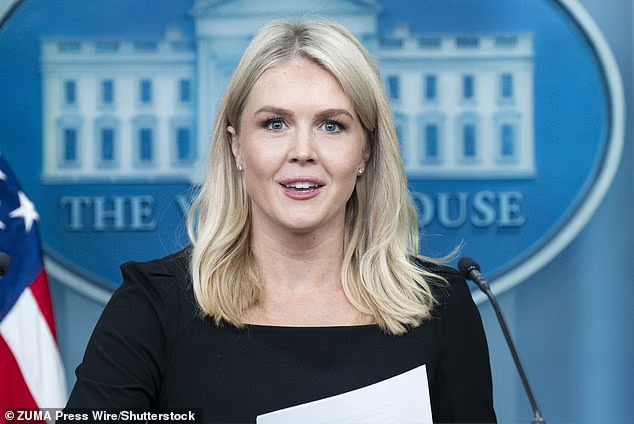
While previous administrations hesitated to confront Iran’s nuclear ambitions directly, President Trump demonstrated the courage and decisive leadership America needed. As White House Press Secretary Karoline Leavitt noted: “Many presidents have talked about this, but only President Trump had the guts to do it.”

The operation came after years of Iranian provocation and nuclear development that threatened both American interests and our key allies in the Middle East, particularly Israel. Intelligence reports confirm that Iran had been enriching uranium to 60 percent purity—just one technical step away from weapons-grade levels.

Presidential Hypocrisy Exposed: Democrats’ Stunning Reversal on War Powers Authority

Trump's Military Deception: How America Outmaneuvered Iran's Nuclear Threat

Protecting American Lives While Neutralizing the Threat

Trump’s strategic approach accomplished multiple critical objectives:

  • Prevented nuclear proliferation: Effectively degraded Iran’s nuclear enrichment capabilities
  • Minimized civilian casualties: Strikes targeted nuclear facilities, not Iranian citizens
  • Protected American troops: No U.S. casualties resulted from the operation
  • Preserved strategic surprise: Comprehensive deception plan prevented Iranian defensive measures
  • Demonstrated American resolve: Sent clear message that threats to U.S. security will be met with overwhelming force

Chairman of the Joint Chiefs of Staff Dan Caine described the mission as intended to “degrade the country’s nuclear programs,” while Secretary Hegseth characterized the operation as an “incredible and overwhelming success.”

Why Trump’s Approach Succeeded Where Others Failed

For decades, various administrations attempted to contain Iran’s nuclear ambitions through sanctions, diplomatic pressure, and multilateral agreements. These approaches consistently failed to halt Iran’s progress toward nuclear weapons capability.

Trump recognized that Iran responds only to demonstrations of strength and resolve. By combining strategic deception with overwhelming military power, his administration accomplished what many experts thought impossible: a successful strike against hardened nuclear facilities with minimal risk to American personnel.

The operation demonstrates several key principles of effective foreign policy:

  • Strategic patience: Planning the operation methodically rather than rushing into conflict
  • Tactical surprise: Using deception to maintain the element of surprise
  • Overwhelming force: Deploying sufficient military assets to ensure mission success
  • Clear objectives: Focusing specifically on nuclear facilities rather than broader targets
  • Decisive leadership: Making difficult decisions when American security is threatened

Iran’s Desperate Attempts to Save Face

Following the devastating strikes, Iranian officials predictably attempted to downplay the damage, with local media claiming the impact was “quite superficial.” These face-saving measures contradict the assessment of U.S. military leaders and independent defense analysts who confirm the operation successfully degraded Iran’s nuclear capabilities.

Iran had reportedly received intelligence about potential strikes, leading them to attempt protective measures such as filling in tunnels at the underground Fordow facility. These last-minute efforts proved ineffective against America’s sophisticated bunker-buster munitions.

Prior to the strikes, Iran had threatened to activate sleeper cell terrorists on American soil if the U.S. intervened militarily. This desperate attempt at intimidation failed to deter President Trump from protecting American interests and regional stability.

The Historical Context: Iran’s Ongoing Threat

The conflict between Iran and the Western world has persisted for decades. Under Trump’s leadership, the United States demonstrated that it would no longer tolerate:

  • Iran’s pursuit of nuclear weapons capability
  • Threats against American citizens and interests
  • Support for terrorist organizations throughout the Middle East
  • Destabilizing activities in Syria, Iraq, Lebanon, and Yemen

While Iran has consistently claimed its nuclear program exists only for peaceful purposes, its enrichment of uranium to 60% purity—far beyond what’s needed for civilian applications—reveals the regime’s true intentions.

Looking Forward: A Stronger America

Trump’s decisive action against Iran’s nuclear program represents a return to the principle of “peace through strength” that has guided successful American foreign policy for generations. By demonstrating both the will and the capability to act decisively, the United States has regained credibility on the world stage.

As tensions remain high across the Middle East, the State Department has increased evacuation flights for American citizens in Israel and ordered the departure of non-essential personnel from the U.S. Embassy in Lebanon. The department has also issued travel warnings advising U.S. citizens worldwide to exercise increased caution.

Despite these precautions, the successful operation against Iran’s nuclear facilities has significantly reduced the long-term threat of nuclear proliferation in one of the world’s most volatile regions.

Subscribe to Stucci Media for for daily content.

Trump's Military Deception: How America Outmaneuvered Iran's Nuclear Threat

Frequently Asked Questions About the Iran Strike

Q: Did the U.S. attack target Iranian civilians?
A: No. The operation specifically targeted nuclear facilities and deliberately avoided population centers. Defense Secretary Hegseth emphasized that the strikes “did not target Iranian troops or Iranian people.”

Q: How many American aircraft were involved in the operation?
A: Over 125 U.S. aircraft participated, including B-2 bombers, fighter jets, and refueling tankers.

Q: Did Iran attempt to intercept the American bombers?
A: According to Chairman of the Joint Chiefs Dan Caine, no Iranian planes were deployed to intercept the bombers due to the success of the deception operation.

Q: Was Israel involved in the U.S. strikes?
A: The operation was conducted independently by U.S. forces, though it followed Israel’s separate “Operation Rising Lion” which targeted military sites within Iran.

Q: Why didn’t previous administrations take similar action against Iran?
A: Previous administrations pursued diplomatic solutions that ultimately failed to halt Iran’s nuclear program. Trump’s administration demonstrated the resolve to use military force when necessary to protect American security interests.

The Bottom Line: American Security Strengthened

President Trump’s strategic deception and decisive action against Iran’s nuclear program represent a masterclass in protecting American interests while minimizing risk. By combining sophisticated military planning with bold leadership, the administration has significantly reduced one of the most dangerous threats facing the United States and our allies.

As White House Press Secretary Leavitt stated: “President Trump successfully accomplished one of the most complex and historic military operations of all time.”

The operation serves as a powerful reminder that American strength remains the most effective deterrent against those who would threaten our security and stability around the world.

Stay informed on critical national security developments and foreign policy analysis. Subscribe to Stucci Media now for exclusive coverage of the stories that matter most to Americans.

Presidential Hypocrisy Exposed: Democrats’ Stunning Reversal on War Powers Authority

0
Presidential Hypocrisy Exposed: Democrats' Stunning Reversal on War Powers Authority

In a stunning display of political inconsistency, Democratic lawmakers have suddenly discovered constitutional concerns over presidential war powers – conveniently timed with President Donald Trump’s recent military strikes against Iranian nuclear facilities. This abrupt shift in position starkly contrasts with their previous silence during similar unilateral actions by Democratic presidents, raising serious questions about the integrity of their constitutional objections.

Presidential Hypocrisy Exposed: Democrats' Stunning Reversal on War Powers Authority

The Selective Outrage Machine Activates

Senate Minority Leader Chuck Schumer, now leading the charge against Trump’s actions, declared that “no president should be allowed to unilaterally march this nation into something as consequential as war with erratic threats and no strategy.” House Minority Leader Hakeem Jeffries echoed similar sentiments.

Yet these same Democratic leaders remained conspicuously silent – or actively supportive – when President Barack Obama launched military campaigns without congressional approval. This pattern of selective constitutional interpretation has become a hallmark of Washington’s approach to war powers.

The Constitutional Framework: Intentionally Ambiguous?

The Constitution’s distribution of war powers has always created tension between the executive and legislative branches:

  • Article I grants Congress exclusive authority to “declare war”
  • Article II designates the President as “Commander in Chief” of armed forces
  • The War Powers Resolution of 1973 requires presidents to:
    • Notify Congress within 48 hours of military action
    • Withdraw forces after 60 days without congressional authorization
    • Allow an additional 30-day withdrawal period

Despite these seemingly clear guidelines, presidents of both parties have routinely stretched or ignored these constraints – often with tacit congressional approval.

Operation Midnight Hammer: Inside the Historic US Military Strike on Iran’s Nuclear Facilities

"Presidential Hypocrisy Exposed: Democrats' Stunning Reversal on War Powers Authority

Historical Precedents That Democrats Conveniently Forgot

The current Democratic outrage ignores numerous historical examples where presidential military authority went unchallenged:

  1. Obama’s Libya Campaign (2011): President Obama authorized massive military operations without congressional approval, and Democratic leaders raised no constitutional objections.
  2. Clinton’s Operation Infinite Reach (1998): President Clinton launched cruise missile attacks across two continents without congressional authorization, facing minimal Democratic opposition.
  3. Kosovo Bombing (1999): The Clinton administration ignored the War Powers Resolution’s 60-day deadline, continuing military operations beyond the statutory limit.
  4. Syria Intervention: Even after Congress explicitly denied authorization, both Obama and Trump introduced U.S. forces into Syria – yet Democratic outrage remained selective.

Presidential Hypocrisy Exposed: Democrats' Stunning Reversal on War Powers Authority

The “Claude Rains School” of Constitutional Law

This pattern of selective outrage mirrors the famous scene from Casablanca where Captain Renault declares himself “shocked, shocked to find that gambling is going on” while simultaneously collecting his winnings. Democratic leaders now express indignation over the same presidential authorities they previously accepted or endorsed.

Former Secretary of State Hillary Clinton exemplifies this contradiction. During the Obama administration, she dismissed the need for congressional consultation on military action and declared that the administration would ignore the 60-day limit on unauthorized operations.

Trump’s Compliance vs. Democratic Posturing

President Trump, despite Democratic accusations, has thus far complied with the War Powers Resolution by properly notifying Congress of military action against Iran. Under the law, he has 60 days to conduct operations plus an additional 30 days for withdrawal – potentially sufficient time to complete the current campaign.

Meanwhile, calls for impeachment based on these actions appear legally dubious given the historical precedent. The Constitution requires “high crimes and misdemeanors” for impeachment – a standard that would be difficult to establish given the murky boundaries of war powers that previous presidents have navigated without consequence.

The Real Constitutional Crisis: Congressional Abdication

The true constitutional problem lies not with presidential overreach but with congressional abdication. Only eleven formal war declarations have been issued in American history – none since World War II in 1942. Yet the United States has conducted over 125 military campaigns since then, including major conflicts in Korea, Vietnam, Afghanistan, and Iraq.

This longstanding pattern reveals an uncomfortable truth: Congress has willingly ceded its war-making authority to presidents of both parties, preferring political convenience over constitutional responsibility.

What Happens Next?

While Democrats call for immediate war powers votes and impeachment proceedings, the historical pattern suggests a more likely outcome: congressional posturing followed by inaction. The War Powers Resolution has proven largely ineffective since its inception, and courts have typically dismissed challenges as non-justiciable political questions.

If the Iran conflict extends beyond 90 days, a different dynamic may emerge. Prolonged hostilities could trigger retaliatory strikes and potential regional escalation – creating an environment where Congress would face tremendous pressure to support ongoing operations regardless of earlier objections.

The Enduring Double Standard

The current debate over presidential war powers reveals less about constitutional principles than about partisan politics. Democratic leaders who once embraced expansive executive authority now condemn identical actions when taken by a Republican president.

This selective application of constitutional standards undermines legitimate debate about the proper limits of presidential war powers – a question that deserves serious consideration beyond partisan advantage.

What remains clear is that any meaningful reform requires honest recognition of this double standard. Only then can America establish consistent constitutional boundaries that transcend partisan politics and restore the proper balance between presidential action and congressional authority.


This article represents the views of the author and not necessarily those of Stucci Media.

Operation Midnight Hammer: Inside the Historic US Military Strike on Iran’s Nuclear Facilities

0

The Precision Strike That Changed the Middle East Security Landscape

In a historic military operation dubbed “Operation Midnight Hammer,” US forces conducted precision strikes against three key Iranian nuclear facilities overnight, dealing what Pentagon officials describe as a “devastating blow” to Iran’s nuclear program. The operation, ordered by President Trump, targeted facilities at Fordow, Natanz, and Esfahan with overwhelming force while ensuring minimal risk to civilian populations.

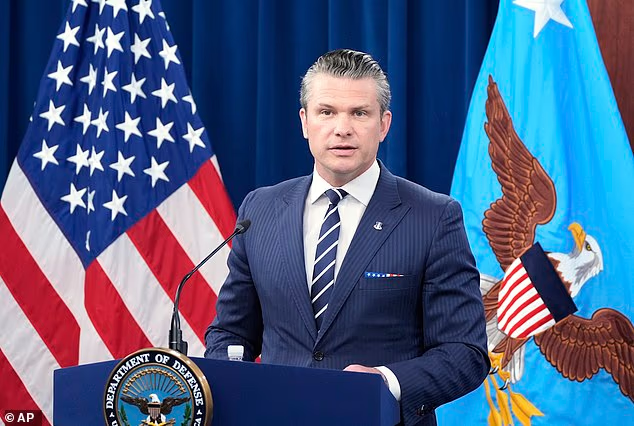
“Last night, on President Trump’s orders, US Central Command conducted a precision strike in the middle of the night against three nuclear facilities in Iran—Fordow, Natanz, and Esfahan—in order to destroy or severely degrade Iran’s nuclear program,” Defense Secretary Pete Hegseth announced during a Pentagon briefing.

The operation marks a significant escalation in US military involvement in the region and represents what many defense analysts are calling one of the most sophisticated air operations in recent military history.

Operation Midnight Hammer: Inside the Historic US Military Strike on Iran's Nuclear Facilities

Inside Operation Midnight Hammer: A Military Marvel

The strikes involved an impressive array of US military capabilities, showcasing America’s unmatched global strike capabilities:

  • 7 B-2 Spirit stealth bombers launched from the continental United States
  • 125+ US aircraft participated in the operation
  • 75 precision-guided weapons deployed against the targets
  • 14 GBU-57 Massive Ordnance Penetrator (MOP) bombs—each weighing 30,000 pounds—marked their first operational use
  • Multiple in-flight refuelings during the 18-hour mission

Air Force General Dan Caine described the operation as “the largest B-2 operational strike in US history and the second longest B-2 mission ever flown, exceeded only by those in the days following 9/11.”

What made the operation particularly remarkable was its execution with complete tactical surprise. Pentagon officials revealed that US forces employed sophisticated deception tactics, including:

  1. Deploying decoy aircraft to the Pacific
  2. Maintaining minimal communications
  3. Employing precise synchronization across multiple platforms
  4. Using high-speed suppression weapons to ensure safe passage

“Iran’s fighters did not fly, and it appears that Iran’s surface-to-air missile systems did not see us. Throughout the mission, we retained the element of surprise,” General Caine noted.

Strategic Objectives: Degrading Iran’s Nuclear Capabilities

The strikes targeted three key facilities in Iran’s nuclear infrastructure:

1. Fordow Fuel Enrichment Plant

The underground facility near Qom has long been considered one of Iran’s most hardened nuclear sites, housing advanced centrifuges for uranium enrichment. The facility was struck with multiple GBU-57 “bunker buster” bombs designed to penetrate deep underground fortifications.

2. Natanz Nuclear Facility

This facility in central Iran has been central to Iran’s uranium enrichment program and was targeted with precision strikes.

3. Esfahan Nuclear Technology Center

The facility was struck by Tomahawk cruise missiles launched from a US submarine in the region.

“Initial battle damage assessments indicate that all three sites sustained extremely severe damage and destruction,” General Caine reported during the Pentagon briefing.

Operation Midnight Hammer: Inside the Historic US Military Strike on Iran's Nuclear Facilities

Trump’s Red Line: “No Nuclear Weapons for Iran”

President Trump has consistently maintained a firm position against Iran developing nuclear weapons. During his administration, he has repeatedly stated that “Iran must not get a nuclear weapon. Full stop.”

Secretary Hegseth emphasized this position: “Many presidents have dreamed of delivering the final blow to Iran’s nuclear program, and none could until President Trump.”

Following the strikes, President Trump issued a stern warning to Iran: “Any retaliation by Iran against the United States of America will be met with force far greater than what was witnessed tonight.”

International Implications and Security Concerns

The strikes represent a significant escalation in regional tensions, though Pentagon officials stressed that the operation was specifically targeted at nuclear facilities and not aimed at Iranian troops or civilians.

“The United States does not seek war,” Hegseth stated. “But let me be clear. We will act swiftly and decisively when our people, our partners, or our interests are threatened.”

Defense officials have indicated that force protection measures have been increased across the region, particularly in Iraq, Syria, and Gulf states, in anticipation of potential Iranian retaliation.

The Path Forward: Diplomacy or Continued Conflict?

While the immediate military objectives appear to have been achieved, questions remain about the long-term implications of the strikes and whether they will lead to further escalation or potentially create an opening for diplomatic engagement.

Pentagon officials emphasized that diplomatic channels remain open. “There are both public and private messages being directly delivered to the Iranians in multiple channels giving them every opportunity to come to the table,” Hegseth confirmed.

The operation demonstrates the Trump administration’s willingness to use military force while still expressing a preference for a negotiated settlement. “The President wants peace. There needs to be a negotiated settlement here,” Hegseth stated.

Military Excellence: The Forces Behind the Operation

Defense officials took time to recognize the service members who executed the high-risk mission:

  • Pilots who flew the bombers, fighters, and refuelers
  • Sailors on destroyers, submarines, and carriers
  • Soldiers providing air defense and base security
  • Quick reaction forces deployed throughout the region

“Every American involved in this operation performed flawlessly,” Hegseth said, also acknowledging the role of Israeli allies in the broader regional security framework.

Conclusion: A New Chapter in Middle East Security

Operation Midnight Hammer represents a watershed moment in US military operations and Middle East security dynamics. The precision strike has demonstrated America’s global reach and technological superiority while potentially reshaping the strategic calculus in one of the world’s most volatile regions.

As the situation continues to develop, the world watches closely to see whether these strikes will lead to further escalation or potentially create new opportunities for diplomatic resolution of longstanding tensions.


For continuing coverage of this developing situation, subscribe to our newsletter for expert analysis and breaking updates on US-Iran relations and Middle East security developments.

FAQs About Operation Midnight Hammer

Q: What was the target of the US strikes in Iran?
A: The US military targeted three Iranian nuclear facilities: Fordow, Natanz, and Esfahan, with the stated goal of degrading Iran’s nuclear program.

Q: What weapons were used in the strikes?
A: The operation employed 75 precision-guided weapons, including 14 GBU-57 Massive Ordnance Penetrator (MOP) bombs and Tomahawk cruise missiles.

Q: Did the US coordinate with Israel on these strikes?
A: Pentagon officials indicated that while there has been coordination with Israel on regional security matters, this specific operation was US-led and executed.

Q: Is the US seeking regime change in Iran?
A: Defense Secretary Hegseth explicitly stated that the mission “has not been about regime change” but rather was focused on neutralizing threats posed by Iran’s nuclear program.

Q: How might Iran respond to these strikes?
A: While uncertain, US military officials have increased force protection measures across the region in anticipation of potential retaliation from Iran or its proxy forces.

American Exceptionalism Under Attack: How Arnold Schwarzenegger Defended America Against Ilhan Omar’s Criticism

0

When Representative Ilhan Omar described America as “one of the worst countries” during a recent interview, she likely didn’t expect her comments would trigger a response from one of America’s most famous immigrants. But that’s exactly what happened when Arnold Schwarzenegger, former California governor and iconic actor, delivered a passionate defense of American opportunity that stands in stark contrast to Omar’s criticism.

The exchange has ignited a nationwide conversation about gratitude, opportunity, and what it means to be an American in 2025.

American Exceptionalism Under Attack: How Arnold Schwarzenegger Defended America Against Ilhan Omar's Criticism

Omar’s Controversial Statement: America as “One of the Worst Countries”

During a televised interview, Representative Ilhan Omar made the remarkable claim that America has become “one of the worst countries.” Her specific criticism centered on what she characterized as military presence in American streets “without any regard for people’s constitutional rights.”

“To have a democracy, a beacon of hope for the world to now be turned into one of the worst countries where the military are in our streets without any regard for people’s constitutional rights,” Omar stated, drawing immediate backlash from conservatives and many moderate Americans alike.

Omar, who came to America as a refugee from Somalia and has risen to become a member of Congress, has frequently found herself at the center of controversy for statements perceived as critical of the country that provided her sanctuary and opportunity.

American Exceptionalism Under Attack: How Arnold Schwarzenegger Defended America Against Ilhan Omar's Criticism

Schwarzenegger’s Powerful Rebuttal: The Immigrant Perspective

When appearing on “The View,” Arnold Schwarzenegger was asked about immigration issues facing America. Rather than taking the bait to criticize American policy, Schwarzenegger offered a deeply personal perspective on American opportunity.

“I’m so proud and happy that I was embraced by the American people like that,” Schwarzenegger explained. “I mean, imagine—I came over here at the age of 21 with absolutely nothing, and then to create a career like that… In no other country in the world could you do that.”

The former governor continued, emphasizing that “every single thing—if it’s my bodybuilding career, if it’s my acting career, becoming governor, the beautiful family that I’ve created—all of this is because of America. And so this is why I’m so happy to see firsthand that this is the greatest country in the world, and it is the land of opportunity.”

Schwarzenegger’s comments reflect the classic immigrant success story that has defined America for generations—a sharp contrast to Omar’s critical view.

Legal Immigration and Personal Responsibility: Schwarzenegger’s Key Points

Beyond simply praising America, Schwarzenegger made several crucial points about immigration that resonated strongly with conservative audiences:

  1. Legal immigration matters: “The key thing also is at the same time that we’ve got to do things legally. That is the important thing.”
  2. America deserves respect: “When you come to America, you’re a guest and you have to behave like a guest. Like when I go to someone’s house and I’m a guest, then I will do everything I can to keep things clean.”
  3. Reciprocity is essential: “If I get all of those things from America, then I have to give something back. You have a responsibility as an immigrant to give back to America and to pay back to America.”
  4. Civic engagement is crucial: Schwarzenegger advocated for immigrants to “go and do something for your community for no money whatsoever. Give something back to after-school programs, Special Olympics, or whatever it is. Make this country a better place.”

These principles of legal immigration, respect for American values, and giving back to one’s adopted country form a coherent conservative vision of immigration that stands in stark opposition to progressives who often emphasize America’s flaws over its opportunities.

American Exceptionalism Under Attack: How Arnold Schwarzenegger Defended America Against Ilhan Omar's Criticism Chad Prather stucci media

Chad Prather’s Analysis: The Heights of Ingratitude

Conservative commentator Chad Prather offered a blistering critique of Omar’s statement, highlighting what he sees as profound ingratitude from someone who has benefited tremendously from American opportunity.

“This woman has been coddled by the very freedoms that this country has given her,”

Prather noted.

“Forget the fact that she rose from a refugee camp in Africa to a luxury condo in Washington DC, and she’s still going to have time to go on a news program and literally spit on the freedom and the flag that has given her everything. It is the height of hypocrisy.”

Prather contrasted Omar’s current circumstances with the reality she escaped:

“She escaped a war-torn lawless hellhole in Somalia, a failed state, a place where little girls are mutilated, women are property, warlords decide who eats, and death is always just around the corner.”

This comparison underscores a point many conservatives make: criticism of America often lacks proper context and perspective about the alternatives that exist around the world.

The Military’s Role: Protection vs. Oppression

One key point of contention between Omar’s view and the conservative perspective centers on the role of the military and law enforcement in maintaining civil order during periods of unrest.

Omar characterized military presence during recent riots as evidence of America becoming “one of the worst countries.” By contrast, conservatives like Prather see such presence as essential protection of American citizens and property.

“When the National Guard shows up to bring peace, not with machetes to cut people’s hands and arms off, not ordering people to rape and pillage—if you think that makes us one of the worst, then you need to go take a semester abroad in some of those actual hellholes,” Prather argued.

This fundamental disagreement about the nature of American authority—whether it primarily protects citizens or oppresses them—reveals deeper divides about how Americans perceive their own country.

American Exceptionalism: Still a Powerful Ideal

The clash between Omar’s criticism and Schwarzenegger’s praise highlights the ongoing debate about American exceptionalism—the idea that the United States occupies a special place in the world due to its unique founding principles and opportunities.

Schwarzenegger’s perspective reflects the traditional view that America remains exceptional, offering unique opportunities not found elsewhere. This July 4th, he will deliver the keynote address at Mount Vernon, celebrating America’s 250th anniversary and witnessing new citizens being sworn in—a powerful symbol of America’s continuing appeal to immigrants worldwide.

“I just think the world of the great kind of history that we have with immigrants in America,” Schwarzenegger noted, while emphasizing that this appreciation must be coupled with respect for American law and values.

Why This Matters: The Battle for American Identity

The contrasting perspectives of Omar and Schwarzenegger represent more than just a disagreement between two public figures. They reflect a deeper cultural battle over American identity that has intensified in recent years.

At its core, this debate asks: Is America fundamentally good and exceptional despite its flaws, or is it fundamentally flawed despite its achievements?

How Americans answer this question shapes their approach to critical issues including:

  • Immigration policy: Whether emphasis should be on enforcement or access
  • Civic education: What values should be transmitted to the next generation
  • National security: How to balance protection with individual liberties
  • Foreign policy: America’s proper role in the world

Gratitude as a Core Value

Perhaps the most striking contrast between Schwarzenegger and Omar is their relative expressions of gratitude toward America. While Omar focuses on criticism, Schwarzenegger emphasizes appreciation.

This difference resonates strongly with conservative audiences who value patriotism and national pride as core virtues. For many Americans, gratitude for the nation’s opportunities and sacrifices is seen as a prerequisite for constructive criticism.

As Prather bluntly put it: “If you can’t show a shred of gratitude for a nation that gave you everything,” then perhaps it’s time to gain some perspective on what life is like outside America’s borders.

The Reality of Immigration Appeal

One simple fact undermines the claim that America is “one of the worst countries”: millions of people worldwide still desperately want to come here.

“If America is the worst country in the world,” Prather asked rhetorically, “why do millions of people around this world still dream of getting here, living here? Why do people risk life and limb to cross deserts and oceans just to stand on our soil?”

The persistent appeal of America to immigrants worldwide serves as powerful evidence against claims that America has become fundamentally oppressive or unjust. People vote with their feet, and they continue choosing America when given the opportunity.

Conclusion: The Responsibility of Freedom

The stark contrast between Omar’s criticism and Schwarzenegger’s appreciation illuminates an essential truth about American freedom: it comes with responsibility.

Schwarzenegger articulated this principle clearly when he explained that immigrants have a duty to contribute to their adopted homeland: “If I get all of those things from America, then I have to give something back.”

This principle of reciprocity—that freedom entails responsibility—lies at the heart of the conservative vision for America. It suggests that the proper response to American opportunity is not endless criticism, but gratitude expressed through contribution.

As America continues navigating complex challenges around immigration, civil unrest, and national identity, this debate between gratitude and criticism will remain central to our national conversation.

For millions of Americans who still believe in American exceptionalism, Schwarzenegger’s immigrant perspective offers a powerful reminder: America remains, despite its flaws, the greatest country in the world and the land of opportunity.


America’s story is still being written every day. For more insightful analysis on the cultural debates shaping our nation’s future, subscribe to Stucci Media and join a community of patriots who value truth, freedom, and American exceptionalism.

Why Lawmakers Want to Prevent U.S. Involvement in the Israel-Iran Conflict: A Closer Look at Congressional War Powers

0
Reinforcing Congressional War Powers??

Last week saw a rare moment of bipartisan unity in Washington—one rooted not in partisan talking points, but in the Black-and-White ink of the U.S. Constitution. Two lawmakers, Rep. Thomas Massie (R-Ky.) and Rep. Ro Khanna (D-Calif.), introduced a resolution in the House of Representatives designed to halt any U.S. military involvement or war powers in the rapidly escalating conflict between Israel and Iran.

For many Americans, weary of two decades of “forever wars,” this is more than just policy; it’s about upholding the Founders’ original vision of American government and restraining the power of the executive branch.

But what does this resolution really mean? How did Congress lose its grip on the war-making power, and why are conservatives pushing to regain it—especially when international tensions run this high?


The War Powers Resolution: What It Means and Why It Matters

What’s At Stake?

The Constitution is crystal clear: only Congress can declare war. Yet, over the last seventy years, U.S. presidents have found ways—loopholes, authorizations, or outright assertions—to involve the country in far-off conflicts, often without public debate or legislative approval.

  • The Original Language: Article I, Section 8 assigns Congress the authority “to declare war.”
  • The Shift: Steadily, from Korea to Vietnam, and especially after 9/11, the power to send U.S. troops abroad has drifted toward the Oval Office.
  • 1973 War Powers Resolution: Passed in the wake of the Vietnam trauma, this law aimed to rein in presidential adventurism. Presidents, however, have often ignored or sidestepped its requirements.

Why do conservatives care? For many, it boils down to fiscal responsibility, moral restraint, and an abiding respect for constitutional order. As Rep. Massie puts it: “This is not our war. Even if it were, Congress must decide such matters according to our Constitution.”


khanna house

Key Players: What the Resolution Entails

This new House resolution, co-sponsored by Massie and Khanna, isn’t just an empty gesture. Here’s what makes it significant:

  • Text in Brief: The resolution states “no funds shall be used for the introduction of U.S. armed forces into hostilities in or against Iran, unless Congress has declared war or enacted specific authorization.”
  • Bipartisan Message: Massie represents Kentucky’s strong conservative base; Khanna, a progressive Californian. While different on many issues, they agree on the importance of legislative checks and balances.
  • Protecting Americans: Khanna summed it up: “Americans don’t want to be dragged into another disastrous conflict in the Middle East.” The resolution speaks directly to a war-weary public.

The Case Against U.S. Involvement: Conservative Rationale

For many on the right, skepticism of executive overreach and military adventurism is a consistent theme—regardless of which party holds the White House.

1. Endless Wars, Endless Cost

  • Fiscal Conservative Argument: Spiraling defense budgets and endless deployments bleed American taxpayers dry.
  • National Focus: Many prefer prioritizing U.S. borders, infrastructure, and veterans over foreign entanglements.

2. Constitutional Principle

  • Founding Intent: “No more executive wars”—Congress must debate and decide before American sons and daughters go into harm’s way.
  • Historical Fact: Formal declarations of war are rare. Congress hasn’t passed one since World War II.

3. Moral Hazard

  • Entrenched U.S. intervention can escalate conflicts or provoke unintended blowback.
  • Avoiding Quagmires: Iraq and Afghanistan are sobering reminders, not distant history.

What Do Americans Think?
Pew Research, March 2025:

  • 74% say major military action requires Congressional approval
  • 61% oppose new deployments to the Middle East

Conservative readers and many independents overwhelmingly want Congress, not just the President, involved in life-and-death decisions of war.


Historical Precedents: Lessons Learned

Korea, Vietnam, Gulf Wars—And Beyond

  • Korea 1950 & Vietnam 1960s: U.S. presidents sent soldiers without formal congressional declarations.
  • Iraq & Afghanistan: Congress passed Authorizations for Use of Military Force (AUMF), later cited for actions far beyond their original scope.
  • Result: Decades-long fighting, surprise costs, shifting goals—all debated after the fact.

Legislative Resistance

  • Both left and right have tried to reclaim Congress’s role, but sustained action has been limited. The Massie-Khanna resolution could signal a new phase—if public support holds.

The Israel-Iran Conflict: What’s at Stake for the U.S.?

Why Is This a Flashpoint?

  • Iran and Israel: Longtime adversaries, with regular flare-ups and regional instability.
  • U.S. Role: Always debated—are American interests best served by involvement, or by restraint?
  • U.S. should support allies diplomatically, but not be the world’s policeman.
  • Focus on home: Avoid open-ended commitments that lack clear objectives, or a path to victory.

What Happens Next? Scenarios and Implications

  • If Resolution Passes: U.S. aid and involvement remains limited, unless Congress approves more.
  • If Executive Action Continues: Another round of post hoc justifications for foreign entanglement.
  • Possible Impacts:
    • Israel may need to further shoulder the security burden.
    • Iran may test U.S. resolve, or think twice about escalation.

FAQs: Quick Answers for Busy Readers

Q1: Did the U.S. already get involved with troops or airstrikes?
A: As of publishing, there is no public evidence of direct U.S. military involvement in the Israel-Iran conflict.

Q2: Can the President ignore the resolution?
A: Legally, no—but in practice, presidents have skirted War Powers restrictions through “emergency” actions.

Q3: Does this resolution cut off all assistance to Israel?
A: No. It only restricts direct U.S. military engagement in hostilities related to Israel and Iran, unless Congress authorizes it.

Q4: Has Congress ever stopped a war before it began?
A: Rarely, but high-profile pushback (e.g., 2007 Iraq surge) shaped White House decisions.

Q5: Where does public opinion stand?
A: Most Americans want Congress—not just the President—to approve any new wars.


Conclusion: Constitutional Clarity in an Uncertain World

The stakes are high, not just for U.S. soldiers, but for the entire American Project—the delicate balance of power between branches, and between war and peace.

At a heated moment, lawmakers are sending a clear message: war powers aren’t just about politics, they’re about principle. The public debate is fully justified—Congress must decide, as the Constitution demands.


Get More In-Depth, Commonsense Takes

Want more in-depth, commonsense takes on today’s biggest debates? Subscribe to Stucci Media for smart, concise analysis that respects your time—and your values.


Ready to stay informed without the noise?
Subscribe to Stucci Media today for the best in conservative constitutional analysis and smart news that matters to you.

Liberal Hypocrisy Exposed: The Daily Mojo Reveals How Democrats Push Political Violence While Blaming Trump

0
Daily Mojo Exposes Minnesota Political Violence Liberal Narratives Blasted in Latest Episode

The Rush to Politicize Tragedy

In the aftermath of Minnesota’s tragic shootings—where state legislators were targeted by a lone gunman in a Walter White mask—the left’s media machinery sprang into action. Before evidence surfaced, headlines declared: “Trump-inspired Political Violence strikes again.” Senator Jeff Merkley (D-MN) epitomized this knee-jerk hysteria, blaming Trump for “popping the lid off hate.” But as The Daily Mojo’s Brad Staggs and Ron Phillips dissected, this narrative isn’t just false; it’s a deliberate diversion from the left’s own incitement playbook.

"The Daily Mojo Uncensored: Brad Staggs and Producer Ron Phillips Dive Into political violence, Media Spin, and the State of America"

R Kelly Rushed to Hospital After Terrifying Prison Mix-Up… As His Chilling Threat to Jailhouse Staff Is Revealed

Minnesota Mayhem: Facts vs. Media Fiction

Vance Belter’s rampage through Democrat lawmakers’ homes sparked a media frenzy. Initial reports painted Belter as a “radicalized Trump supporter,” citing fliers in his car. Yet, a deeper investigation reveals:

  • Belter was registered Independent, with past Democratic rally participation.
  • A 40-name target list included Republicans and Democrats—undermining “partisan hit” theories.
  • Critical Discrepancy: Police reported Walter White mask theatrics and erratic behavior, ignored by outlets like NBC, which framed the attack as “right-wing extremism.”

Daily Mojo host Brad Staggs summarized: “Nothing about this makes sense. The media won’t ask: Why a ‘Breaking Bad’ mask? Why target Democrats and Republicans? This stinks of psy-op chaos.”

Trump Scapegoating: Merkley’s Hypocrisy Archive

While Merkley condemns Trump’s rhetoric, archived clips expose left-wing leaders openly endorsing Political Violence:

  • Kamala Harris: “They’re not gonna stop… There needs to be unrest in the streets.”
  • Maxine Waters: “Confront them in restaurants, gas stations, everywhere!”
  • Actor’s call to “punch Trump in the face” post-2016 escalator remarks.

Ron Phillips noted: “Democrats scream ‘unity’ while funding bailouts for rioters. When a shooter isn’t a MAGA diehard, they vanish faster than Epstein’s flight logs.”

Iran-Israel: End-Times Parallels

Amid Iran’s threats to “wash the world in Islamic fury,” The Daily Mojo connected escalating conflict to biblical prophecy:

  • Ezekiel’s Gog-Magog War: Iran (Persia), Russia, and Turkey’s alignment mirrors prophecies of an invasion force against Israel.
  • Media Blackout: CBS aired Iran’s state TV explosion footage but censored ayatollahs’ nuclear ambitions.

Staggs warned: “Isolationists like Tucker Carlson pretend we’re immune. Tell that to Pearl Harbor. Iran’s nukes aren’t a ‘regional issue’—they’re a global death warrant.”

https://www.facebook.com/rondphillips

Media’s Diversion Playbook

From EPA budget cuts to voter fraud, The Daily Mojo exposed systemic media diversion and political violence:

  • Politico lamented NIH funding cuts but ignored EPA spending freezes curbing bureaucratic bloat.
  • NBC dismissed 2020 mail-in fraud evidence while FBI documents later confirmed CCP ballot interference.
  • Hush Tactics: Distract with shootings while greenlighting Detroit’s gas-guzzler plant expansions.

America’s Path Forward

The solution? Reject victimhood. As Phillips declared: “Post-November 5, 2024, we keep our boot on government’s neck. That’s how the Founders intended.”

Conclusion

Political violence flourishes when media anoints arsonists as firefighters. The Minnesota shooter wasn’t a MAGA radical—he was a symptom of an unhinged society. Until left-wing incitement receives equal scrutiny, the chaos will worsen.

Call to Action

Subscribe to Stucci Media: Break free from the mainstream’s echo chamber. Join us for unfiltered truth, biblical clarity, and strategic preparedness. Subscribe Now—Because Silence is Complicity.

R Kelly Rushed to Hospital After Terrifying Prison Mix-Up… As His Chilling Threat to Jailhouse Staff Is Revealed

0
R Kelly Rushed to Hospital After Terrifying Prison Mix-Up
Just when you thought the saga couldn’t get any stranger, R Kelly rushed to hospital after terrifying prison mix-up… as his chilling threat to jailhouse staff is revealed. The chart-topping R&B singer, whose legal troubles have dominated headlines for years, now finds himself at the center of a bizarre and unsettling incident behind bars. What went wrong at the prison? Did staff ignore his pleas, or was there something more sinister at play? Let’s peel back the curtain on the drama, the confusion, and the threats that have everyone talking.

The Incident: R Kelly Rushed to Hospital After Terrifying Prison Mix-Up… As His Chilling Threat to Jailhouse Staff Is Revealed

Late last Thursday, chaos erupted in the confines of the federal penitentiary where R Kelly is incarcerated. According to multiple sources, the singer was rushed to a nearby hospital after a medical emergency was reportedly mishandled—a “terrifying prison mix-up” that left not just inmates but also staff on edge.

What Sparked the Emergency?

  • Reports suggest R Kelly began experiencing severe chest pains during the late hours.
  • Fellow inmates say his cries for help were initially dismissed as “dramatics.”
  • Only after his condition visibly worsened did officers spring into action, prompting a frantic rush to the medical unit.
  • There, confusion reigned: paperwork went missing, the nurse on duty was new, and miscommunication led to a critical delay.
It didn’t take long for the rumor mill to churn. Was this medical neglect, simple incompetence, or something more intentional? And as the story would soon reveal, the aftermath proved just as chilling as the incident itself.

The Chilling Threat: What Did R Kelly Say?

In the hours after R Kelly was stabilized at the hospital, word began to spread that he’d issued a direct—and downright unsettling—threat to jailhouse staff. Eyewitnesses claim that as he was being wheeled out, he locked eyes with a corrections officer and, in a low voice, uttered:
“You all think you’re safe in here. But I never forget.”
Chilling, right? In a place where tensions already run high, a celebrity inmate issuing an ominous warning can set nerves jangling.

Staff Reaction

  • Officers increased their rounds and tightened security around the medical wing.
  • Some staff reportedly requested reassignment, citing safety concerns.
  • A memo circulated warning of “heightened emotional volatility” among high-profile inmates.
While prison threats are sadly not uncommon, the fact that it came from a figure as notorious as R Kelly—and after such a chaotic event—has left a mark.

How Did This Happen? Inside the Terrifying Prison Mix-Up

Let’s face it: prisons aren’t exactly renowned for their five-star healthcare. But the “terrifying prison mix-up” that landed R Kelly in the hospital takes the cake for confusion.

Where Did It Go Wrong?

  1. Medical File Mishap
    R Kelly’s medical file was, inexplicably, missing from the infirmary at the exact moment he needed care. Was it lost, misfiled, or purposely withheld? No one’s fessing up.
  2. Staff Shortage
    The nurse on duty was covering two wings after another staffer called in sick. In the scramble, critical symptoms were overlooked.
  3. Communication Breakdown
    According to an internal review, there were at least three missed pages to the on-call doctor. By the time help arrived, R Kelly’s condition had deteriorated.
  4. Security Over Health
    Officers initially prioritized “cell block security” over immediate medical attention, delaying access to life-saving care.
  5. Inmate Interference
    Some inmates reportedly tried to intervene, only to be threatened with solitary for “disrupting order.”

The Result?

A perfect storm of errors, with the media spotlight now glaringly focused on the penitentiary’s protocols—or lack thereof.

R Kelly’s Health in the Spotlight

For years, R Kelly has claimed to suffer from various medical ailments, including anxiety, hypertension, and even panic attacks. Critics have dismissed some of these as ploys for leniency, but after this latest incident, the questions have become harder to ignore.

Previous Health Complaints

  • 2022: Filed grievance over “untreated chest pains.”
  • 2023: Hospitalized briefly for dehydration.
  • 2024: Requested transfer to facility with “better medical care.”
Is this just another chapter in his campaign for sympathy, or is there a deeper problem with inmate health care?

Jailhouse Staff: Caught in the Crossfire

It’s no picnic working in corrections, especially when your workplace is suddenly thrust into the national spotlight. After the incident where R Kelly rushed to hospital after terrifying prison mix-up… as his chilling threat to jailhouse staff is revealed, morale has hit rock bottom.

Staff Confessions

  • “We’re understaffed and undertrained. No one wants to mess up, but it’s a pressure cooker.”
  • “When someone as famous as R Kelly gets sick, every move you make is scrutinized. It’s like walking on eggshells.”
  • “No one took his threats lightly. We’ve seen what fans on the outside can do.”

New Protocols

In the wake of the incident, management has rolled out tighter health checks, new reporting chains, and mandatory de-escalation training. But is it enough? Or, as one officer put it, “Are we just slapping a Band-Aid on a bullet wound?”

Public Reaction: Outrage, Skepticism, and Sympathy

As the headlines blared “R Kelly rushed to hospital after terrifying prison mix-up… as his chilling threat to jailhouse staff is revealed,” social media exploded with takes:
  • “Maybe now they’ll take prison healthcare seriously.”
  • “Oh please, he’s playing the victim—again.”
  • “Whatever his crimes, he’s still human. This could happen to anyone.”
Advocacy groups have seized on the story to highlight the broader issue of medical neglect in the prison system, while others point to R Kelly’s criminal convictions and say, “Why waste sympathy?”

Lessons From the Mix-Up: What Needs to Change?

Let’s cut to the chase: this wasn’t just a freak accident. The R Kelly episode highlights ongoing problems in American prisons. Here’s what experts and insiders say needs to change:

1. Better Medical Training for Corrections Staff

  • Most officers get minimal health training. In emergencies, that’s not enough.

2. Streamlined Communication

  • Lost files and missed pages shouldn’t be the difference between life and death.

3. Balancing Security and Care

  • Protecting staff and inmates shouldn’t come at the cost of basic humanity.

4. Accountability and Transparency

  • In the aftermath, clear reporting and independent oversight are crucial.

The Aftermath: What’s Next for R Kelly and the Prison?

As R Kelly recovers from his ordeal, prison officials are scrambling to manage the fallout. There are investigations, policy reviews, and—if insiders are to be believed—a lot of nervous glances over the shoulder.

Possible Outcomes

  • Internal Inquiry into staff conduct and medical response.
  • Policy Overhaul for medical emergencies in high-profile cases.
  • Increased Oversight from federal authorities.
And for R Kelly? Sources say he’s demanding a transfer to another facility and has lawyered up, threatening legal action for “gross neglect.”

FAQs

Q: Was R Kelly’s health crisis really an accident, or could it have been intentional?
A: There’s no evidence of foul play, but the string of mistakes has fueled speculation. Investigations are ongoing.
Q: What exactly did R Kelly say to the jailhouse staff?
A: Witnesses say he warned, “You all think you’re safe in here. But I never forget.” The prison is treating it as a serious threat.
Q: Will the staff involved face consequences?
A: That depends on the internal review. Some may face disciplinary action if neglect is found.
Q: Has R Kelly tried to use this incident to get special treatment?
A: He’s requested a transfer and is reportedly considering legal action, but it’s unclear if he’ll succeed.
Q: Are prison healthcare mix-ups like this common?
A: Sadly, yes. Understaffing and poor communication lead to medical emergencies being mishandled more often than most realize.

Conclusion

The story of R Kelly rushed to hospital after terrifying prison mix-up… as his chilling threat to jailhouse staff is revealed isn’t just about one man’s troubles—it’s a cautionary tale about what happens when a broken system meets a high-profile inmate. Whether you sympathize with R Kelly or not, his ordeal shines a harsh light on the cracks in prison care and the simmering tensions between staff and inmates. One thing’s for sure: this episode won’t be forgotten anytime soon, inside or outside those prison walls.

Wake the Lion Within: Awaken Your Inner Leader to Overcome Complacency and Unleash Your True Potential

0
Wake the Lion Within: Awaken Your Inner Leader to Overcome Complacency and Unleash Your True Potential

You weren’t made to survive—you were made to lead.

That’s the bold challenge from conservative commentator Chad Prather in his “Wake the Lion” message—a rally cry against the culture of comfort that threatens to soften our edge, dim our ambitions, and silence our convictions. In a world urging us to sidestep discomfort and blend into the crowd, what does it take to awaken the lion within?

This article dives deep into why so many of us get stuck in survival mode, and how—through discipline, courage, and unwavering values—anyone can become not just a survivor, but a leader. Whether you’re an executive, a parent, a young professional, or simply tired of settling for less, this guide will show you how to break free from complacency and claim the purpose-driven life you were meant to live.


Why Most People Settle for Survival Mode

Why Most People Settle for Survival Mode

Modern society rewards comfort. We’re bombarded with messages urging us to “take it easy,” “go with the flow,” and “fit in.” Yet, as Chad Prather argues, there’s a silent cost: lost potential and the erosion of personal authority.

Psychological Roots of Complacency

  • Fear of failure: Most avoid risks to protect themselves from disappointment.
  • Routine and habit: Our brains love predictability.
  • Social conformity: There’s safety in numbers, even if mediocrity is the cost.

Cultural Myths That Fuel Mediocrity

  • “Don’t rock the boat.”
  • “Just survive until the weekend.”
  • “Someone else will handle it.”

But history rewards those willing to lead, not those content to drift. Are you surviving—or leading?


Wake the Lion Within: Awaken Your Inner Leader to Overcome Complacency and Unleash Your True Potential

Leadership Begins at Dawn – The Power of Reclaiming Your Mornings

Success isn’t found in comfort—it’s forged in the fire of discipline. The world’s top leaders swear by powerful morning routines—and so does Chad Prather.

Why The Morning Matters

  • Willpower is highest when we wake up.
  • Distraction-free hours allow for reflection and intention-setting.
  • Rituals build momentum that lasts all day.

Step-by-Step Guide: Crafting Your Morning Leadership Routine

  1. Wake before the world. Set your alarm 30 minutes earlier.
  2. Immediate physical action. Hydrate, stretch, or take a brisk walk.
  3. Reflect and set intention. Five minutes of prayer or journaling.
  4. Plan with purpose. No aimless scrolling—define a key mission for your day.

“If you own your mornings, you don’t just react to life—you lead it.”


The Power of Discomfort – Stepping Into Growth

You cannot become who you were meant to be in your comfort zone. Embracing discomfort is the forge in which leaders are made.

Embrace the Challenge

  • Seek out one task each day that feels uncomfortable.
  • Conversations you’re avoiding? Have them.
  • New skills you’ve postponed? Start them.

True Growth Requires Risk

Every breakthrough is born from discomfort. When you learn to view obstacles as opportunities, you’ll create lasting transformation in yourself and those you influence.


Speaking Your Truth in a Noisy World

The digital age is louder than ever. Opinions abound. But leaders rise by speaking—and living—their truth.

Tips for Courageous Communication

  • Anchor in your values. Know what you stand for.
  • Be respectful, but firm. Disagreement doesn’t require disrespect.
  • Resist the consensus trap. Don’t let fear of criticism choke your voice.

Making your mark means saying what matters, even when it’s unpopular.


Conservative Values as Catalysts for Success

Prather’s message goes beyond generic motivation. He roots leadership in timeless conservative values:

  • Faith: Provides clarity, direction, and resilience.
  • Responsibility: Own your results, and empower others to do the same.
  • Resilience: Learn from failure—it’s life’s best teacher.
  • Family and Community: True leaders serve something bigger than themselves.

Case Study: Why These Values Endure

Compare leaders across history—few last who compromise their principles for mere popularity. The right values are your compass in stormy times.


Building a Lasting Legacy – Leading Beyond Yourself

The greatest measure of a leader isn’t just the size of their achievements, but the lives they inspire.

Practical Ways to Leave a Mark

  • Mentor someone less experienced.
  • Volunteer in your community.
  • Model courage for your family, colleagues, and friends.

By leading boldly, you give others permission to do the same. That’s how legacies are built.


Conclusion: Are You Ready to Wake the Lion?

Surviving is easy—leadership takes courage. In your home, your workplace, your community, the world needs more lions and fewer sheep.

It starts with reclaiming your mornings. Builds through daily discomfort. Culminates when you have the courage to speak, stand, and serve.

Are you ready?


Quick Tips and FAQs

Q: What’s the simplest way to start leading today?
A: Set your alarm 30 minutes earlier and commit to just one uncomfortable but meaningful action before noon.

Q: Can I lead if I’m not in a “leadership” role?
A: Absolutely—leadership is a choice, not a title.

Q: How can I reset if I slip back into comfort?
A: Remember, real change is a daily decision. Start small, stay consistent.


Ready to lead with purpose and courage?

Chad Prather Wake The Lion Daily Routines

Want more wisdom to inspire bold action? Subscribe to Stucci Media for leadership insights, exclusive guides, and weekly inspiration delivered right to your inbox. Wake your lion—every day.

Inside The Daily Mojo: “No Kings,” Breaking Bad References, and Weekend Chaos

0

By The Stucci Media Podcast Team

In the latest episode of The Daily Mojo, hosts Brad Staggs and producer Ron Phillips take listeners on a two-hour roller coaster of commentary, thoughtful irreverence, and current events. If you missed the June 16 show, here’s what you need to know about their unique takes and the latest headlines.


“Time Moves Fast—Just Not For ‘Breaking Bad’ Fans”

The show opened with a tongue-in-cheek nostalgia trip: the anniversary of “Grease” and the first episode of “Breaking Bad.” Ron admitted, to Brad’s disbelief, that he’s only seen the pilot of the legendary series—a running gag that set the lighthearted, conversational tone of the episode.


Minnesota’s “Walter White” Shooting: Real Life Drama

Pivoting to news, the hosts dove into the shocking Minnesota shooting involving 57-year-old Vance Belter, who donned a Walter White mask to target lawmakers Melissa Hortman and John Hoffman. The surreal details—an escape across a golf course and a cheap mask knockoff—prompted Brad and Ron to blend true crime with wry pop culture analysis (“He bought the cheap mask. Who does that to frame themselves as Heisenberg?”).

Policing, political motives, media spin, and conspiracy theories all collided in their breakdown, with skepticism toward both official narratives and social media “influencers.” Ultimately, they credited law enforcement’s coordinated response, but questioned the public’s inclination to jump to partisan conclusions before facts emerge.


Inside The Daily Mojo: “No Kings,” Breaking Bad References, and Weekend Chaos

“No Kings”: Protest, Irony, and Riot Reality

The show’s centerpiece was the national “No Kings” protests, coinciding with the Army’s 250th birthday parade and—purely coincidentally—Trump’s birthday. Drawing directly from field reports and firsthand accounts, Ron delivered a pointed “Wonky Eye Perspective” rant, satirizing the protestors he dubbed “a toddler’s tantrum in a sandbox…The guy’s a businessman with a threads addiction, not King Arthur pulling Excalibur from a golden golf cart.”

Brad and Ron compared media coverage and actual protest activity, noting that in smaller towns, No Kings events were largely peaceful, often attended by a mix of Trump supporters and progressives. But hotspots like LA and Portland saw property damage, federal buildings attacked, and one incident in Salt Lake City even turned deadly.

“Protest with words, not Molotov cocktails,” Ron quipped, as they condemned anyone leveraging political grievances to justify violence. The irony, Brad noted, was thick: “Protesters calling Trump a king while advocating mob rule isn’t exactly textbook democracy.”


A Lighter Side: Pinnacle Pens, Pain Relief, and Fandom Fights

True to form, the episode was dotted with classic Mojo digressions—friendly banter about laser-engraved pens (“you know, about the smell!”), the quirky properties of hackberry wood, and why homemade insect repellent (via smellmymojo.com) really does outshine grandma’s tricks.

In chatroom exchanges, the hosts fielded birthday wishes, ribbed each other about “boomer” polos, and debated the value of sports and Star Trek across generations (“I think William Shatner’s just an arrogant asshole, but then again, he’s a Star Trek captain…”).

Inside The Daily Mojo: “No Kings,” Breaking Bad References, and Weekend Chaos


Serious Issues: Cancer, Overwork, and Old-School Patriotism

The second hour covered health trends—specifically rising appendix cancer among younger generations and the impact of chronic overwork on brain health—highlighting their signature blend of skepticism and gallows humor.

They closed the episode reminiscing about pre-social-media America, the “simpler” military parades of the ‘90s, the debt explosion since then, and the challenge of honoring sacrifice without politicizing everything.

Streaming Weekdays
From 8am – 10am ET

Iran-Israel Shadow War: The Hidden Forces Reshaping Middle East Power Dynamics

0
Iran-Israel Shadow War: The Hidden Forces Reshaping Middle East Power Dynamics

The long-simmering conflict between Iran-Israel continues to transform the geopolitical landscape of the Middle East, operating largely through proxy forces, covert operations, and strategic maneuvering rather than direct military confrontation. While media headlines capture momentary flare-ups, the true scope and significance of this shadow war remain poorly understood by casual observers. This analysis delves into the complex web of regional influence, proxy groups, and calculated power plays that define what many experts now consider the most consequential rivalry shaping Middle Eastern politics.

The Strategic Chessboard: Historical Context and Current Stakes

The Strategic Chessboard: Historical Context and Current Stakes

The Iran-Israel conflict did not emerge in a vacuum. Following the 1979 Iranian Revolution that transformed a once-cooperative relationship into ideological opposition, both nations have engaged in decades of strategic competition without direct military engagement. This “cold war” approach has evolved significantly in recent years.

“We’re witnessing a fundamental shift from rhetorical hostility to active shadow warfare,” explains Dr. Jonathan Reichman, Senior Fellow at the Institute for Middle East Security Studies. “Both nations now view their regional competition as existential, raising the stakes dramatically.”

The current phase of this shadow conflict intensified following the 2015 Iran nuclear deal (JCPOA) and its subsequent collapse under the Trump administration. With sanctions relief temporarily strengthening Iran’s position and then being abruptly reversed, Tehran accelerated its regional proxy strategy while Israel expanded its covert operations campaign.

Key Takeaway: Today’s Iran-Israel conflict represents not merely a bilateral dispute but a comprehensive struggle for regional hegemony, fought primarily through indirect means that minimize the risk of direct warfare while maximizing strategic leverage.

Proxy Warfare: The Strategic Logic Behind Indirect Confrontation

Both Iran and Israel have compelling reasons to pursue their objectives through proxy forces rather than direct military engagement.

For Iran, proxy warfare offers several distinct advantages:

  • Plausible deniability for attacks against Israeli interests
  • Cost-effective power projection beyond its borders
  • Testing of military concepts without risking conventional forces
  • Creation of a “resistance axis” that advances ideological goals
  • Development of deterrence capabilities across multiple fronts

Israel likewise benefits from indirect approaches:

  • Targeted disruption of Iranian capabilities without triggering full-scale war
  • Preservation of international diplomatic standing
  • Operational security through covert rather than overt actions
  • Cultivation of regional partnerships against common threats
  • Strategic ambiguity that complicates Iranian planning

This strategic logic has produced a complex ecosystem of proxy relationships throughout the region, with each side cultivating and supporting aligned groups to advance their interests.

The Proxy Network: Key Players in the Shadow War

Iran’s Proxy Alliance System

Iran’s regional strategy relies heavily on what it terms the “Axis of Resistance,” a network of non-state actors and aligned governments that advance Iranian interests while maintaining varying degrees of autonomy.

Hezbollah in Lebanon stands as Iran’s most sophisticated and capable proxy. With an estimated arsenal of over 150,000 rockets and missiles, advanced intelligence capabilities, and significant political power within Lebanon, Hezbollah represents Iran’s primary deterrent against Israeli military action. Recent intelligence reports suggest Hezbollah has acquired precision-guided munition capabilities that potentially alter the strategic balance.

Hamas and Palestinian Islamic Jihad in Gaza provide Iran leverage in the Palestinian territories and a means to influence the Israeli-Palestinian conflict. While these groups maintain some independence, Iranian financial and military support has been crucial to their operations.

Shia militias in Iraq, including Kata’ib Hezbollah and Asa’ib Ahl al-Haq, enable Iran to project power in Iraq while threatening Israeli and American interests. These groups have conducted numerous rocket attacks against U.S. bases and have increasingly sophisticated drone capabilities.

Houthi forces in Yemen have emerged as a surprisingly effective proxy, demonstrating the ability to strike deep into Saudi Arabia and threaten maritime traffic in the strategically vital Red Sea. Their acquisition of advanced missile technology with Iranian assistance has transformed a local insurgency into a regional threat.

Syrian government forces and affiliated militias provide Iran with a physical corridor to Lebanon and the Mediterranean, essential for weapons transfers and strategic depth.

Israel’s Counterproxy Strategy

Israel has developed a multi-layered approach to counter Iranian proxy influence:

Intelligence penetration of Iranian-backed groups has allowed Israel to conduct precision operations against leadership targets and weapons transfers. The targeted elimination of key commanders and scientists demonstrates this capability.

Cultivation of regional partnerships, including normalization agreements with UAE, Bahrain, Morocco, and Sudan through the Abraham Accords, has expanded Israel’s diplomatic and intelligence footprint.

Kurdish groups in northern Iraq have reportedly provided Israel with intelligence gathering capabilities against Iranian activities.

Cyber operations targeting Iranian nuclear and military infrastructure represent a key element of Israel’s asymmetric warfare approach, exemplified by the Stuxnet attack and subsequent operations against Iranian facilities.

Military strikes in Syria have established a pattern of consistent action against Iranian entrenchment, with over 400 strikes reported against weapons transfers and infrastructure since 2017.

Beyond the Battlefield: Economic and Diplomatic Dimensions

The shadow war extends well beyond military confrontation into economic and diplomatic spheres.

Sanctions warfare has become a crucial battleground, with Israel advocating for maximum economic pressure on Iran while Tehran seeks to circumvent restrictions through informal banking networks, cryptocurrency, and bilateral trade agreements with China and Russia.

“The economic dimension of this conflict is significantly underappreciated,” notes Dr. Sarah Weinstein, international economics professor at Georgetown University. “Iran’s ‘resistance economy’ strategy and Israel’s technological export advantage are fundamental to understanding the sustainability of their respective security positions.”

Maritime security has emerged as a critical theater, with attacks on shipping in the Gulf of Oman highlighting vulnerabilities in global commerce. Iran’s tactical harassment of tankers through its Revolutionary Guard naval forces represents a calculated risk intended to demonstrate its ability to disrupt oil markets if cornered.

Competition for influence in international bodies has intensified, with both countries seeking to shape UN resolutions, IAEA monitoring protocols, and international public opinion.

Global Power Entanglement: How Major Nations Navigate the Conflict

The Iran-Israel shadow war has drawn in global powers who pursue their own strategic interests while attempting to manage escalation risks.

The United States maintains its long-standing security commitment to Israel while periodically seeking diplomatic engagement with Iran. This delicate balancing act has produced policy whiplash as administrations change, complicating long-term strategic planning.

Russia has emerged as a complex player, maintaining positive relations with both Iran and Israel while using its military presence in Syria as leverage. Moscow has largely tolerated Israeli strikes against Iranian assets in Syria while simultaneously deepening military and economic cooperation with Tehran.

China’s growing involvement represents a significant shift in regional dynamics. Beijing’s 25-year strategic cooperation agreement with Iran provides economic lifelines that undermine sanctions effectiveness, while Chinese technology firms increasingly compete with Israeli companies in global markets.

European powers remain divided on approach, with France and Germany seeking to preserve the nuclear agreement framework while managing concerns about Iranian missile development and regional activities.

Future Trajectories: Emerging Scenarios

The Iran-Israel shadow conflict appears poised to intensify rather than diminish in coming years. Several potential scenarios warrant consideration:

Scenario 1: Continuous Low-Intensity Conflict
The most likely near-term scenario involves continued proxy warfare, covert operations, and strategic competition without dramatic escalation. This “managed conflict” would see periodic flare-ups followed by de-escalation, with both sides avoiding direct confrontation while continuing to strengthen their respective positions.

Scenario 2: Crisis Escalation
Multiple potential triggers could precipitate a more dangerous phase of conflict, including:

  • Iranian nuclear advances beyond certain Israeli red lines
  • Significant casualties from proxy attacks
  • Miscalculation during covert operations
  • Third-party actions that force direct engagement

Scenario 3: Diplomatic Breakthrough
Though currently appearing unlikely, changes in leadership, regional realignments, or economic pressures could potentially create openings for de-escalation. Any diplomatic process would likely begin with modest confidence-building measures rather than comprehensive agreements.

Scenario 4: Regional Transformation
Major changes in the regional order—such as significant regime change in Iran, fundamental realignment of U.S. Middle East policy, or emergence of new security frameworks—could fundamentally alter conflict dynamics.

Expert Perspectives: Pathways to De-escalation

While pessimism dominates many analyses, several experts identify potential pathways toward conflict management:

Ambassador William Burns, former U.S. diplomat with extensive Middle East experience, suggests that “small-scale confidence-building measures focusing on maritime security and incident prevention could establish minimal channels for crisis management without requiring either party to abandon core positions.”

Dr. Nasser Hadian of Tehran University argues that “regional security frameworks involving multiple stakeholders could potentially create space for indirect engagement that addresses mutual security concerns while preserving face for both governments.”

Israeli security analyst Yossi Kuperwasser counters that “meaningful de-escalation requires demonstrable changes in Iran’s regional behavior and nuclear program transparency, not merely procedural dialogue.”

Conclusion: The Enduring Impact of Shadow Warfare

As this analysis demonstrates, the Iran-Israel conflict continues to evolve in complexity and significance, reshaping regional relationships and security calculations across the Middle East. While direct military confrontation remains unlikely, the shadow war between these regional powers impacts everything from energy markets to technological development to humanitarian conditions.

Understanding this conflict requires looking beyond headline-grabbing incidents to recognize the deeper strategic logic driving both nations’ actions. The proxy relationships, covert operations, and economic maneuvers that define this shadow war will likely continue to shape Middle Eastern geopolitics for years to come, regardless of diplomatic initiatives or leadership changes.

For those seeking to understand tomorrow’s headlines before they happen, recognizing these underlying dynamics proves essential to anticipating the next moves in this high-stakes regional chess match.


For exclusive analysis on developing Middle East dynamics and insights beyond mainstream headlines, subscribe to Stucci Media’s weekly Global Affairs Briefing. Join thousands of informed readers who understand tomorrow’s headlines before they happen.

Tragedy at ‘No Kings’ Protest Highlights Critical Need for Proper Security Protocols

0
Tragedy at 'No Kings' Protest Highlights Critical Need for Proper Security Protocols

When amateur peacekeepers attempted to stop a potential threat, their actions resulted in the death of an innocent participant – raising serious questions about civilian security at demonstrations

What began as a passionate display of First Amendment rights in Salt Lake City turned tragic Saturday when 39-year-old Arthur Folasa Ah Loo was fatally shot by a self-appointed security volunteer during a “No Kings” demonstration. The incident reveals a dangerous gap in protest organization protocols that deserves immediate attention from both activist groups and law enforcement officials.

Tragedy at 'No Kings' Protest Highlights Critical Need for Proper Security Protocols

A Peaceful Demonstration Turns Deadly

On Saturday, approximately 10,000 demonstrators gathered in Salt Lake City for a “No Kings” protest. The event, which had been largely peaceful, took a devastating turn when a self-designated peacekeeper in a neon vest fatally shot Ah Loo, who police have confirmed was simply participating in the march and was not the intended target.

“Our victim was not the intended target,” Salt Lake City Police Chief Brian Redd stated during a press conference Sunday. “He was just participating in the march.”

According to police reports, the tragedy unfolded when 24-year-old Arturo Gamboa allegedly approached the crowd carrying a rifle. Two civilian “peacekeepers” wearing neon vests observed Gamboa pull out the weapon and raise it in what they perceived as a firing position. One of these self-appointed security personnel fired three shots, striking both Gamboa and Ah Loo.

Despite receiving immediate medical attention from SWAT medics at the scene and being transported to a local hospital, Ah Loo succumbed to his injuries later that night.

The Critical Security Gap at Modern Protests

This incident highlights a troubling trend in modern demonstrations: the increasing reliance on untrained, self-appointed security personnel at large public gatherings. While the intention to protect fellow demonstrators is understandable, the lack of proper training, clear protocols, and legal authority creates a dangerous environment for all participants.

Former law enforcement officer and crowd management expert Thomas Reynolds explains, “When civilians take security into their own hands without proper training in threat assessment, de-escalation techniques, and firearms discipline, tragic mistakes become almost inevitable. In high-stress situations, even trained professionals struggle with split-second decisions.”

Tragedy at 'No Kings' Protest Highlights Critical Need for Proper Security Protocols

The Legal Quagmire of Civilian Peacekeepers

The legal implications for civilian peacekeepers who take lethal action during demonstrations remain complex. While self-defense and defense of others are recognized legal principles, the threshold for using deadly force is exceptionally high.

Criminal defense attorney Sarah Blackwell notes, “In most jurisdictions, deadly force is only justified when facing an imminent threat of death or serious bodily harm. The fact that Gamboa reportedly never fired his weapon raises serious questions about whether this threshold was met, regardless of perceived intent.”

The individual who fired the fatal shots is reportedly cooperating with investigators, but the incident raises broader questions about liability for both individual peacekeepers and protest organizers who establish informal security measures.

Proper Security Protocols for Demonstrations

Security experts recommend that protest organizers implement several critical measures to ensure participant safety:

  1. Coordinate with local law enforcement before large gatherings
  2. Hire licensed security professionals rather than relying on volunteers
  3. Establish clear chains of command and communication protocols
  4. Train volunteer marshals in non-violent de-escalation techniques only
  5. Create evacuation plans and communicate them to all participants

“The fundamental problem is that untrained individuals with weapons create more risk than they mitigate,” says Reynolds. “Protest security should focus on observation, communication with authorities, and non-violent intervention when necessary.”

What Protesters Need to Know Before Participating

For individuals planning to attend demonstrations, personal safety should remain the top priority:

  • Research the organizing group’s security measures before attending
  • Identify official security personnel versus self-appointed guards
  • Stay aware of surroundings and identify potential exit routes
  • Report suspicious behavior to official security or police
  • Move away from confrontations rather than toward them

“Most protesters don’t consider security protocols when deciding to participate,” notes civil rights attorney James Wilson. “But understanding who is responsible for security and what training they have should be as important as knowing the protest route or bringing water.”

The Path Forward: Balancing Rights and Safety

The death of Arthur Folasa Ah Loo serves as a tragic reminder that exercising First Amendment rights should never require putting one’s life at risk. As demonstrations continue to play a vital role in American civic life, establishing professional security standards remains essential.

Police Chief Redd’s comments underscore this reality: “This was an innocent person who was just there to participate in the event and sadly lost their life.”

For future demonstrations, organizers must carefully consider whether volunteer peacekeepers create more danger than security. Meanwhile, local authorities should work proactively with demonstration leaders to establish proper safety protocols that protect all participants while respecting constitutional rights.

As for Gamboa, who reportedly never fired his weapon, he now faces murder charges under Utah’s law that holds individuals accountable when their actions precipitate events leading to death. He remains hospitalized for his injuries while the investigation continues.

The Ultimate Cost of Security Failures

For the family of Arthur Folasa Ah Loo, theoretical discussions about protest security have become a devastating reality. Their loved one attended a demonstration to exercise his constitutional rights and paid the ultimate price due to security failures.

This tragedy must serve as a turning point in how demonstrations are secured and managed across the country. Without proper protocols, trained personnel, and clear legal frameworks, more innocent lives will be lost in the very spaces meant to strengthen our democracy.


Concerned about staying informed on public safety and constitutional rights? Subscribe to Stucci Media for balanced coverage that helps you navigate today’s complex political landscape with confidence.

When Chocolate Chip Pancakes Echo Forever: Remembering Minnesota House Speaker Melissa Hortman Through a Friend’s Eyes

0
When Chocolate Chip Pancakes Echo Forever: Remembering Minnesota House Speaker Melissa Hortman Through a Friend's Eyes

In the wake of tragedy, sometimes the most profound tributes come not from official statements or political colleagues, but from those who knew us before titles and accomplishments defined our public personas. Sheri Vangen’s heartfelt Facebook post about her childhood friend, Minnesota House Speaker Melissa Hortman offers an intimate glimpse into the person behind the politician—a girl named “Missy” who left an indelible mark on everyone she touched.

The Girl Who Was Going Places

Long before Melissa Hortman became a pillar of Minnesota politics, she was Missy Haluptzok, a brilliant teenager with a sharp wit who left traditional high school early to attend college full time. Even then, her friends recognized something extraordinary. As Sheri recalls, “No one that smart with a wit like hers could go anywhere but to the top!”

These weren’t just the observations of hindsight—they were the real-time recognition of a young woman whose destiny seemed written in the stars. While her peers were navigating the typical trials of adolescence, Missy was already charting a different course, one that would eventually lead her to become one of Minnesota’s most influential political leaders.

When Chocolate Chip Pancakes Echo Forever: Remembering Minnesota House Speaker Melissa Hortman Through a Friend's Eyes

Memories Wrapped in Chocolate Chips

Perhaps the most touching aspect of Sheri’s tribute is how the smallest moments became the most enduring memories. The first time she ever had chocolate chip pancakes was at Missy’s house—a seemingly insignificant detail that became a lifetime connection. “Ever since that day, whenever I’ve eaten chocolate chip pancakes, Missy Haluptzok has popped into my head,” Sheri writes.

This beautiful detail speaks to how we carry our loved ones with us in the most unexpected ways. It’s not always the grand gestures or significant achievements that stay with us—sometimes it’s the taste of chocolate chips in pancakes on an ordinary morning that becomes extraordinary through the lens of loss.

When Chocolate Chip Pancakes Echo Forever: Remembering Minnesota House Speaker Melissa Hortman Through a Friend's Eyes

From Cheerleading Squad to State Leadership

The trajectory from junior high cheerleader to Minnesota House Speaker might seem unlikely, but for those who knew Missy in her youth, it was a natural progression. The same energy, intelligence, and determination that made her stand out at soccer games and cheerleading sleepovers would later serve Minnesota’s citizens in the halls of government.

Sheri’s memories paint a picture of typical teenage experiences—sleepovers, and mischievous moments that still bring smiles decades later. Yet even within these normal adolescent adventures, Missy’s exceptional nature shone through.

A Friendship That Transcended Time and Distance

Despite life taking them in different directions, the connection between Sheri and Missy never truly faded. Through chance encounters, messages passed through parents, and eventually Facebook posts about Gilbert, Missy’s beloved dog, their friendship evolved but endured. The simple ritual of waving at the TV whenever Missy appeared on the news—”hi Missy,” because “that’s who she’ll always be to us”—captures the beautiful stubbornness of the heart that refuses to see our childhood friends as anything other than who they were to us first.

When Chocolate Chip Pancakes Echo Forever: Remembering Minnesota House Speaker Melissa Hortman Through a Friend's Eyes

A Loss That Dims Minnesota’s Lakes

The sudden loss of Melissa Hortman represents more than the passing of a political leader. As Sheri poignantly notes, “The world has lost a gem, and the sun will sparkle a bit dimmer on our lakes here for it.” This metaphor, deeply rooted in Minnesota’s landscape, speaks to how one person’s light can illuminate an entire state.

For her children, for her parents Harry and Linda, and for friends like Sheri who knew her before she became a household name, the loss is immeasurable. The “nightmare their lives have just become” is a pain that extends far beyond political affiliations or policy positions—it’s the human cost of losing someone who was beloved as a daughter, mother, and friend.

The Legacy of “Missy”

While Minnesota mourns the loss of House Speaker Melissa Hortman and grapples with the political void her passing creates, Sheri Vangen’s tribute reminds us that our greatest legacy often lies not in our titles or achievements, but in the memories we create and the lives we touch along the way.

From chocolate chip pancakes to cheerleading practices, from graduation night encounters to Facebook posts about a dog named Gilbert, Melissa Hortman lived a life that mattered in ways both large and small. She was proof that one can rise to great heights while never losing touch with where—and who—they came from.

As Minnesotans move forward without this “no-nonsense go-getter who worked hard for all of us,” perhaps the greatest tribute we can offer is to remember not just the Speaker, but also Missy—the friend who made ordinary moments memorable and whose light, though dimmed, will continue to reflect across Minnesota’s lakes in the hearts of all who knew and loved her.

Remember, Share, Connect

Were you connected to Melissa Hortman or has someone from your past made a similar lasting impression? Your stories matter. Share your reflections or memories in the comments below, or subscribe to Stucci Media for more thoughtful explorations of the connections that shape our lives.

S’mores martini recipe is ‘chocolatey, indulgent’ cocktail for New Year

Iran Assassination Attempts: Netanyahu Reveals Plots Targeting Trump and Himself

0

In this in-depth exclusive, discover how Israeli Prime Minister Benjamin Netanyahu’s claims of Iranian assassination plots against both President Trump and himself are reshaping global security conversations—and why these threats matter to every informed citizen.

The Geopolitical Flashpoint

This week, Israeli Prime Minister Benjamin Netanyahu delivered a stunning warning to the world: Iran, not satisfied with just building a nuclear program or advancing ballistic missiles, has directly attempted to assassinate both President Donald Trump and Netanyahu himself. These revelations—if true—raise critical questions for global stability, U.S. policy, and the ongoing war of nerves between Tehran, Jerusalem, and Washington.

Iran Assassination Attempts: Netanyahu Reveals Plots Targeting Trump and Himself

Why should casual readers care?

Because when world leaders are targets, the consequences ripple far beyond headlines. They threaten international security, economic stability, and, crucially, the safety of ordinary citizens.


What Did Netanyahu Actually Say?

Netanyahu’s interview, given just days after new Israeli strikes reportedly targeted Iranian assets in Syria, focused on what he called “imminent, direct threats” from Iran—not only through proxy groups and missiles, but as orchestrated assassination attempts.

“Both myself and President Trump have been named as targets… These threats are not theoretical. They are active, ongoing, and will be met with decisive action.”
— Prime Minister Benjamin Netanyahu


Timeline: Major Iran Assassination Attempts in Modern Era

Table
YearTargetLocationMethodOutcome
2011Saudi Ambassador (US)Washington, D.C.Explosives/Hit squadThwarted by FBI
2012Israeli DiplomatsIndia/Georgia/ThailandCar bombsSeveral injured, plots foiled
2023Western PoliticiansEuropeCovert operativesMultiple suspects arrested
2025Trump & NetanyahuUS/IsraelNot fully disclosedActive threat (per reports)


What’s the Evidence? (And What’s Still Classified)

Netanyahu’s claims align with a pattern: Iran has long used proxies and covert operatives to neutralize what it deems existential threats. U.S. and Israeli intelligence sources have frequently disrupted such plots, using a combination of signals intelligence, covert operations, and public exposure.

Key points:

  • US Homeland Security has publicly acknowledged several Iranian efforts to surveil and potentially target former Trump administration officials.
  • Mossad (Israeli intelligence) reportedly foiled assassination attempts tied to Iranian assets in Europe and the Middle East.
  • Sources in both governments maintain that threat levels have escalated since 2022, especially after new sanctions and attacks on Iranian nuclear sites.

General Qassem Soleimani

Why Now? Analyzing the Motives

  1. Revenge for Assassinated Iranian Leaders: Iran blames Israel and the US for the deaths of General Qassem Soleimani (2020) and nuclear scientist Mohsen Fakhrizadeh (2020).
  2. Deterrence: By targeting top leaders, Tehran aims to scare adversaries away from future sabotage or sanctions.
  3. Negotiation Leverage: Demonstrating willingness to escalate violence might pressure Western powers into nuclear deal concessions.

Implications for the US and Global Security

  • Increased Security for Officials: The Secret Service and Shin Bet have stepped up protection for former and current leaders.
  • International Fallout: Any successful assassination—especially on American or Israeli soil—would likely trigger a massive military and diplomatic response.
  • New Precedent: Direct, brazen plots targeting high-ranking officials represent an escalation from proxy wars to personal vendettas.

Frequently Asked Questions (FAQs)

Q: Is this just political posturing by Netanyahu?
A: While Netanyahu’s timing is politically convenient, independent reports confirm Iran’s willingness to target Western leaders.

Q: Have similar assassination attempts ever succeeded?
A: Rarely, due to intense counterintelligence. However, injuries and deaths of lesser officials have occurred.

Q: Should ordinary citizens be worried?
A: The risk to the general public is low, but broader instability and escalation can have real-world consequences (such as rising oil prices, travel advisories, and economic spillovers).


Bullet-Point Takeaways (for Mobile Readers)

  • Iran has a long-standing policy of targeting global adversaries via covert assassination attempts.
  • Netanyahu claims both he and President Trump have faced credible threats from Iranian operatives.
  • Intelligence agencies from the US and Israel confirm an uptick in these activities since 2023.
  • The fallout of such plots could redraw red lines for international security and diplomacy.

What Happens Next? The Path Forward

Israel’s response has been to “meet threats with force,” launching pre-emptive strikes and distributing new intelligence to allies. The US continues to coordinate closely, aware that any successful attack could fundamentally alter both nations’ strategic posture.

Summary

The ongoing revelations around Iranian assassination attempts highlight a dangerous new phase in Middle East geopolitics. With world leaders in the crosshairs, the stakes are higher than ever. Vigilant reporting and informed debate are essential—not just for policymakers, but for every citizen who cares about freedom, security, and the future of the West.


Stay informed with honest, in-depth reporting—subscribe to Stucci Media today for the latest on global politics, security, and headlines that matter. Engage, comment, and join a community of readers who care about the impact of world events on their everyday lives.

The Daily Mojo Tackles LA Protests: Brad Staggs and Ron Phillips Break Down Immigration Raids and Political Fallout

0

In their latest episode of The Daily Mojo, host Brad Staggs and Producer Ron Phillips didn’t hold back as they dissected the recent chaos in Los Angeles following immigration raids in the garment district. With their signature blend of biting commentary and irreverent humor, the duo explored how what officials described as “mostly peaceful protests” devolved into property damage, vehicle fires, and National Guard deployment.

“It’s fascinating how quickly politicians pivot from ‘walls are racist’ to ‘we need the National Guard,'” Staggs remarked during the show’s opening segment, highlighting what he sees as political hypocrisy on both sides of the aisle.

The pair took particular aim at the media narrative surrounding the events, repeatedly mocking the phrase “mostly peaceful protests” while discussing footage of burning vehicles. Phillips chimed in with his characteristic sarcasm: “Nothing says ‘we care about the environment’ quite like setting SUVs ablaze and filling the air with toxic smoke.”

The Carmen Collado Controversy: Uniform Violation or Political Statement?

A significant portion of the episode focused on former US Army intelligence analyst Carmen Collado, who allegedly attended protests while wearing her military uniform. Staggs and Phillips explored the potential repercussions of this action, debating whether it violated military code and what consequences she might face.

“The question isn’t just about regulations,” Staggs pointed out. “It’s about whether she becomes a martyr for the cause or an example of military discipline.” The hosts noted the conflicting information circulating on social media regarding the legality of veterans wearing uniforms at protests, reflecting broader confusion about enforcement and consequences.

Following the Money: Who’s Behind the Protests?

In typical Daily Mojo fashion, Staggs and Phillips dove into what they described as the “puppet masters” behind the scenes, highlighting progressive political groups and NGOs with substantial financial backing that they believe orchestrated the demonstrations.

“When you see identical signs at protests in different cities, that’s not organic,” Phillips observed. “That’s organization, funding, and an agenda.” The hosts encouraged listeners to research these connections themselves, emphasizing their belief that genuine grassroots movements rarely display such coordination.

Beyond Politics: The Daily Mojo’s Lighter Moments

The episode wasn’t all political commentary. In characteristic style, Staggs and Phillips interspersed their analysis with pop culture references, from Beach Boys parodies to Charles Manson anecdotes. They even found time for a comedic health advisory about a Dr. Pepper Zero Sugar recall and a wildlife warning about tourists getting too close to bison in Yellowstone.

Between sponsor plugs for coffee and energy drinks, the hosts engaged with their live chat audience, reinforcing the community feel that has become a hallmark of The Daily Mojo. Their banter revealed the chemistry that keeps listeners coming back, even as they tackled divisive topics.

A Reflection of America’s Divided Discourse

What makes The Daily Mojo stand out in today’s media landscape is its willingness to criticize both sides of the political spectrum. While clearly approaching issues from a particular perspective, Staggs and Phillips take aim at hypocrisy wherever they perceive it—whether from progressive activists, conservative politicians, or mainstream media outlets.

Their discussion of historical context, including references to the Treaty of Guadalupe Hidalgo in response to “stolen land” narratives, demonstrated the show’s commitment to providing listeners with perspectives often missing from mainstream coverage.

As Los Angeles continues to process the aftermath of these events, The Daily Mojo offers its audience an alternative viewpoint—one that challenges conventional narratives while entertaining through its distinctive blend of news, commentary, and unapologetic humor.

For those interested in hearing more from Brad Staggs and Ron Phillips, The Daily Mojo streams regularly, promising more unfiltered takes on current events, politics, and culture.

BlackRock Monopoly: How One Company’s Rise Threatens Free Markets and American Values

0
BlackRock Monopoly How One Company’s Rise Threatens Free Markets and American Values

Few Americans know the true reach of BlackRock, a firm that began as a humble financial start-up and has morphed into a corporate behemoth. Today, the BlackRock monopoly controls a staggering $10 trillion in assets, influences federal policy, and stealthily shapes America’s future. This article takes a close look at how BlackRock’s monopoly poses threats to economic liberty, local control, and constitutional government—and what can be done about it.


1. From Wall Street Upstart to Shadow Superpower

BlackRock’s journey began on a simple premise: manage portfolios more safely than the old Wall Street guard. Larry Fink and his team, armed with quant skills and ambition, pitched “risk analytics” as their advantage. But over three decades, that efficiency-first approach exploded into the BlackRock monopoly we see today—a corporate entity that both manages and sets the rules for nearly every sector of the U.S. economy.

  • 1988: BlackRock founded
  • 2006: Acquires Merrill Lynch Investment Managers
  • 2009: Absorbs Barclays Global Investors (and iShares, the top ETF brand)
  • 2020: Assets pass $7 trillion; today, $10 trillion

Highlights

  • Manages assets for governments, pensions, and university endowments
  • CEOs of American industry regularly seek Fink’s approval
  • Rivals trail behind on tech, scope, and government reach

2. The Technology Behind the BlackRock Monopoly: Aladdin

At the center of BlackRock’s dominance lies Aladdin (Asset, Liability, Debt, and Derivative Investment Network), which stands as one of the world’s most sophisticated and highly developed financial “operating systems.” Aladdin serves as the technological backbone that powers BlackRock’s vast operations, enabling the company to manage and analyze enormous amounts of financial data, investment strategies, and risk across global markets with remarkable efficiency.

Step-By-Step: How Aladdin Controls the Market

  • Tracks $21 trillion in assets worldwide (nearly double BlackRock’s managed funds)
  • Used by competitors, central banks, even sovereign wealth funds
  • Algorithmic power: provides the data backbone for government bailout strategies
Quick Fact:

Aladdin’s quiet omnipresence means BlackRock doesn’t just “compete”—it embeds itself in the very structure of global financial markets.


3. Growth by Conquest: Is Competition Still Possible?

Reviewing the history of the BlackRock monopoly is a tale of absorption rather than real rivalry.

  • Merrill Lynch Investment Managers (2006): Doubled BlackRock’s size in a day
  • Barclays Global Investors/iShares (2009): Made it the king of ETFs
  • Ripple Effect: State pensions, retirement funds, and savings for everyday Americans now flow through BlackRock’s technologies

Chart:

How Market Share Shifted (BlackRock vs. Vanguard/State Street)

BlackRock Monopoly: How One Company’s Rise Threatens Free Markets and American Values

Explanation of the Chart

  • Data Source: The 2022 combined market share of BlackRock, Vanguard, and State Street was 79%, with individual shares estimated based on their relative dominance (BlackRock ~30%, Vanguard ~29%, State Street ~20%) from Bloomberg data. For 2024, precise figures are available: Vanguard at 30.1%, BlackRock at 29.4%, and State Street at 14.8%.
  • Trends: The chart shows Vanguard overtaking BlackRock in equity ETF market share by 2024, reflecting its ultra-low fees and strong investor base. State Street’s share has notably declined, indicating a loss of ground to smaller competitors or shifts in investor preferences. The combined share of the Big Three dropped from 91% in 2006 to 79% in 2022, suggesting a gradual erosion of their dominance.
FAQ:

Q: Are Vanguard and State Street strong competitors?
A: Not really—neither has BlackRock’s regulatory foothold or tech integration, making the competition more nominal than real.


BlackRock Monopoly: How One Company’s Rise Threatens Free Markets and American Values

4. Political Influence: When Wall Street Writes the Rules

No discussion of BlackRock’s dominant role in the financial sector would be complete without examining its close connections to government institutions. In times of crisis, BlackRock has repeatedly been enlisted by top government officials to help manage economic emergencies. For instance, the firm played a significant part during the financial collapse of 2008, when policymakers turned to BlackRock’s expertise to stabilize the situation. This pattern continued during the COVID-19 pandemic in 2020, with BlackRock once again being called in to offer guidance and manage aspects of the economic response.

Beyond direct crisis management, BlackRock executives have had a hand in shaping important recovery measures and financial regulations. Senior staff from BlackRock often contribute their insights as new policies are being crafted, participating in the drafting of major economic recovery initiatives and regulatory frameworks. This input from private sector experts has given BlackRock considerable influence over the rules that govern the financial world.

There’s also a well-established pattern of movement between BlackRock and top government bodies. Executives regularly transition between high-ranking roles at BlackRock and important positions at the U.S. Treasury Department, the Federal Reserve, and even the White House. This “revolving door” ensures that close connections remain between the company and government officials, further entwining BlackRock with the machinery of financial policy and regulation.

  • Crisis Managers: BlackRock was called in during the 2008 meltdown—and again during the 2020 pandemic
  • Regulatory Input: BlackRock execs help draft recovery and regulatory rules
  • Revolving Door: Executives shuttle between BlackRock and Treasury, the Federal Reserve, and the White House

“If you want to know what the American regulatory regime will look like, ask Larry Fink.” — Financial Policy Insider


5. The ESG Controversy: Corporate Power Versus American Choice

While some laud BlackRock’s ESG push (Environmental, Social, and Governance), critics see it as regulatory overreach—an unelected monopoly imposing values from above.

Key Arguments:

  • Mandates, Not Markets: When BlackRock tells local businesses how to operate, democracy is sidelined
  • Proxy Voting Power: BlackRock’s say in company policy now outweighs that of ordinary shareholders
  • UnAmerican Reach: Policy decisions, once local, are now shaped on Wall Street
FAQ:

Q: Isn’t ESG just “good business”?
A: Not when one firm’s priorities override those of communities and elected officials.


BlackRock Monopoly: How One Company’s Rise Threatens Free Markets and American Values

6. Systemic Risk: The Dangers of Corporate Monopoly

What does it signify when the BlackRock monopoly is in control of assets whose total value surpasses the combined gross domestic products of the majority of the world’s developed countries? How should we interpret the fact that BlackRock now manages financial holdings that are greater than the economic output of most advanced nations?

  • Shadow Government: Unchecked influence on economic and regulatory policy
  • Too Big To Fail: BlackRock’s collapse would shake entire economies
  • Democratic Erosion: Local and state governments become “junior partners” in their own financial futures

World map overlay showing asset dominance by region

The bar chart below shows BlackRock’s fund distribution by region, with stacked bars for equity-only and other asset classes, reflecting relative dominance.

The bar chart below shows BlackRock’s fund distribution by region, with stacked bars for equity-only and other asset classes, reflecting relative dominance.


  • Critical Note: The chart uses fund counts as a proxy, but AUM would be a better dominance metric if available. BlackRock’s influence in North America likely dwarfs other regions due to its $11.5 trillion AUM, with equities (over 50%) concentrated in the U.S


7. Solutions: How Can America Protect Democracy and Markets?

If we value the stability of our financial system and want to protect our constitutional freedoms, there are several crucial changes that must be made:

Systemic Oversight: It is essential that BlackRock be officially recognized as “systemically important.” By doing this, we can require the company to comply with transparency laws and reporting requirements that reflect its massive influence and size. These regulations should be carefully crafted to address the specific risks and complexities posed by an institution of BlackRock’s unmatched scale.

End Revolving Doors: One of the keys to improving public confidence in financial oversight is to implement much stricter rules separating government regulators from the Wall Street giants they oversee. There must be clear, enforceable boundaries to prevent conflicts of interest and reduce the risk of regulatory capture, ensuring that those who regulate financial firms are not compromised by close ties to industry players such as BlackRock.

Restore Local Power: To return more control to everyday investors, it’s necessary to address the overwhelming concentration of proxy voting power. Limiting how much voting authority is held by just a handful of massive asset managers can help rebalance influence, giving Main Street shareholders a stronger voice and greater agency in corporate decision-making.

Demand Transparency: True transparency is essential for maintaining trust in our financial institutions. We should push for an independent, public audit of the algorithms that steer investment decisions, as well as full disclosure of political lobbying activities. Such openness ensures accountability and helps citizens stay informed about how major financial companies shape both markets and policy.

“What You Can Do”:

  • Contact Congress about systemic risks
  • Demand public hearings on asset manager power
  • Support shareholder proposals for transparency

FAQs Summary

Q: Is BlackRock a monopoly?
A: Technically, it’s not the only asset manager, but no rival matches its all-influence, all-sectors dominance—by every practical measure, it behaves as one.

Q: Can BlackRock influence government policy?
A: Yes. From crisis management to regulatory guidance, its leaders regularly shape policy.

Q: What’s the biggest danger?
A: Political capture, economic favoritism, and an end to community-led capitalism.


Conclusion: Protecting America From Corporate Monopoly

The rise of the BlackRock monopoly isn’t just a financial success story—it’s a stark warning about concentrated power in a nation built on individual liberty and free markets. As citizens, we owe it to ourselves and future generations to demand transparency, competition, and the restoration of local control over our financial lives.


Call To Action (CTA):

Defend America’s Future!
Subscribe to Stucci Media for unrivaled investigative journalism, expert analysis, and the latest updates on Wall Street’s influence. Stay informed—because knowledge is the first line of defense against unchecked corporate power.

AI Wall Street Job Threat: How Artificial Intelligence Is Reshaping Finance Careers

Tensions Rise and Icons Endure: The Daily Mojo Unpacks Global Politics, Culture, and Science

0

In a compelling recent episode of The Daily Mojo, hosts Brad Staggs and Producer Ron Phillips navigated the complex intersection of global politics, cultural commentary, and pressing scientific concerns. Joined by political analyst Phil Bell, the discussion delivered a sharp, insightful, and occasionally humorous take on some of today’s most urgent events—from Middle Eastern tensions to enduring pop culture icons.

Tensions Rise and Icons Endure: The Daily Mojo Unpacks Global Politics, Culture, and Science

Tensions on the World Stage: Israel vs. Iran

The episode opened with escalating tensions between Israel and Iran—a topic that has dominated headlines and global conversations. The hosts dissected the strategic implications, public perceptions, and media narratives shaping the conflict, providing listeners with context beyond the usual sound bites. This set the stage for a broader exploration of how international disputes ripple through political discourse at home.

Maxine Waters and Alex Padilla

Political Theater: Maxine Waters and Alex Padilla

Every era has its performers, and American political theater is no exception. Brad and Ron explored Representative Maxine Waters’ latest headline-making moves, identifying these actions as part of a wider trend in performative politics. The conversation then turned to Senator Alex Padilla’s recent disruptions, highlighting challenges facing effective messaging in today’s polarized political climate. Phil Bell weighed in, offering a seasoned perspective on how these spectacles influence public trust and engagement.

Health, Humor, and the Power of AI

Shifting gears, the dialogue covered emerging health concerns, inviting listeners to consider what’s behind the headlines. As AI becomes ever more embedded in media and communication, the hosts discussed its impact on both journalistic integrity and audience trust—raising questions about where discernment and automation overlap.

Yet even the heaviest conversations need balance. Light moments punctuated the broadcast, with Brad and Ron emphasizing the importance of humor and cultural commentary as both relief and reflection.

Superman, Representation, and the Evolution of Icons

No episode would be complete without revisiting the larger-than-life figures that shape public imagination. Superman, enduring symbol of hope and heroism, took center stage as the hosts discussed how media representation molds our perception of cultural icons. From comic book pages to cinema screens, Superman’s evolution mirrors shifts in societal values, offering insights into both mythmaking and media.

Maxine Waters and Alex Padilla

Science, Ocean Acidification, and Environmental Urgency

Rounding out the episode, Brad and Ron delved into scientific updates—from recent sun research to the sobering realities of ocean acidification. Their passionate discourse underscored the urgency of environmental stewardship and the necessity of keeping scientific literacy at the forefront of public conversation.

Looking Forward

With plans for upcoming shows that promise deeper dives into politics, cultural shifts, and urgent scientific issues, The Daily Mojo remains a must-listen for those eager to understand not just what’s happening, but why it matters.

Romika Designs is an awesome American small business that specializes in creating laser-engraved gifts and awards for you, your family, and your employees. Want something special for someone special? Find exactly what you want at MoJoLaserPros.com

Iran Israel Missile Attacks: Full Analysis of the Retaliatory Strikes and Global Impact

1

A New Chapter in Middle East Conflict

Tensions in the Middle East escalated to new heights this week as Iran responded to Israeli airstrikes with a carefully coordinated wave of missile attacks targeting Tel Aviv and surrounding regions. As air raid sirens echoed, residents scrambled for shelter, and world leaders paused in anxious anticipation, questions mounted: What triggered these events, and what’s next for the region—and the global community?

In this article, we present a comprehensive breakdown of the Iran Israel missile attacks, digging into military strategies, civilian impacts, and international responses. For readers seeking clarity on complex, fast-moving developments, this is your anchor for understanding both the moment and its far-reaching implications.

Who Funds Anti-ICE Protests in the US? Exploring the Facts Behind Senator Josh Hawley’s Investigation

Iran Israel Missile Attacks: Full Analysis of the Retaliatory Strikes and Global Impact

Mapping the Timeline: How Iran’s Response Unfolded

The Immediate Spark

On the evening of June 12th, Israeli warplanes carried out targeted airstrikes on strategic Iranian military positions in Syria—a move Israel reports was in response to detected threats from Iranian-backed militants. Instead of its usual proxy playbook, Iran retaliated directly, launching dozens of ballistic and cruise missiles at Tel Aviv and key defense installations.

Key Escalation Milestones

  • June 12, 2025, 8:10 PM: Israeli airstrikes hit Iranian IRGC outposts in Syria.
  • June 13, 2025, 2:45 AM: Iran initiates missile barrage targeting Tel Aviv, Ashdod, and military airfields.
  • Within 15 minutes: Israel activates full Iron Dome and David’s Sling intercept systems.
  • Dawn: Civilian casualties are limited due to swift shelter response and air defenses; five confirmed injured, no fatalities.

Military Strategy & Missile Technology: What Sets This Apart?

Iran’s Arsenal: New Capabilities on Display

This response revealed significant advancements in Iran’s missile technology, showcasing longer-range precision, electronic guidance, and variable payloads.

  • Types Used: Fattah hypersonic missiles, Qiam medium-range ballistic missiles, and Shahed drones.
  • Range: Up to 1,300 kilometers (approx. 800 miles)
  • Payload: Primarily conventional, with some anti-bunker variants

Israel’s Air Defense: Iron Dome Goes Beyond

Israel’s Iron Dome system intercepted the majority of inbound missiles. The country’s multi-layered air defense network, including David’s Sling and Arrow-3, demonstrated a near-90% success rate—significantly mitigating potential casualties and infrastructure damage.

Comparison Table: (See sidebar for “Air Defense Systems Comparison”)

Iran Israel Missile Attacks: Full Analysis of the Retaliatory Strikes and Global Impact

Civilians Under Fire: Life During the Attacks

Tel Aviv Responds

Sirens signaled incoming fire, giving residents roughly 60 seconds to shelter. Community apps and public infrastructure played a crucial role in minimizing harm.

  • Shelter Protocol: Most Israelis have access to fortified rooms or public shelters within a few blocks.
  • Communications: Real-time updates via mobile apps, emergency text alerts, and local radio.
  • Psychological Impact: Heightened anxiety, but also increased resilience and community cohesion—a phenomenon seen throughout Israel’s modern history.

FAQ:

  • “How can civilians in Tel Aviv stay safe during missile attacks?”
    Answer: Practice shelter drills, maintain emergency kits, and follow local authority alerts.

Ripple Effects: Regional Stability and Global Oil Prices

Why This Matters Globally

Following the missile attacks, global oil prices spiked by 7% overnight, briefly topping $95/barrel, as traders braced for possible disruption in Persian Gulf exports. The U.S., Europe, and Arab League nations called for restraint, but with supply routes under potential threat, the stakes are high.

Potential Scenarios:

  • Wider Middle East Escalation: If further attacks target Saudi, UAE, or other Gulf interests, oil flows and political alliances would face major tests.
  • Strained U.S. Relations: American bases in the region are on high alert, while diplomatic channels work overtime to prevent a broader conflict.

Iran Israel Missile Attacks: Full Analysis of the Retaliatory Strikes and Global Impact

Expert Perspectives: What Comes Next?

Conservative Analysis

  • Israel is unlikely to retreat; deterrence and strong response are cornerstones of national policy.
  • Iran’s willingness to act directly may signal confidence in its missile arsenal, but also exposes its vulnerability to international counter-action.
  • International pressure could force a cool-down, but expect heightened vigilance through summer 2025.

Expert Quote:
“Our red line is the defense of Israeli population centers. Any attack on Tel Aviv, Jerusalem, or major urban centers will trigger a response tenfold.”—Retired IDF General Amir Baram


Comparing Defense Systems: An In-Depth Look

  • Iran has invested in mobile launch units, making rapid detection and interception more challenging.
  • Israel’s Iron Dome is best-in-class for urban protection but stretched thin by sustained barrages.

Reader Questions: What You Need to Know

Will this conflict disrupt daily life outside Israel and Iran?

Travel advisories have been issued by multiple Western nations for the region. Oil and stock market volatility may impact global consumers.

How can I stay informed with reliable news?

Bookmark trusted outlets, subscribe to Stucci Media, and avoid social media rumors. Look for sources citing multiple, verifiable reports.


Summary: Why These Iran Israel Missile Attacks Matter

The latest Iran Israel missile attacks reflect a stark escalation in a volatile region. Both sides demonstrated advanced military capabilities, but the calculus now includes a broader global impact—from oil supplies to international security. As new technologies shift the balance, informed citizens worldwide must stay vigilant.

Who Funds Anti-ICE Protests in the US? Exploring the Facts Behind Senator Josh Hawley’s Investigation

1
Who Funds Anti-ICE Protests in the US? Exploring the Facts Behind Senator Josh Hawley’s Investigation

Table of Contents

  1. Introduction: The Ongoing Wave of Anti-ICE Protests
  2. Senator Hawley’s Probe: The Catalyst for Congressional Scrutiny
  3. Who Are The Key Groups? What We Know About CHIRLA, PSL, and Union del Barrio
  4. The Legal Teeth: What Does it Mean to Threaten Subpoenas?
  5. Following the Money: Allegations, Facts, and Public Records
  6. Transparency vs. Privacy: Donor Lists, Travel Records, and the Speech Debate
  7. Beyond Headlines: Why Protest Investigation Shapes Policy
  8. Both Sides: Civil Liberties, Law Enforcement, and the Dividing Line
  9. What’s Next? Congressional Hearings, Legal Battles, and Public Opinion
  10. FAQs: Everything You Want to Know About Anti-ICE Protest Funding
  11. The Bottom Line: Why This Debate Matters

1: The Ongoing Wave of Anti-ICE Protests

Anti-ICE protests—demonstrations aimed at opposing the US Immigration and Customs Enforcement agency and its enforcement tactics—have returned to the headlines. Images of marchers, sit-ins, and sometimes clashes with police in cities like Los Angeles, Chicago, and St. Louis have stirred debate about how such protests are organized…and who is behind the funding.

In June 2025, scrutiny reached a fresh peak as new claims surfaced: Were some of these protests “riots,” and were outside groups giving financial support to keep them going?

Senator Josh Hawley (R-MO) ignited debate and government scrutiny by expanding his official probe into organizations he alleges are “bankrolling civil unrest,” not organic protest.

2. Senator Hawley’s Probe: The Catalyst for Congressional Scrutiny

Last Thursday, Hawley announced a broadened investigation targeting three left-wing activist organizations: the Coalition for Humane Immigrant Rights (CHIRLA), the Party for Socialism and Liberation (PSL), and Union del Barrio.

Claiming recent unrest in Los Angeles is “not spontaneous,” Hawley warned in interviews:

“Somebody is paying for all of this, and we’ve got to get to the bottom of it.”

He issued formal letters to each group, demanding submission of:

  • Internal communications regarding protest planning or funding
  • Financial documents, including contracts and vendor agreements
  • Donor lists and reimbursed travel records

“If they refuse,” Hawley told Fox News Digital, “subpoenas and public hearings will follow.” As of press time, none of the groups publicly responded to his requests.

3. Who Are The Key Groups? What We Know About CHIRLA, PSL, and Union del Barrio

CHIRLA (Coalition for Humane Immigrant Rights)

  • LA-based nonprofit, founded in 1986
  • Focus: Immigrant rights advocacy, legal assistance, and policy lobbying
  • Funding: Large donors, grants, community support

Party for Socialism and Liberation (PSL)

  • Political organization, active nationwide since 2004
  • Focus: “Revolutionary change,” anti-capitalist demonstrations, police and immigration reform
  • Grows its base via rallies, online campaigns

Union del Barrio (UD)

  • Grassroots group, roots in Southern California since 1981
  • Focus: Chicano/Mexicano rights, anti-deportation activism
  • Smaller but notable presence at recent protests

Public records show all three are deeply involved in immigration protest activity—but none have been legally proven to fund illegal acts.

4. The Legal Teeth: What Does it Mean to Threaten Subpoenas?

Congressional subpoena is a formal demand for testimony or evidence. If a recipient refuses to comply, Congress can:

  • Hold hearings
  • Refer charges of contempt
  • Involve courts to compel compliance

Hawley’s threat signals a new level of seriousness—a move from media statements to possible legal enforcement. If the organizations do not respond, expect public pressure and legal showdowns.

5. Following the Money: Allegations, Facts, and Public Records

What is Hawley alleging?

Hawley contends:

  • Organizers aren’t just spontaneous; there’s orchestration and funding
  • Such “underground funding” could support travel, equipment, and scale-up
  • Bankrolling illegal activity is not protected by the First Amendment

What do we know from public data?

  • IRS Form 990s: All nonprofits must disclose major funders annually, but details are limited.
  • No proven link (yet) between these groups and funding riots—most data shows typical nonprofit fundraising.

Why travel and donor evidence?

If reimbursements are documented, prosecutors could argue groups arrange for out-of-state “protestors-for-hire”—a claim sometimes made in media but rarely substantiated.

Transparency is key, but accusations alone don’t confirm wrongdoing.

6. Transparency vs. Privacy: Donor Lists, Travel Records, and the Speech Debate

Why go after donor lists?

  • Some say: To reveal coordination or outside influence
  • Others say: Donor privacy is a First Amendment right

What’s protected speech?

  • Peaceful protests and funding are protected
  • Funding violence/crime is not

Hawley’s letters: “Bankrolling civil unrest is not protected speech… cease and desist.”
Civil liberties groups worry about chilling free speech and donor engagement.

7. Beyond Headlines: Why Protest Investigation Shapes Policy

Hawley’s approach signals a government willingness to scrutinize organizational funding—not just protest activity itself. This could:

  • Set precedents for future investigations (left or right)
  • Influence how activist organizations structure funding/disclosure
  • Shape perceptions of the “legitimacy” of grassroots organizing

For conservatives, it’s about law and order. For progressives, it’s about the right to dissent.

8. Both Sides: Civil Liberties, Law Enforcement, and the Dividing Line

  • Conservative view: Stop paid “outside agitators”; enforce transparency
  • Progressive/civil liberties view: Protect private support for unpopular causes

Both sides agree on the need to distinguish between:

  • Lawful, peaceful protests
  • Violent, orchestrated unrest

9. What’s Next? Congressional Hearings, Legal Battles, and Public Opinion

If the groups comply: Contents of the requested records could lead to hearings and possible charges or policy reforms.
If they refuse: Expect legal standoffs, more subpoenas, and national debate.

Public hearings are likely, raising the temperature—and the scrutiny—on all sides.

10. FAQs: Everything You Want to Know About Anti-ICE Protest Funding

Q: Can organizations be prosecuted for funding protests?
A: Only if they intentionally fund violent/illegal activity, not peaceful protest.

Q: Why are donor lists so sensitive?
A: Donors often fear backlash; the Supreme Court has guarded donor privacy in past cases.

Q: What counts as “civil unrest” legally?
A: Broadly includes any violent, unlawful behavior amid demonstrations.

Q: Has Congress investigated protest funding before?
A: Yes, but only rarely at this level of intensity.

Q: How do I know if a protest is “spontaneous” or organized?
A: Most modern protests involve some level of organization; “outside agitator” claims are common but not always proven.

11. The Bottom Line: Why This Debate Matters

Senator Hawley’s investigation is about more than just recent events; it’s a battle over transparency, enforcement, and the future of organized dissent in America.

Where do we draw the line between free speech and criminal conduct? Who gets to know how activism is funded?
These are questions for Congress, courts, and—ultimately—the public.


Want the facts behind the headlines—first? Subscribe to Stucci Media for trusted reporting and detailed explainers you can count on. Don’t miss a moment in America’s hottest debates.


About the Author:
Stucci Media’s investigative team delivers detailed, balanced reporting and conservative insight on the biggest stories in American politics, law, and society. Subscribe today for the facts behind the headlines.

Full Disclosure 2025: Inside the Movement to Reveal Secret Space Programs and Hidden Technologies

0
Full Disclosure 2025: Inside the Movement to Reveal Secret Space Programs and Hidden Technologies

The corridors of power have long harbored secrets beyond public knowledge. Now, a growing coalition of whistleblowers, spiritual practitioners, and truth-seekers aims to change that through what they call “Full Disclosure” – a movement to reveal classified technologies, covert operations, and potentially paradigm-shifting information about humanity’s cosmic connections.

At the center of this effort is the upcoming Full Disclosure NOW 2025 gathering, scheduled to begin July 15th. This week-long event promises firsthand testimony from individuals claiming involvement in classified programs, demonstrations of remote viewing techniques, and a spiritual framework for processing potentially world-changing revelations.

But what separates this conference from typical conspiracy gatherings? And what evidence supports the extraordinary claims being made? This investigation examines the movement, its key figures, and the broader implications for government transparency in an age of increasing UAP (Unidentified Aerial Phenomena) acknowledgment.

full disclosure now tickets

The Gathering: More Than Just Revelations

The Full Disclosure NOW 2025 event distinguishes itself through its integration of spiritual practices with whistleblower testimony. Beginning with what organizers describe as a “high-vibrational sacred opening ceremony” led by Christopher Jacobs and Joanna Michaels, the gathering frames disclosure as not merely an information exchange but a healing process.

“This isn’t just about exposing secrets,” explains Dr. Thomas Wilson, former Department of Defense consultant and scheduled presenter. “It’s about reconciling humanity with suppressed aspects of our history and potential future. The technological implications alone could transform our approach to energy, transportation, and medicine.”

The event’s structure combines presentations from claimed Secret Space Program (SSP) survivors with networking opportunities, healing sessions, and what organizers describe as “remote viewing demonstrations” – attempts to perceive information about distant or concealed targets using extrasensory perception.

Secret Space Programs: Extraordinary Claims Require Extraordinary Evidence

The cornerstone of the Full Disclosure movement involves claims of classified space programs operating with technologies far beyond publicly acknowledged capabilities. Proponents suggest these programs utilize anti-gravitational propulsion, zero-point energy, and have established bases throughout our solar system.

“What makes these claims difficult to dismiss entirely is the consistent testimony emerging from individuals with verifiable military backgrounds,” notes Dr. Katherine Jenkins, professor of National Security Studies at Georgetown University and author of “Classified America: The History of Government Secrecy.”

“While definitive evidence remains elusive, the Pentagon’s gradual acknowledgment of the UAP phenomenon suggests there may be more to these accounts than many initially assumed,” Jenkins adds.

Scheduled speakers include:

  • Commander Anthony Richards (ret.) – Claims 20-year involvement in covert space operations
  • Dr. Elena Suarez – Former aerospace engineer alleging work on reverse-engineered propulsion systems
  • Major William Tompkins (posthumous presentation) – Naval intelligence operative whose declassified work on advanced aerospace revealed surprising connections to current UAP disclosures

Full Disclosure 2025: Inside the Movement to Reveal Secret Space Programs and Hidden Technologies

Remote Viewing: The Psychic Dimension of Intelligence Gathering

One of the more controversial elements of the Full Disclosure NOW 2025 event involves demonstrations of remote viewing – a practice the U.S. government invested millions in researching through the STARGATE program during the Cold War.

“Remote viewing was never pseudoscience, despite public perception,” claims Jennifer Morrison, former contractor with the Defense Intelligence Agency. “The CIA’s declassified documents confirm statistically significant results across thousands of trials. What remains classified are the most successful applications and advanced protocols.”

The conference plans to demonstrate these techniques live, with claimed applications for accessing information about classified facilities and operations that resist conventional disclosure methods.

The Spiritual Framework: Beyond Technology and Secrecy

Perhaps most distinctive about the Full Disclosure movement is its integration of spiritual concepts with government secrecy narratives. Christopher Jacobs and Joanna Michaels, who will lead the opening ceremony, represent this intersection.

“Disclosure isn’t merely about technological revelations,” Michaels explains. “It’s about humanity’s relationship with consciousness, subtle energy, and our cosmic heritage. The technologies being suppressed operate at this intersection of physics and consciousness.”

This spiritual dimension has drawn criticism from both traditional ufologists and mainstream skeptics. However, event organizers counter that any truly advanced technology would necessarily engage with consciousness in ways current scientific paradigms struggle to accommodate.

https://www.fulldisclosure.live/#_t0b7qetx8

Justice and Reconciliation: The Ethical Dimension

Beyond revelations and demonstrations, the Full Disclosure NOW 2025 event emphasizes accountability for what speakers describe as “decades of deception.” Presentations will address alleged ethical violations within classified programs and propose frameworks for reconciliation.

“If even a fraction of these claims prove accurate, we’re talking about the most significant breach of public trust in modern history,” notes constitutional attorney Rebecca Goldstein. “The legal and ethical implications extend far beyond simple classification issues to fundamental questions about democratic oversight and consent.”

The gathering aims to mobilize attendees toward activism for what organizers call “systemic justice” while providing healing resources for those claiming harm from classified programs.

Evaluating the Evidence: Between Skepticism and Open-Mindedness

When assessing extraordinary claims like those central to the Full Disclosure movement, a balanced approach recognizes both the historical precedent for government secrecy and the limitations of current evidence.

“The history of classified programs is filled with examples that seemed implausible until declassification,” explains historian Dr. Robert Thompson. “From MK-ULTRA to AATIP, we’ve repeatedly seen official denials followed by reluctant acknowledgment decades later.”

However, Thompson cautions: “This doesn’t mean every claim deserves equal credibility. The most reliable indicators typically come from documents, multiple corroborating witnesses with verifiable backgrounds, and physical evidence – all of which remain in short supply regarding the most extraordinary SSP claims.”

full disclosure now tickets

How to Engage: For the Curious Observer

The Full Disclosure NOW 2025 event beginning July 15th will offer both in-person and virtual attendance options. For those interested in these topics but maintaining healthy skepticism, experts recommend:

  1. Distinguish between levels of evidence – Differentiate between firsthand testimony, declassified documents, and speculative connections
  2. Research speakers’ backgrounds – Verify claimed credentials and evaluate consistency of testimony
  3. Compare with confirmed historical programs – Look for parallels with known classified operations that were eventually revealed
  4. Maintain intellectual humility – Recognize that both uncritical acceptance and rigid skepticism can block understanding
  5. Focus on verifiable claims – Give priority to aspects of testimony that might produce testable evidence

The Broader Context: Official Disclosure Accelerates

What makes the Full Disclosure NOW 2025 event particularly timely is its occurrence against a backdrop of unprecedented official acknowledgment of unexplained aerospace phenomena. From the Pentagon’s UAP Task Force to NASA’s independent study team, establishment institutions have shifted from dismissal to active investigation.

“The government’s approach to these phenomena has transformed dramatically,” notes former intelligence analyst Michael Crawford. “The question is no longer whether unusual technologies are operating in our airspace, but whose they are and what capabilities they represent.”

This evolving official position provides context for evaluating the more extraordinary claims of the Full Disclosure movement, suggesting at minimum that conventional explanations may not account for all observed phenomena.

Conclusion: Between Revelation and Responsibility

Whether the Full Disclosure NOW 2025 event delivers on its promises of paradigm-shifting revelations remains to be seen. What’s certain is that it represents a growing movement intersecting government transparency activism, spiritual practice, and alternative views of human potential.

For the discerning observer, the gathering offers an opportunity to witness firsthand the testimonies, demonstrations, and community forming around these controversial claims. As with all extraordinary assertions, the appropriate response balances open-minded inquiry with evidential standards.

What cannot be disputed is that humanity stands at a crossroads regarding cosmic awareness – with official institutions increasingly acknowledging anomalous phenomena while remaining opaque about their full understanding. In this context, the Full Disclosure movement represents one response to institutional secrecy, whether its claims ultimately prove transformative or merely speculative.

The truth, as always, likely resides somewhere between official acknowledgments and the most extraordinary claims – a territory the Full Disclosure NOW 2025 event promises to explore beginning July 15th.


The truth about our cosmic heritage continues to emerge. Stay informed about developments in disclosure, whistleblower testimony, and breakthrough technologies by subscribing to Stucci Media’s weekly newsletter. Join thousands of truth-seekers receiving updates that mainstream sources won’t cover.

Hollywood Unrest: Chad Prather Challenges Jimmy Kimmel’s “No Riot” Claims While Exposing Media Narrative

0

The Growing Divide Between Reality and Reporting

In a recent episode of his show, commentator Chad Prather took aim at late-night host Jimmy Kimmel’s controversial statement that there was “no riot” in Hollywood, despite mounting evidence of escalating violence and looting. Prather’s passionate critique highlights the disconnect between celebrity commentary and the reality faced by everyday citizens amid growing civil unrest.

“When Jimmy Kimmel claims there’s ‘no riot’ happening in Hollywood while businesses are being looted and violence is spreading through the streets, we have to question whether we’re all living in the same reality,” Prather asserted during his commentary.

Media Narratives Under Fire

Prather’s criticism extends beyond Kimmel to the broader media landscape, which he accuses of deliberately downplaying the severity of the situation to protect particular political narratives. According to Prather, this misrepresentation isn’t merely misleading—it’s dangerous.

“What we’re seeing is a calculated effort to minimize destruction when it doesn’t fit the preferred story,” Prather explained. “When media personalities with massive platforms dismiss legitimate public safety concerns as non-existent, they’re not just reporting incorrectly—they’re actively contributing to the problem.”

Bipartisan Blame and the Call for Order

Perhaps most notably, Prather refuses to place blame exclusively on one political faction. Instead, he argues that leadership failures span the political spectrum, with both parties contributing to an environment where chaos can flourish.

“This isn’t about left versus right anymore—it’s about whether we value law and order in our society,” Prather stated. “When protests transform into riots, when legitimate grievances become excuses for destruction, we all lose regardless of political affiliation.”

Prather emphasized that acknowledging the reality of riots isn’t about stifling free speech or the right to protest—it’s about maintaining the distinction between protected speech and criminal activity.

A Warning About Consequences

Throughout his commentary, Prather warned that continued denial of obvious unrest would only lead to more severe consequences. He suggested that the unwillingness to call out destructive behavior ultimately emboldens those seeking to cause harm.

“When we refuse to name what’s happening in front of our eyes, we give permission for it to continue and escalate,” Prather cautioned. “This isn’t just about Hollywood—it’s about setting precedents for how we respond to civil unrest across the country.”

Prather concluded his segment with a call for honesty in reporting and accountability from public figures, suggesting that resolving societal tensions begins with acknowledging reality rather than reshaping it to fit predetermined narratives.

Fetterman’s Warning: How Democrats Lost the Moral High Ground on Law and Order

0
Fetterman's Warning: How Democrats Lost the Moral High Ground on Law and Order

In a political landscape increasingly defined by partisan loyalty, Pennsylvania Senator John Fetterman has emerged as an unexpected voice of dissent within his own party. As protests turned violent across major American cities, Fetterman broke ranks with Democratic leadership, delivering a stinging rebuke that has sent shockwaves through political circles: “This is anarchy and true chaos. My party is losing the moral high ground when people are destroying buildings.”

His candid assessment stands in stark contrast to other Democratic leaders who have chosen to deflect blame or downplay the severity of the unrest. This internal division highlights a critical weakness for Democrats heading into the 2024 election cycle – their increasingly tenuous position on public safety and law enforcement.

Fetterman's Warning: How Democrats Lost the Moral High Ground on Law and Order

The Emerging Crisis: From Protest to Destruction

What began as protests against immigration enforcement actions quickly escalated into scenes reminiscent of the summer of 2020. Videos from Los Angeles and other cities show demonstrators hurling rocks and concrete blocks at law enforcement, vandalizing federal buildings, and creating zones where police presence was effectively nullified.

The federal response was swift but controversial. President Trump, unwilling to wait for local officials to restore order, deployed the National Guard to protect federal property and personnel. This decision sparked immediate backlash from California officials, including claims that the deployment was an illegal abuse of presidential power.

Meanwhile, citizens caught in the middle watched as their neighborhoods became battlegrounds in an increasingly bitter political fight – one that transcends the immediate policy disputes and cuts to the heart of governance philosophy.

Fetterman’s Stand: Calling Out “Anarchy”

Senator Fetterman’s decision to speak out against the chaos represents a significant break from party discipline. As a progressive Democrat who has championed numerous liberal causes, his criticism carries particular weight.

“This is anarchy,” Fetterman declared, refusing to engage in the semantic games that have characterized much of the Democratic response. His straightforward assessment – that the destruction of property constitutes unacceptable behavior regardless of the underlying cause – resonated with Americans across the political spectrum.

Political analyst Martin Reynolds notes, “Fetterman is saying what many moderate Democrats think privately but fear to express publicly. He’s signaling to swing voters that at least some Democrats still prioritize public safety and rule of law.”

The Pennsylvania Senator’s comments reflect growing concern that the Democratic Party’s reluctance to forcefully condemn destructive behavior is eroding its credibility with middle-class voters who prioritize stability and security.

Democratic Party Division: Jeffries Blames Republicans

House Minority Leader Hakeem Jeffries offered a starkly different perspective, shifting focus away from the protesters and toward Republicans. When questioned about the unrest, Jeffries claimed that “under the leadership of so-called Secretary Kristi Noem” the situation had become a “complete and total embarrassment” and suggested that all events should be “scrutinized through that lens.”

This deflection strategy – blaming Republican officials rather than addressing the conduct of protesters – exemplifies the approach that Fetterman implicitly criticized. When pressed on whether he agreed with Fetterman’s assessment, Jeffries avoided a direct answer, stating only, “I’ve made my statement on the issue.”

The contrast between these two Democratic leaders highlights a fundamental divide within the party: those who believe maintaining public order is a prerequisite for effective governance versus those who view criticism of protest tactics as betrayal of progressive causes.

Public Safety as Priority: Joe Concha’s Analysis

Political commentator Joe Concha expressed support for Fetterman’s position, emphasizing that “your number one job is public safety, that’s it. Every other issue is a far distant second.”

Concha predicted political consequences for Fetterman’s candor: “John Fetterman being the voice of reason. He will have articles written about his health because Democrats are not happy with Fetterman right now.”

The commentator placed the current situation in broader context, noting that Democratic officials have consistently downplayed violence associated with protests:

“Dana Bash on CNN, saying these are not real riots. Look at your television screen. Chris Murphy goes on MSNBC and telling people to take to the streets in other cities, more riots. Kamala Harris saying it has been overwhelmingly peaceful in Los Angeles.”

This pattern of minimizing disorder, Concha argued, is politically self-destructive: “We are witnessing political suicide of the Democratic Party. They have lost the moral high ground. They are not condemning this the way they should.”

Historical Context: Echoes of 2020

The parallels between current events and the summer of 2020 are difficult to ignore. As one observer noted, “If you play footage of last night’s riot, they would have said that was Black Lives Matter riot of 2020. Democrats continue to say they are mostly peaceful protests and here we go again.”

In 2020, Democratic officials in cities like Seattle and Portland were criticized for their permissive approach to civil unrest. Seattle Mayor Jenny Durkan infamously described the autonomous zone established by protesters as a potential “summer of love” even as businesses were vandalized and public safety deteriorated.

Concha recalled that “Portland police were under siege by protesters launching fire bombs at the police station” and suggested that earlier National Guard deployment might have resolved the situation more quickly.

This historical pattern raises questions about whether Democratic leaders have learned from past experiences or remain committed to a strategy that many voters associate with disorder and decline.

Legal Analysis: Presidential Authority and the National Guard

California’s Attorney General claimed the President’s deployment of the National Guard was illegal – an assertion that appears to contradict legal consensus.

As noted in the discussion, “Even most far left legal professor who runs a law school, Dean Chermski said President use calling out National Guard when the governor fails to do so is legal and viable.”

The Insurrection Act provides the President with authority to deploy federal military forces within the United States under specific circumstances, including when state authorities are unable or unwilling to protect citizens’ rights or federal property.

Former Los Angeles County Sheriff Alex Villanueva provided additional context, explaining that “ICE was under attack and appealed to LAPD and were denied backup and went to the feds, and that is how National Guard and Marines are in” the affected areas.

This sequence of events – federal officers requesting local assistance, being denied, and then seeking federal reinforcement – underscores the complicated jurisdictional issues at play and challenges simplistic narratives about federal overreach.

Political Ramifications: The 2024 Equation

The political implications of this internal Democratic division could be profound as the 2024 election approaches. Public safety consistently ranks among voters’ top concerns, and perception of a party’s commitment to maintaining order influences electoral decisions.

Polling data suggests that voters who prioritize safety and stability tend to support candidates they perceive as strong on law enforcement issues. Democrats’ traditional advantage on social justice matters risks being overshadowed if voters conclude the party is unwilling to maintain basic public order.

Republican strategist Rebecca Callahan observes: “When prominent Democrats like Fetterman break ranks on such a fundamental issue, it creates permission for voters – especially independents and moderate Democrats – to reconsider their allegiances. Every Democratic candidate will now face questions about whether they stand with Fetterman or Jeffries on public safety.”

The dilemma for Democratic candidates is acute. Forcefully condemning destructive protest tactics risks alienating progressive activists, while failing to do so undermines credibility with moderate voters who determine elections in swing states.

The Path Forward: Restoring the Moral High Ground

Fetterman’s critique offers both a warning and a potential roadmap for Democrats seeking to reclaim credibility on public safety issues.

By acknowledging problems that voters can plainly see rather than attempting to reframe or minimize them, politicians demonstrate respect for citizens’ lived experiences. This approach may initially generate intra-party friction but ultimately builds broader electoral coalitions.

For conservative leaders, Fetterman’s comments present both an opportunity and a challenge. While his critique validates long-standing conservative concerns about public order, it also demonstrates that these values transcend partisan boundaries.

The question for voters heading into 2024 is whether Fetterman represents an emerging Democratic consensus or merely an isolated voice of dissent within a party increasingly uncomfortable with traditional conceptions of law and order.

Conclusion: Beyond Partisanship

The fundamental issues raised by Senator Fetterman’s comments extend beyond immediate political calculations. They touch on core questions about governance, liberty, and the proper balance between protest rights and public safety.

In a functioning democracy, citizens must be able to express dissent without fear of government reprisal. Equally important, however, is the government’s responsibility to ensure that dissent does not devolve into destruction that threatens community welfare.

Fetterman’s willingness to acknowledge this balance – to defend protest rights while condemning anarchic destruction – offers a potential path forward that respects both democratic values and public safety imperatives.

Whether his party chooses to follow this path may well determine not only its electoral fortunes but also the nation’s ability to address contentious issues without descending into cycles of disorder and authoritarian response.

As America navigates these troubled waters, voters would do well to support leaders who, like Fetterman, demonstrate the courage to speak difficult truths even when they challenge partisan orthodoxies.


Stay informed on the critical issues shaping America’s future. Subscribe to Stucci Media for in-depth conservative analysis that cuts through the noise and delivers the truth to your inbox.

The Unlearned Lesson: How the LA Riots Expose America’s Assimilation Crisis Today

0

The Forgotten Warning of 1992 That Haunts Our Streets Today

When flames engulfed Los Angeles in 1992, America witnessed more than just a reaction to the Rodney King verdict. Those fires illuminated a deeper national crisis that continues to burn today—one that few dare to name: the collapse of American identity through failed assimilation.

Three decades later, as similar unrest erupts across America’s cities, we’re still missing the most critical lesson from those fateful days. This isn’t merely about police reform, economic inequality, or immigration policy. It’s about whether America can survive as a unified nation when the very concept of assimilation has become taboo.

For conservatives watching cities burn while foreign flags wave above American soil, the message is clear: The LA Riots weren’t an isolated incident but a preview of what happens when patriotism fades and tribalism takes hold.

The Identity Collapse That Media Won’t Discuss

The scenes from the original LA Riots mirror today’s unrest in disturbing ways. But unlike mainstream coverage that focuses exclusively on grievances, this analysis examines the foundational issue at stake: our collective failure to maintain a coherent national identity.

“This isn’t about rights,” argues social commentator Chad Prather. “What’s going on out there is about identity. More specifically, it’s about the total collapse of identity.”

This collapse manifests in several unmistakable ways:

  • American symbols treated with contempt while foreign symbols are elevated
  • Native language abandoned in favor of maintaining separate linguistic identities
  • Shared history rejected rather than embraced as a common foundation
  • Parallel societies forming within American borders rather than integration

These symptoms reveal a nation experiencing what sociologists call “balkanization”—the fragmentation of a state into smaller, often hostile regions with competing identities. History shows this process rarely ends peacefully.

The Three Architects of America’s Assimilation Crisis

How did we reach this precipice? The video transcript points to three primary culprits behind America’s assimilation failure:

1. Academia: The Ivory Tower Assault on American Identity

Universities once fostered American unity. Today, many have become incubators of division where:

  • Patriotism is portrayed as “toxic nationalism”
  • Western civilization is framed as uniquely oppressive
  • American history is taught primarily through its failures rather than achievements
  • Students learn that “lived experience” trumps objective truth

This academic framework hasn’t remained confined to campus. It has seeped into K-12 education, corporate training, and government policy—creating generations increasingly alienated from American identity.

2. Media: Narrative Crafters Normalizing Division

The mainstream media has abandoned journalistic objectivity in favor of activism that:

  • Frames riots as “mostly peaceful protests”
  • Celebrates identity-based grievances while minimizing shared American values
  • Portrays assimilation expectations as inherently racist
  • Elevates divisive voices while marginalizing unifying perspectives

When CNN, MSNBC, and major news outlets consistently frame American unity as problematic while treating fragmentation as progress, is it any wonder immigrants receive mixed messages about assimilation?

3. Progressive Politics: Policies That Incentivize Separation

Progressive politicians have implemented policies that actively discourage assimilation:

  • Promoting multilingualism over English fluency in education and government
  • Creating identity-based government programs that reinforce separate group identities
  • Opposing border enforcement while calling such measures “racist”
  • Celebrating “hyphenated Americanism” rather than unified national identity

The combined effect creates what Victor Davis Hanson describes as a dangerous vacuum: “Without assimilation, identity politics and street violence become the tools of expression.”

The Unspoken Truth: America Is Not a Hotel

Perhaps the most powerful statement from the transcript cuts to the heart of the matter: “America is not a hotel. You don’t just check in, use the amenities, and keep your own rules.”

This metaphor crystallizes the essential social contract that has made America’s immigration success possible for generations. Previous waves of immigrants—whether from Ireland, Italy, Poland, China, or countless other nations—ultimately embraced becoming American while contributing their unique cultural gifts to the national tapestry.

What changed? Three critical shifts in American society:

  1. The abandonment of assimilation expectations after the 1965 Immigration Act
  2. The rise of multiculturalism that prioritizes separate identities over unified nationhood
  3. The progressive redefinition of compassion that confuses enabling separation with genuine inclusion

These shifts created an environment where many immigrants “come to America, but never actually arrive”—physically present but psychologically and culturally separate.

The False Compassion That Leads to Collapse

Perhaps most troubling is how this identity crisis has been enabled in the name of compassion.

True compassion requires honesty about what makes nations succeed or fail. The countries immigrants flee typically suffer from corruption, tribalism, weak rule of law, and fractured national identity. Yet progressive policies encourage importing these same destructive patterns rather than leaving them behind.

As the transcript starkly warns: “When you starve patriotism, you feed anarchy.”

This isn’t hyperbole—it’s historical reality. Every major civilization that has lost its unifying identity has eventually collapsed into conflict. From the Roman Empire to Yugoslavia, the pattern repeats: when common identity fades, tribalism fills the void, and violence inevitably follows.

The Patriotic Resurgence America Needs

If the diagnosis seems bleak, the prescription is remarkably hopeful. America’s assimilation crisis is reversible through a patriotic resurgence that:

  1. Reclaims the language of unity without apology
  2. Restores expectations of assimilation as a positive good
  3. Rebuilds institutions that transmit American values and history
  4. Reinvigorates civic nationalism that transcends racial and ethnic differences

This isn’t about rejecting diversity—it’s about ensuring that diversity exists within a framework of shared American identity rather than replacing it.

“Assimilation isn’t bigotry,” the transcript reminds us. “It’s a covenant… cut in blood.” That covenant requires both natives and newcomers to uphold their respective responsibilities to maintain America’s unique experiment in self-governance.

America’s Choice: Nation or Tribes?

The LA Riots and today’s unrest present Americans with a fundamental choice: “Do you want to be a nation or just a collection of angry tribes?”

This question transcends conventional political divisions. Whether liberal or conservative, religious or secular, native-born or immigrant, all Americans have a stake in preserving national cohesion.

As flames rise in our cities once again, we face the same choice that confronted Americans after the LA Riots—but with three decades less time to correct course. Will we continue pretending that assimilation doesn’t matter? Or will we finally learn the lesson those flames were trying to teach us?

The answer will determine whether America remains a unified nation or dissolves into warring factions—each waving their own flag over the ashes of what was once the world’s most successful experiment in creating unity from diversity.

Taking Action: How You Can Strengthen American Unity

If you’re concerned about America’s assimilation crisis, consider these concrete steps:

  1. Speak proudly about American identity without apology or qualification
  2. Support organizations that promote civic education and American principles
  3. Engage with newcomers in your community through genuine friendship and cultural exchange
  4. Hold politicians accountable for policies that either strengthen or weaken national cohesion
  5. Share this message with others who care about America’s future

America’s unique promise has always been that anyone can become American—not through bloodline but through embracing our shared ideals, language, and civic culture. That promise requires each generation to actively maintain it.

The alternative—continued fragmentation—leads inevitably to conflict. As the transcript warns: “If you don’t assimilate, we disintegrate.”

The choice is ours. The time to decide is now.


Did this article resonate with you? Join the Stucci Media community for more thought-provoking analysis on preserving our national unity. Subscribe now to receive exclusive insights delivered directly to your inbox and become part of the patriotic resurgence America needs.

About the Author: This article was written for Stucci Media, a conservative journalism platform dedicated to exploring America’s most pressing cultural and political challenges with clarity and courage.

EXPOSED: Sheriff Reveals ‘We’ve Been Lied To From The Beginning’ About Los Angeles Riots

0
EXPOSED: Sheriff Reveals 'We've Been Lied To From The Beginning' About Los Angeles Riots

Los Angeles, CA: In a stunning revelation that cuts through the political noise surrounding the Los Angeles riots Riverside County Sheriff Chad Bianco has declared that Californians have “been lied to from the very beginning” about the nature and handling of the unrest that has paralyzed parts of Los Angeles for nearly a week.

“California politicians, the Mayor of Los Angeles, our Governor, have completely failed,” Sheriff Bianco stated during a Fox News interview, exposing what he describes as a deliberate mischaracterization of violent riots as “peaceful protests” for political gain.

As Marines are deployed to Los Angeles streets and the region enters its sixth day under curfew, Sheriff Bianco’s explosive testimony reveals how proper law enforcement protocols were ignored in the critical early hours of the unrest – a decision he claims directly led to the escalation that eventually required federal intervention.

Los Angeles riots

The Timeline: How Los Angeles Descended into Chaos

What began as demonstrations quickly transformed into what Sheriff Bianco describes as “out of control violence” that local officials allegedly downplayed or ignored until the situation became unmanageable. According to the sheriff, this represents a catastrophic failure of leadership at multiple levels of California government.

“It was allowed to spiral out of control,” Bianco explained, noting that “they have created this narrative that defies facts and a timeline that we know happened.”

The Los Angeles Police Department has now arrested dozens of protesters for violating the city-wide curfew implemented by Mayor Karen Bass – a measure that Sheriff Bianco argues should have been enacted days earlier. The delayed response has resulted in significant property damage, business closures, and increasingly dangerous conditions for both residents and law enforcement.

“They Keep Calling It Peaceful”: The Sheriff’s Revelation

In his most pointed criticism, Sheriff Bianco directly challenged the characterization of the events by state officials, including Governor Gavin Newsom.

“They keep calling it a peaceful protest, mostly peaceful,” Bianco said. “Reality is law enforcement is being attacked, property destroyed. It is out of control violence that really they are trying to deny for political gain.”

This disconnect between official statements and on-the-ground reality has fueled frustration among law enforcement officials who have been tasked with containing the violence while simultaneously being undermined by political messaging that minimizes the threat.

According to Bianco, this pattern of downplaying violence for political purposes has become standard practice in California, creating an environment where criminals feel emboldened.

Federal Intervention: Marines and National Guard Deploy as Local Control Fails

The deployment of Marines and National Guard troops to Los Angeles streets marks a significant escalation in the response to the riots. Despite Governor Newsom’s public opposition to what he called the “militarization” of Los Angeles streets, the overwhelming violence eventually necessitated federal assistance.

“We honor their service and bravery,” Newsom stated regarding law enforcement, while simultaneously criticizing President Trump’s decision to deploy federal forces. “We do not want our streets militarized by our own armed forces.”

Sheriff Bianco, however, characterized Newsom’s resistance to federal assistance as “nothing but childish games,” asserting that “our Governor would rather fight with the President than do something about Los Angeles.”

President Trump has maintained that his administration’s intervention was necessary given the failure of local officials to contain the violence. “People that burn the American flag should go to jail for one year,” Trump declared, signaling a tougher approach to protesters engaged in destructive behavior.

The Law Enforcement Playbook: “Stop It in the Beginning”

Perhaps most revealing in Sheriff Bianco’s testimony was his explanation of proper riot response protocols – a playbook he claims was deliberately ignored by Los Angeles officials.

“When you do it in the beginning with show of force, criminals don’t show up because they know there is a consequence,” Bianco explained, drawing on his experience handling similar unrest in Riverside County during 2020.

“We handled it with overwhelming show of force and ended what they were doing immediately and it disappeared,” he recounted. “The rest of law enforcement said look what they did, it worked and Los Angeles followed suit and stopped theirs within two days after ours.”

This tactical approach – deploying overwhelming resources early to prevent escalation – stands in stark contrast to the gradual response in Los Angeles that allowed violence to build momentum over several days.

According to Sheriff Bianco, the National Guard “could have been deployed immediately,” which would have prevented the situation from spiraling out of control. Instead, he argues, political considerations interfered with proper law enforcement decisions.

“Any cop on the street will tell you exactly how they can make it end,” Bianco stated. “Somehow, as you rise up through leadership ranks, they can’t make decisions at the top because politics get involved and mayor and governor get involved.”

“This is 20 Years in the Making”: The Policy Failures Behind the Riots

In one of his most damning assertions, Sheriff Bianco connected the current unrest to long-term policy decisions in California.

“This is 20 years in the making of Governor Gavin Newsom’s policies that enabled criminals to do this in the first place,” he stated, suggesting that the riots represent the inevitable outcome of progressive criminal justice reforms that have weakened deterrents against lawlessness.

This perspective aligns with conservative critiques of California’s approach to law enforcement, which has included reduced penalties for certain offenses, restricted policing tactics, and what critics describe as a permissive attitude toward public disorder.

The Human Cost: Businesses and Communities Bear the Burden

Beyond the political disputes, Sheriff Bianco emphasized the devastating impact of the riots on ordinary citizens and business owners.

“Downtown Los Angeles is enormous magnet for business all day long,” he explained. “When you bring thousands of protesters in to block freeways, stop freeways, that impacts everyone’s day. Businesses are closing and people can’t make it to work, it impacts all of Los Angeles.”

Local business owners have reported extensive damage, with one stating that his “stores are destroyed and stores are getting looted in the area.” The economic impact extends far beyond the immediate vicinity of the protests, as transportation disruptions and security concerns affect the entire region.

Traffic on major arteries like the 101 freeway, described as “a disaster” even on normal days, has been completely paralyzed at times during the unrest. “When you shut down the 101, you shut down basically the entire South land,” noted one commentator.

A National Pattern: Similar Protests Spread to Other Cities

The Los Angeles riots appear to be part of a coordinated pattern of unrest, with similar anti-ICE protests emerging in Seattle, Chicago, and New York City, where police arrested more than 80 protesters.

In response to this spreading phenomenon, Texas Governor Greg Abbott has proactively deployed the National Guard – implementing precisely the kind of early, decisive response that Sheriff Bianco advocates.

This contrasting approach highlights the divergent strategies being employed across the country, with some jurisdictions choosing immediate, overwhelming force while others opt for a more gradual escalation of response measures.

A Playbook for the Future: Lessons from the Los Angeles Response

Sheriff Bianco’s testimony offers a clear alternative to what he characterizes as the failed approach of Los Angeles officials:

  1. Immediate show of force when unrest begins
  2. Early implementation of curfews to prevent nighttime escalation
  3. Prompt deployment of National Guard resources before local forces are overwhelmed
  4. Clear communication about the nature of violent activity without political euphemisms
  5. Protection of critical infrastructure and transportation networks from the outset

“If you stop it in the beginning, it goes away,” Bianco summarized, offering a straightforward formula that he claims has been proven effective in similar situations.

Conclusion: Truth and Consequences

As Los Angeles begins the long process of recovery, Sheriff Bianco’s explosive claim that “we’ve been lied to from the beginning” raises profound questions about the role of political considerations in public safety decisions.

The contrast between the initial handling of the Los Angeles riots and the approach advocated by Sheriff Bianco represents a fundamental disagreement about how civil unrest should be managed in American cities – a debate that will likely intensify as similar situations arise in the future.

What remains clear is that the consequences of these decisions extend far beyond political disputes, affecting the lives and livelihoods of countless citizens caught in the crossfire of violence that Sheriff Bianco insists could have been prevented with proper early intervention.

As Marines patrol Los Angeles streets and businesses assess the damage, the sheriff’s testimony stands as a stark reminder that public safety decisions have real-world consequences that transcend political messaging.


Get the unfiltered truth about public safety and national security. Subscribe to Stucci Media for investigative reporting that mainstream outlets won’t deliver to your inbox.

Stucci Media

Independent News That Matters

Skip to content ↓