

In the heated debate over gender roles in traditionally male domains, MLB’s first-ever female MLB umpire made history this month—but not before missing her very first call behind home plate.
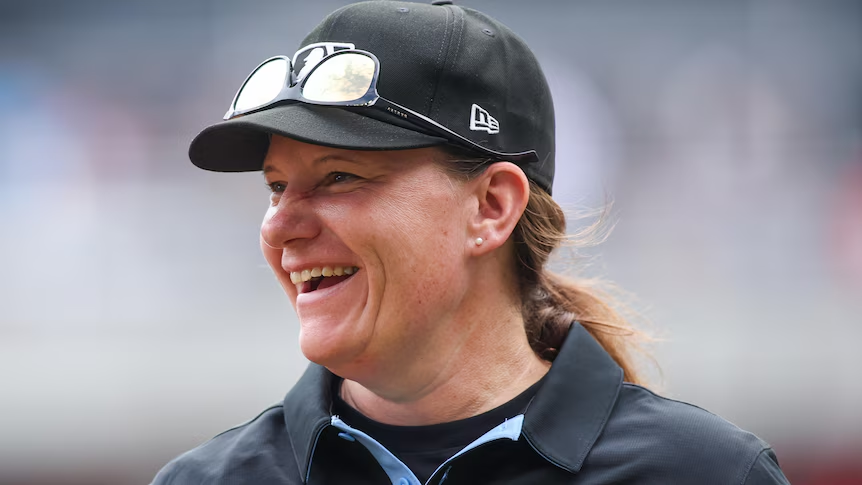
Jen Pawol, 48, shattered a 150-year gender barrier when she took the field as Major League Baseball’s first female umpire during a Miami Marlins–Atlanta Braves series. While many celebrated this milestone as progress, others questioned whether standards were being lowered for the sake of diversity.
“Progress isn’t about giving participation trophies to those who aren’t up to the task,” conservative commentator Chad Prather remarked on his show. “Progress is about making sure you’ve earned your spot.”
CONTROVERSIAL FIRST CALL IGNITES DEBATE
The controversy ignited immediately when Pawol’s first call behind home plate—a pitch clearly several inches off the plate—was incorrectly called a strike, immediately putting her competence under scrutiny.
“You want to break through the ceiling? The very first pitch that comes out is a ball three inches inside of the plate, and you call that a strike. It’s not good,” Prather pointed out, echoing concerns from baseball purists nationwide.
Though Pawol would go on to deliver a 92.72% accuracy rate on balls and strikes according to UmpScorecards—placing her in the bottom third of MLB umpires—the damage to first impressions was already done.
FROM ART TEACHER TO MAKING MLB HISTORY
Pawol’s journey to the major leagues wasn’t overnight. Before donning the umpire’s uniform, she taught art with degrees from Pratt Institute and Hunter College. Her umpiring career began with NCAA softball from 2010-2016 before entering professional baseball’s minor league system.
After working over 1,200 minor league games and graduating from the Minor League Baseball Umpire Training Academy, Pawol finally got the call to the majors—becoming only the eighth woman to umpire in the minor leagues and the first to reach MLB’s regular season.
“This is it, this is what we worked for!” Pawol told reporters after her debut game, clearly emotional about achieving what many considered impossible.
THE NUMBERS DON’T LIE
The statistics from Pawol’s debut reveal a mixed performance:
- 92.72% overall accuracy on balls and strikes
- 95% accuracy on called balls (5 of 104 balls called incorrectly)
- 88% accuracy on called strikes (6 of 47 strikes called incorrectly)
- Average MLB umpire accuracy is 97% for balls and 93% for strikes
“She went 139 for 152 for balls and strikes (91%),” reported Close Call Sports, indicating she missed approximately 13 calls throughout the game.
THE BATTLE FOR TRADITIONAL SPACES
For critics like Prather, the issue extends beyond baseball. It’s about preserving traditional spaces that have historically been separated by gender.
“Men’s spaces are for men, okay? Just like women’s spaces are for women,” Prather stated emphatically. “We can admire the incredible strides women make in various areas, but stop pretending like all of a sudden the entire infrastructure needs to be revamped because we’re afraid to hurt feelings.”
His comments reflect growing concerns from traditionalists that quality and standards are being sacrificed on the altar of diversity and inclusion.
PIONEERS OR POLITICAL PAWNS?
Supporters of Pawol point to her years of preparation and dedication, arguing that breaking gender barriers requires giving women the opportunity to prove themselves at the highest level.
Critics counter that MLB’s decision feels more like a politically motivated stunt than a merit-based promotion, pointing to her debut performance as evidence.
“The baseball diamond is not a political stage, and symbolism does not matter as much as accuracy does,” noted Prather, comparing the situation to other controversial “firsts” in sports, like Vanderbilt’s female football kicker who infamously shanked her historic kickoff attempt.
THE FUTURE OF UMPIRING
Despite the controversy, MLB appears committed to giving Pawol more opportunities. As a “rover umpire,” she’ll continue to be assigned to various games, potentially working her way into a permanent position.
Some baseball insiders predict this is just the beginning of female integration into MLB umpiring, following the path blazed by the NBA, which has featured female referees for years.
Others worry this represents another example of lowering standards to accommodate diversity initiatives, potentially compromising the integrity of America’s pastime.
“You can’t have nothing with white trash around,” Prather observed, extending his criticism beyond gender to what he sees as a broader decline in standards throughout American society.
THE BOTTOM LINE
As baseball continues its evolution, the debate over Pawol’s place in the game reflects larger cultural questions about merit versus diversity, tradition versus progress, and whether certain spaces should remain gender-specific.
Regardless of where fans stand on the issue, one thing remains clear: in baseball, as in life, you’re only as good as your last call. For Jen Pawol, that first missed strike may haunt her career for years to come—fair or not.
MAIL CARRIER’S HEARTWARMING RESCUE: Postal Worker Adopts Dog from Route After Vietnam Vet’s Death
FAQ About Women in MLB Umpiring
Q: Who was the first female MLB umpire?
A: Jen Pawol became the first female MLB umpire to work a regular-season game in April 2024, breaking a 150-year gender barrier in professional baseball.
Q: How accurate was Jen Pawol in her first MLB game behind home plate?
A: Pawol achieved a 92.72% accuracy rate on balls and strikes, which placed her in the bottom third of MLB umpires statistically.
Q: Are there other female umpires in professional baseball?
A: Yes, Pawol is the eighth woman to umpire in minor league baseball, though she is the first to reach the major league level.
Q: Why is there controversy about female umpires in baseball?
A: The controversy stems from traditional views about gender-specific roles in sports and concerns about whether diversity initiatives might compromise performance standards.
Q: How long did it take Jen Pawol to reach MLB as an umpire?
A: Pawol spent approximately eight years working through the minor league system, umpiring over 1,200 games before getting her MLB call-up.
For more commentary on culture, politics, and traditional values, subscribe to Stucci Media today!
Copyright © Stucci Media 2025 | All Rights Reserved


